
The questions families ask us about the National Economics Challenge (NEC) repeat almost word for word: who can enter, how many people are on a team, what each round actually is, and how a China team reaches the global rounds. This page answers those concrete questions directly, with the official source noted wherever a detail can change season to season — so always confirm dates and fees on the official CNEC channels before you commit.
Who is eligible, and which division do we enter?
The NEC is for secondary-school students, and entry is organised by division rather than by a single age cut-off. There are three divisions, and they escalate in both difficulty and the economics covered. The Pre division is the entry tier; the David Ricardo division is intermediate; and the Adam Smith division is the advanced tier, which has no entry barrier — an ambitious student may choose it directly. The academic standard is set by the Council for Economic Education (CEE, founded 1949), the same body that runs the competition in the United States, where it reaches roughly 10,000 students a year.
From China, eligibility and entry both run through CNEC — the official China National Round, operated by Hanlin (SKT) since 2016 across 20+ provinces and 300+ schools. CNEC is the only official path from China into the NEC global rounds, so the precise grade bands and any in-school requirements for your division should be confirmed on the official CNEC pages rather than assumed from another competition. The table below summarises how the divisions differ.
| Division | Level | Economics covered | Team requirement |
|---|---|---|---|
| Pre | Entry | Micro + macro (introductory) | Individual, or a team of 2–4 |
| David Ricardo | Intermediate | Micro + macro + international economy | Team of 4 (required) |
| Adam Smith | Advanced (no entry barrier) | Micro + macro + international economy | Team of 4 (required) |
How big is an NEC team — and can my child compete solo?
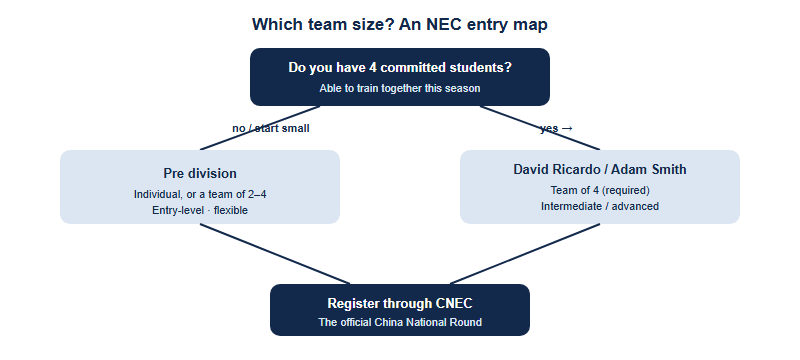
Team size is the single most common point of confusion, because it depends on the division. In the Pre division a student can enter as an individual or form a small team of two to four. In both the David Ricardo and Adam Smith divisions, a team is required and is made up of four students — you cannot enter those two divisions alone. So the honest answer to “can my child compete solo?” is: yes, but only through the Pre division.
This matters for planning. A confident, broad student who wants the full team experience — including the live buzzer round — is heading toward a four-person David Ricardo or Adam Smith team, which means recruiting and training three teammates well before the season starts. A student who wants to test the waters first, or who has no ready team, can start individually in Pre. The diagram below maps that choice.
What are the rounds, and what does each one test?
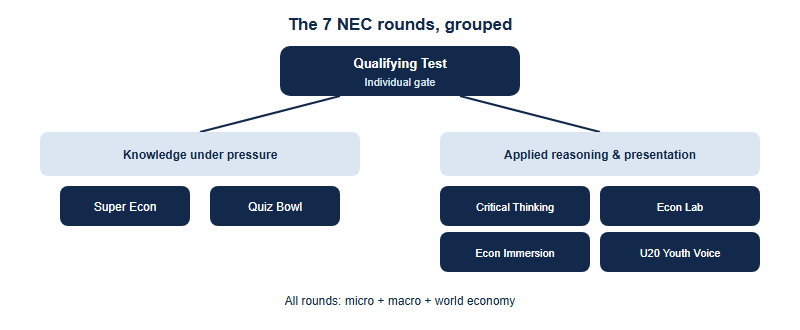
The NEC is built from seven rounds: the Qualifying Test, Super Econ, Quiz Bowl, Critical Thinking, Econ Lab, Econ Immersion, and U20 Youth Voice. They share the same economic content — microeconomics, macroeconomics, and the world / international economy — but each delivers it in a different format. The simplest way to hold them in your head is as one solo gate followed by team events that split into knowledge-under-pressure and applied reasoning.
The Qualifying Test is the individual entry gate, where most of the field is filtered. Super Econ and Quiz Bowl reward fast, accurate recall — Quiz Bowl is the live, buzzer-style team round. Critical Thinking, Econ Lab and Econ Immersion shift toward applying economics to problems and cases, and U20 Youth Voice leans into communication and presentation. Which rounds apply to your team can depend on your division and the season, so confirm the exact line-up on the official CNEC pages. If you want the round-by-round training breakdown, see our guide to the seven NEC rounds.
How does advancement work — and what about dates and fees?
Broadly, a team progresses by clearing the qualifying stage and performing through the China National Round (CNEC), which is the official gateway from China to the NEC global rounds. Because CNEC is operated by Hanlin (SKT) and the global standard is set by the CEE, the exact cut-offs, the schedule of each stage, the registration windows and any entry fees are organiser-defined and can change each season. We deliberately do not print specific dates or fee figures here that could go stale — the authoritative, current numbers live on the official CNEC channels, and that is where you should confirm them before registering.
One more honest note for families in China: the organiser positions CNEC as a professional, social-practice academic activity, not a domestic admissions credential. For overseas university applications, NEC participation can be a meaningful signal of economics ability and teamwork; it is not, and should not be presented as, a guarantee of any admission or a domestic exam advantage. Treat it as genuine academic development first.
Quick answers to the rest
Is the NEC an essay competition?
No. It is a timed, test-and-team economics competition, not a single long written piece — that is what distinguishes it from economics essay contests.
Who writes the questions?
The academic standard is set by the CEE; the organiser names economists such as Mankiw and Shiller in its materials — treat that as an organiser claim and confirm officially.
Do all three divisions cover the same topics?
Roughly: Pre focuses on micro and macro, while David Ricardo and Adam Smith add the world / international economy on top.
Can a student pick Adam Smith without doing Pre first?
Yes — the advanced Adam Smith division has no entry barrier, though it expects a strong, exam-ready, team-based student.
Published by the NEC / CNEC editorial desk, operated by Hanlin Education as the officially authorized China National Economics Challenge (CNEC) test center. The NEC is run by the Council for Economic Education, which sets the official rules — always confirm current dates, divisions, fees and awards on the official CNEC channels. Any errors will be corrected within 7 working days.