The National Economics Challenge (NEC) tests globalization and international institutions inside its world-economy strand, alongside microeconomics and macroeconomics. You are expected to know what the WTO, the IMF and the World Bank each actually do, how trade and monetary integration deepen across stages, and how to argue both sides of the globalization debate using welfare, growth and distribution evidence — not slogans.
Where globalization sits in the NEC subject map
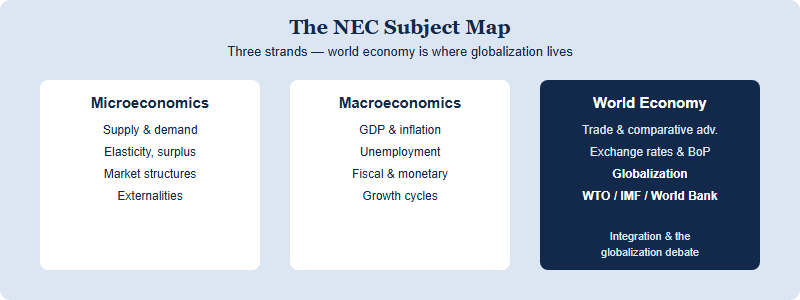
The NEC, run by the Council for Economic Education (CEE, founded 1949), assesses three subject areas: microeconomics, macroeconomics, and the world / international economy. Globalization and the major international institutions live in that third bucket. They are not a separate round — they are content that can surface in any question format the CEE uses.
That matters for how you study. The micro and macro strands have crisp, formula-driven anchors (elasticity coefficients, AD-AS, MR=MC). The world-economy strand is broader and more conceptual: it rewards students who can connect a single news headline — a new tariff, an IMF loan, a currency crisis — to the institution involved, the mechanism at work, and the welfare trade-off it creates. Globalization is the umbrella idea that ties trade theory, exchange rates and institutions together.
Around 10,000 US students sit the NEC each year. From China, the official path runs through the China National Economics Challenge (CNEC), the official China National Round operated by Hanlin (SKT) since 2016 across 20+ provinces and 300+ schools. CNEC is the only official route from China to the NEC global rounds, so the academic standard you prepare against is the CEE's.
The three institutions: don’t mix up who does what
The single most common error students make on globalization questions is blurring the WTO, the IMF and the World Bank into one vague "global economy organisation." Each has a distinct mandate, and questions often test exactly that distinction. Memorise the mandate, the instrument, and one concrete example for each.
- WTO (World Trade Organization) — sets and enforces the rules of international trade. Its tools are trade agreements, the most-favoured-nation principle, and a dispute-settlement system. Think tariffs, quotas and trade disputes, not loans.
- IMF (International Monetary Fund) — guards monetary and financial stability. It provides short-term balance-of-payments lending and surveillance when a country faces a currency or financial crisis. Think bailouts and exchange-rate pressure.
- World Bank — funds long-term development. It lends for infrastructure, education and poverty-reduction projects in developing economies. Think roads, schools and multi-year growth, not emergency liquidity.
A clean way to lock this in: the WTO writes the trade rulebook, the IMF is the global emergency room, and the World Bank is the long-term development bank. When a question describes a country negotiating tariff cuts, that's the WTO; a country drawing down emergency funding to defend its currency, that's the IMF; a multi-year dam or schooling project, that's the World Bank.
| Institution | Core mandate | Primary instrument | NEC-style trigger phrase |
|---|---|---|---|
| WTO | Rules of international trade | Trade agreements & dispute settlement | "tariff reduction," "trade dispute," "most-favoured nation" |
| IMF | Monetary & financial stability | Short-term BoP lending & surveillance | "currency crisis," "bailout," "reserves under pressure" |
| World Bank | Long-term economic development | Project lending for infrastructure & poverty reduction | "development project," "poverty reduction," "long-term growth" |
Economic integration: reading the staircase
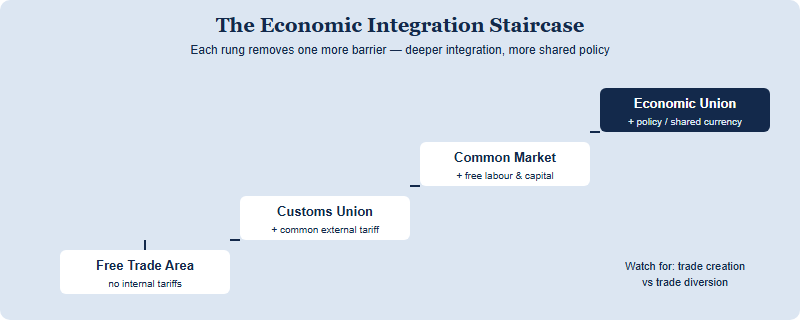
Globalization questions frequently test economic integration — the deepening of economic ties between countries in defined stages. The standard ladder runs from loose to tight, and each rung removes one more barrier. You should be able to name the stages in order and place a real bloc on the right rung.
- Free trade area — members remove tariffs among themselves but keep their own external tariffs.
- Customs union — a free trade area plus a common external tariff against non-members.
- Common (single) market — a customs union plus free movement of labour and capital.
- Economic / monetary union — a single market plus coordinated economic policy and, at the deepest level, a shared currency.
The exam value here is mechanism, not memorisation. Integration creates trade creation (efficient producers within the bloc displace inefficient domestic ones — a welfare gain) but also trade diversion (a low-tariff partner displaces a genuinely cheaper outside producer — a possible welfare loss). A strong answer weighs both, rather than treating "more integration" as automatically good. That two-sided framing is exactly what the world-economy strand rewards, and it links directly back to the comparative-advantage logic that underpins the whole trade syllabus.
The globalization debate: argue both sides
Open-ended and discussion-style formats in the NEC reward balance. A globalization prompt is rarely answered well with "globalization is good" or "globalization is bad." The expected move is to structure the trade-offs and then take a reasoned position backed by evidence. Build your answer from three lenses:
- Efficiency & growth — specialisation by comparative advantage, larger markets, technology transfer and lower consumer prices. The gains-from-trade case.
- Distribution — who wins and who loses. Globalization can raise aggregate income while displacing specific workers and widening inequality within a country, which is why the politics is fierce even when the net effect is positive.
- Stability & sovereignty — deeper integration spreads shocks faster (financial contagion) and constrains national policy, which is where the IMF's crisis role and the integration trade-offs re-enter the picture.
A practical first-party tip from coaching CNEC teams: students lose marks not because they lack facts but because they pick one side and ignore the obvious counter-argument. Train the habit of writing one sentence of rebuttal for every claim — "globalization lowers prices for consumers, but concentrates job losses in import-competing sectors." That single discipline is what separates a defensible argument from an opinion, and it maps onto how the world-economy content is assessed across rounds.
How to study the globalization strand for CNEC
Because globalization content can appear in several round formats rather than one dedicated section, spread your preparation rather than cramming it:
- Build an institutions flashcard set — three cards (WTO / IMF / World Bank), each with mandate, instrument and one example. This alone fixes the most-tested distinction.
- Map every trade headline you read to: the institution, the mechanism, and the welfare effect. Ten minutes a day builds intuition the textbook can't.
- Practise the integration ladder until you can draw it from memory and attach trade creation vs diversion to it.
- Rehearse two-sided arguments aloud — useful for team-based and open-ended rounds where you defend a position under time pressure.
For the authoritative subject breakdown, round formats and the current season timeline, always work from the CEE standard and the official CNEC pages rather than memory. The exact mix of world-economy content, scoring and award tiers is set by the organiser and can change year to year — confirm it on the official CNEC channels.
Frequently asked questions
Does the NEC really test the WTO, IMF and World Bank by name?
The NEC covers the world/international economy, which includes globalization and the major institutions. For the exact tested topics, confirm on the official CNEC channels.
What’s the difference between the IMF and the World Bank for the exam?
The IMF handles short-term monetary and balance-of-payments stability; the World Bank funds long-term development projects. Mixing them up is the classic mistake.
Is globalization its own NEC round?
No. It sits in the world-economy subject strand and can appear across question formats, not in one dedicated round. Verify round formats officially.
How do I prepare globalization content from China?
Prepare against the CEE academic standard via the official CNEC path operated by Hanlin, the China National Round route to the NEC global rounds.
Published by the NEC / CNEC editorial desk, operated by Hanlin Education as the officially authorized China National Economics Challenge (CNEC) test center. The NEC is run by the Council for Economic Education, which sets the official rules — always confirm current dates, divisions, fees and awards on the official CNEC channels. Any errors are corrected within 7 working days.