
If you are in Grade 8 or 9 and curious about economics competitions, the NEC Pre division is most likely your on-ramp. It is the entry tier of the National Economics Challenge, open to students in grades 7–12 (under 20), built for beginners who are new to economics or have only taken an introductory course. You enter in a small team of 2–4 and are tested on core microeconomics and macroeconomics — no prior competition record required.
What the Pre division actually is
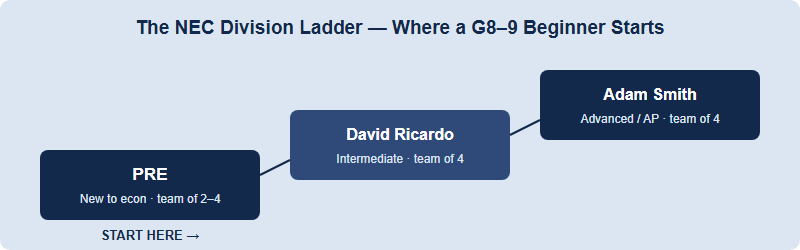
The NEC (National Economics Challenge) is run by the Council for Economic Education (CEE), a US non-profit founded in 1949, and reaches roughly 10,000 students a year in the United States. It is structured into three divisions of increasing difficulty. The Pre division sits at the bottom of that ladder — deliberately. Per the official CNEC pages, it is for “students new to economics, or who have only taken IGCSE introductory economics,” with the stated goal of “building interest and a base for higher-level study.”
Two design choices make Pre friendly to a Grade 8–9 starter. First, the team is small: 2 to 4 students, versus the strict teams of four in the higher divisions. You can start with one or two friends instead of recruiting a full squad. Second, and this is the line worth tattooing on every beginner's notebook, the official guidance states that the right division depends on experience, not age. A motivated Grade 9 beginner belongs in Pre even if an older sibling is in Adam Smith.
| Division | Who it is for | Team size | Best fit for G8–9? |
|---|---|---|---|
| Pre | New to economics / introductory course only | 2–4 (individual or team) | Yes — the intended entry point |
| David Ricardo | First-time competitors with limited prior coursework (no more than one econ course) | Team of 4 | Stretch goal for the following year |
| Adam Smith | Advanced, AP / honours and returning competitors | Team of 4 | Usually too advanced this early |
If you are in China, the route into all of this is CNEC — the official China National Round, run by Hanlin (SKT) since 2016 across 20+ provinces and 300+ schools. CNEC is the only official path from China to the NEC global rounds, and it is where the Pre division is offered for entry-level students. You can read the structure on the CNEC China hub.
Realistic expectations for a first season
Beginners often arrive expecting a quiz they can cram for in a weekend. The honest picture is different, and better. The Pre division is a real economics assessment built on micro and macro fundamentals, so progress comes from understanding concepts, not memorising answer keys. Here is what a sensible first year looks like:
- Treat year one as a learning year. Your goal is to finish the season understanding supply and demand, opportunity cost, and how a central bank thinks — not necessarily to win a medal. That foundation is the actual prize.
- You are graded against other beginners. The whole point of a Pre division is that you are not thrown in with AP-level returning competitors. The field is other new students.
- The competition is seasonal and staged. For the 2026–2027 cycle, CNEC registration runs roughly June 10 to December 1, 2026, with an online Regional round around December 12–13, 2026, and the China National Round in March 2027. Treat these as the dates to confirm officially — always check the live figures on the CNEC schedule page before you plan.
- A 2-person team is fine. You do not need to fill four seats to compete in Pre. Start small and add teammates as interest grows.
One thing we will not do here is promise an outcome. No competition, and no coach, can guarantee a result or a university place. What a Grade 8–9 start genuinely buys you is time: an early, low-pressure first contact with economics that compounds over three or four years.
The foundational economics you actually need
The Pre division tests microeconomics and macroeconomics. You do not need international trade theory or game theory yet — those belong to the higher divisions and the world-economy content of the full NEC. For a Grade 8–9 beginner, a focused foundation goes a long way:
- Microeconomics core: scarcity and opportunity cost, supply and demand, how prices are set, elasticity (the basic idea that quantity responds to price), and what markets do.
- Macroeconomics core: what GDP measures, inflation and unemployment, and the basic role of a central bank and government in steadying an economy.
- Reading the news economically: being able to look at a headline — a price rise, an interest-rate change — and explain it with a concept rather than a guess.
If your school offers IGCSE Economics or an intro course, that already overlaps heavily with the Pre syllabus — the official framing explicitly names IGCSE introductory economics as the kind of background Pre expects. If it does not, a good introductory textbook plus the official CNEC preparation resources covers the ground. The exact topic weighting and any multiple-choice format details should be confirmed on the official CNEC channels, since the assessment design is set by the organiser and the CEE.
The three- to four-year growth path
The real argument for starting in Grade 8 or 9 is not the first competition — it is the runway. Used well, Pre is step one of a ladder you climb over a high-school career, and that progression is exactly the kind of sustained, self-directed interest that strong economics and business applicants in the UK and US tend to show.
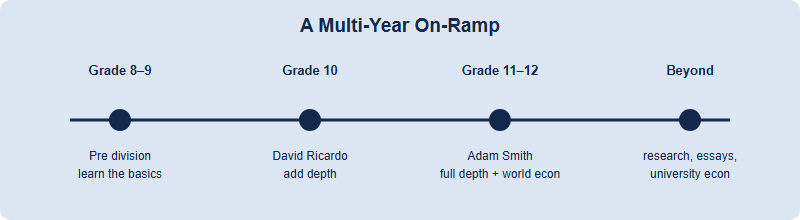
A realistic arc: spend Grade 8–9 in Pre getting comfortable with micro and macro and how a team competition feels. Around Grade 10, if you have a course under your belt, David Ricardo — the intermediate tier for first-time-but-prepared competitors — becomes the natural next rung. By Grade 11–12, AP / honours students who have stuck with it can take on Adam Smith, where the full depth and world-economy content live. From there the interest you built early opens onto essay competitions, independent research, and university-level economics.
The mistake to avoid is the opposite of starting too late: starting too high. Jumping a Grade 9 beginner into Adam Smith to “look impressive” usually backfires — the gap in coursework is real, and a discouraging first experience is the fastest way to quit. The whole reason a Pre division exists is to let you start where you actually are.
How to make the most of starting early
- Find one or two teammates, not four. A team of 2–4 is enough for Pre. Shared study makes economics stick and keeps it fun.
- Build a weekly habit, not a cram. Twenty focused minutes a week across a season beats a panic weekend. Concepts compound; cramming evaporates.
- Anchor to the official calendar. Register in the open window and work backward from the Regional round. Confirm the current cycle on the CNEC schedule.
- Use the official resources first. The CEE sets the academic standard; start from the CNEC preparation materials before paid extras.
FAQ
Is Grade 8 too young for the NEC Pre division?
No. Pre is open to grades 7–12 (under 20) and is built for beginners. Placement depends on experience, not age, so a motivated Grade 8 starter fits.
Do I need a team of four to enter the Pre division?
No. The Pre division allows teams of 2–4, smaller than the four required in David Ricardo and Adam Smith. You can start with one or two friends.
What economics do I need to know for the Pre division?
Core microeconomics and macroeconomics — supply and demand, opportunity cost, GDP, inflation. IGCSE intro economics is the kind of background it expects.
How do students in China enter?
Through CNEC, the official China National Round run by Hanlin (SKT) since 2016 — the only official path from China to the NEC global rounds. Confirm dates on the official CNEC channels.
Published by the NEC / CNEC editorial desk, operated by Hanlin Education as the officially authorized China National Economics Challenge (CNEC) test center. The NEC is run by the Council for Economic Education, which sets the official rules — always confirm current dates, divisions, fees and awards on the official CNEC channels. Corrections are made within 7 working days.