
On the National Economics Challenge (NEC), market-failure questions reward a tight three-step move: name the failure (negative or positive externality, public good, or common resource), match a corrective instrument (a Pigouvian tax or subsidy, defined property rights and Coasean bargaining, or direct provision), then show the welfare gain by pushing output toward the socially efficient quantity. This guide drills that micro-topic only — not market structures or macro policy.
What "market failure" actually means on the exam
A market fails when a freely operating market, left to itself, does not allocate resources efficiently — the quantity it produces is not the quantity that maximises total social welfare. The microeconomics syllabus the NEC draws on (the Council for Economic Education, CEE, sets that academic standard) treats this as a small, well-defined family of cases, not a vague catch-all. Strong NEC answers begin by classifying the failure, because the classification dictates the correct fix.
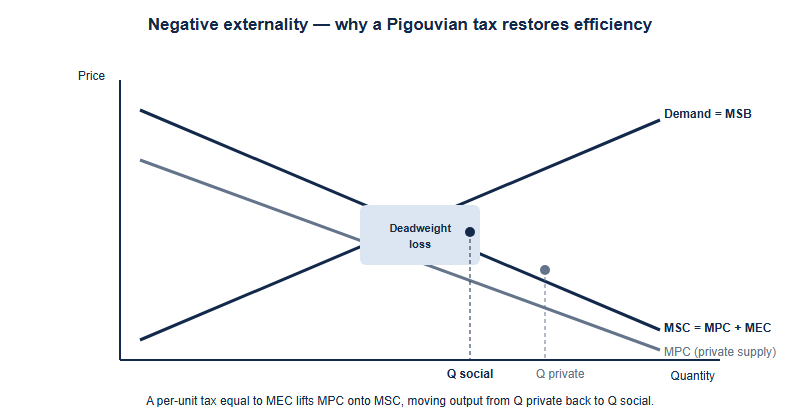
The single idea underneath every case is the gap between private and social costs or benefits. When a decision-maker only counts the costs and benefits that fall on themselves, and ignores the spillover onto third parties, the marginal private curve diverges from the marginal social curve. Equilibrium forms where private marginal benefit meets private marginal cost; efficiency requires social marginal benefit to meet social marginal cost. The distance between those two intersection points is the misallocation — and the shaded triangle between them is the deadweight loss graders look for.
| Failure type | What goes wrong | Market outcome vs efficient | Typical corrective instrument |
|---|---|---|---|
| Negative externality | Spillover cost on third parties (e.g. pollution) | Over-produced (Qprivate > Qsocial) | Pigouvian tax; tradable permits; regulation |
| Positive externality | Spillover benefit not captured (e.g. vaccination) | Under-produced (Qprivate < Qsocial) | Pigouvian subsidy; mandates; public provision |
| Public good | Non-excludable & non-rival → free-riding | Under-provided or not provided at all | Government provision funded by taxation |
| Common resource | Rival but non-excludable → over-use | Over-consumed ("tragedy of the commons") | Property rights; quotas; usage charges |
Notice the symmetry that examiners prize: negative externalities and common resources lead to too much; positive externalities and public goods lead to too little. If you can state the direction of the distortion in one sentence, you have already earned the structure marks before drawing a single curve. For the broader context of how these micro-topics fit into a contest round, the CNEC homepage is the reference point.
Externalities and the Pigouvian fix
An externality is a cost or benefit imposed on a third party who is not part of the transaction. Take a factory whose production emits pollution. The firm pays for labour, materials and energy — its marginal private cost (MPC) — but it does not pay for the health and environmental damage borne by the surrounding community. That uncounted damage is the marginal external cost (MEC). The true cost to society is marginal social cost (MSC) = MPC + MEC, which sits above the firm's private supply curve.
Because the firm optimises against MPC rather than MSC, it produces where price equals MPC — further along the quantity axis than the efficient point where price equals MSC. The result is over-production, and the welfare loss is the triangle between MSC and MPC over the range of excess output.
The classic correction, named after the economist Arthur Pigou, is a Pigouvian tax set equal to the marginal external cost at the efficient quantity. The tax "internalises" the externality: it shifts the firm's private cost curve up until it coincides with the social cost curve, so the profit-maximising firm now chooses the socially efficient output on its own. The mirror image applies to positive externalities — a vaccination confers benefits on others (herd protection) that the individual does not capture, so the market under-supplies, and a Pigouvian subsidy equal to the marginal external benefit raises output to the efficient level.
- Negative externality → tax. Set the per-unit tax equal to MEC at Qsocial; the firm internalises the spillover and cuts output to the efficient level.
- Positive externality → subsidy. Set the per-unit subsidy equal to the marginal external benefit; consumption or production rises to where social benefit meets social cost.
- Why graders like Pigouvian tools. Unlike a blunt quantity cap, a tax preserves the price mechanism — firms that can abate cheaply abate most, so the same environmental target is met at lower total cost.
The Coase logic: when bargaining beats taxing
A Pigouvian tax is not the only answer, and NEC's Critical Thinking and Econ Lab rounds reward students who know the alternative. The Coase theorem — associated with economist Ronald Coase — argues that if property rights are clearly assigned and the cost of bargaining is low, the parties affected by an externality can negotiate their way to the efficient outcome on their own, without government setting a tax. Strikingly, the theorem says the efficient quantity is reached regardless of who initially holds the right; the assignment changes who pays whom, but not the final allocation.
Picture a factory and a fishery sharing a river. If the fishery holds the right to clean water, the factory must pay it to pollute; if the factory holds the right to discharge, the fishery can pay it to abate. Either way, pollution settles at the level where the marginal benefit of one more unit of output equals the marginal damage it causes — the efficient level. The mechanism is private negotiation rather than a public levy.
The examiner's real interest is in why Coasean bargaining so often fails in practice, which is where transaction costs come in. A confident NEC answer lists the breakdown conditions:
- High transaction costs. When pollution affects thousands of dispersed people, organising them to negotiate is prohibitively costly — bargaining never gets off the ground.
- Unclear or unenforceable property rights. If no one clearly owns "clean air," there is no right to trade and nothing to bargain over.
- Free-riding and holdouts. Each affected party hopes others will pay; an individual can hold out for a larger share, stalling the deal.
- Information asymmetry. Parties may not know the true costs and benefits, so they cannot agree on the efficient bargain.
| Dimension | Pigouvian tax / subsidy | Coasean bargaining |
|---|---|---|
| Who acts | Government sets a price on the spillover | Private parties negotiate directly |
| Key requirement | Regulator can measure the external cost | Clear property rights + low transaction costs |
| Works best when | Many dispersed parties; damage is measurable | Few parties; well-defined rights |
| Main weakness | Hard to value the externality precisely | Breaks down under high transaction costs |
| Role of who holds the right | Not central — tax targets the activity | Affects who pays, not the efficient quantity |
The point graders reward is judgement, not memorisation: a few neighbouring landowners is a Coasean situation; nationwide carbon emissions is a Pigouvian one. Stating that contrast explicitly signals genuine understanding rather than recall.
Public goods, common resources and the role of excludability
Externalities are only half the market-failure syllabus. The other half turns on two properties of goods: excludability (can non-payers be prevented from consuming?) and rivalry (does one person's consumption reduce what is left for others?). Crossing these two yes/no questions gives four categories, and the off-diagonal cases are where markets struggle.
A public good — non-excludable and non-rival, like national defence or a lighthouse — invites free-riding: since no one can be charged, everyone hopes someone else pays, and the private market under-provides or fails to provide at all. The standard remedy is government provision funded through taxation. A common resource — rival but non-excludable, like an ocean fishery or shared grazing land — suffers the tragedy of the commons: each user takes as much as they can because the depletion cost falls on everyone, so the resource is over-exploited. Remedies assign rights, set quotas, or charge for use — effectively making the resource excludable.
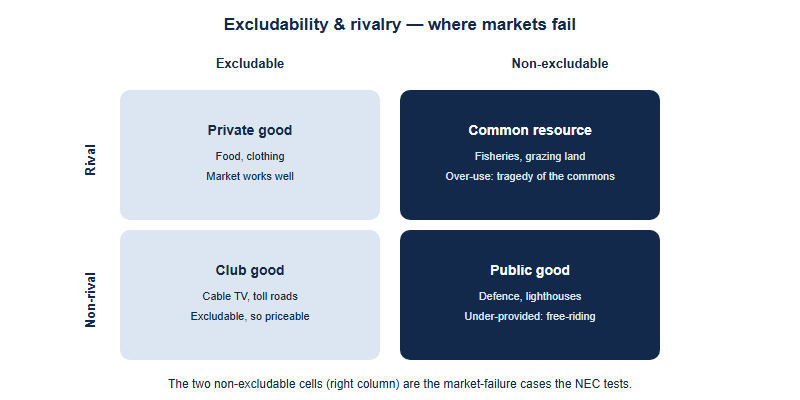
A useful exam habit: the moment a prompt mentions a good, ask the two excludability/rivalry questions first. They route you to the right cell of the matrix, and the cell tells you both the failure (under-provision vs over-use) and the standard remedy (provision vs rights/quotas). That routing discipline is exactly what separates a structured answer from a scattergun one.
How this shows up across NEC rounds — a first-party note
As the officially authorized China test center for the NEC, the CNEC desk sees how the same market-failure ideas surface in different formats. In the multiple-choice Qualifying Test, the question is usually recognition — identify whether a scenario is a positive externality or a public good, or read the direction of a tax shift off a diagram. In Critical Thinking and Econ Lab, the demand rises to application and judgement: given a real scenario, defend whether a Pigouvian tax or a Coasean bargain is the better tool, and justify it using transaction costs and the number of parties involved.
The recurring weakness we observe is students reaching for a single memorised remedy. A negative externality does not automatically mean "impose a tax" — with few parties and clear rights, bargaining may be cleaner; with measurement problems, tradable permits may dominate. Examiners reward the candidate who first classifies the failure, then weighs the instruments against the situation, and finally explains the welfare consequence in terms of moving output toward the efficient quantity. The seven NEC rounds, divisions and the China-round timeline are published on the official CNEC homepage; the CEE sets the underlying academic standard, so confirm any specific syllabus framing on the official CNEC channels. This article covers the externalities and market-failure micro-topic only.
Frequently asked questions
What is a Pigouvian tax in NEC terms?
A per-unit tax set equal to the marginal external cost, so a polluting firm internalises the spillover and cuts output to the socially efficient quantity.
How does the Coase theorem differ from a Pigouvian tax?
Coase relies on clear property rights and low transaction costs so parties bargain to efficiency privately; a Pigouvian tax has the government price the externality instead.
Why do public goods cause market failure?
They are non-excludable and non-rival, so free-riding means private firms cannot charge enough to supply them; government provision funded by taxation is the usual fix.
How does market failure appear across NEC rounds?
Recognition in the multiple-choice Qualifying Test; application and judgement in Critical Thinking and Econ Lab. Confirm round formats on the official CNEC channels.
Published by the NEC / CNEC editorial desk, operated by Hanlin Education as the officially authorized China National Economics Challenge (CNEC) test center. The NEC is run by the Council for Economic Education, which sets the official rules — always confirm current dates, divisions, fees and awards on the official CNEC channels. Any errors will be corrected within 7 working days.