
When the National Economics Challenge (NEC) turns from “why countries trade” to “what happens when a government blocks trade,” it is testing protectionism — tariffs, quotas and the welfare consequences they create. The single highest-yield skill is reading the tariff welfare diagram: identifying who gains (domestic producers, the government), who loses (consumers), and the net deadweight loss that nobody captures. Master that one diagram and most protectionism questions become mechanical.
Where protectionism sits in the NEC world-economy strand
The NEC, organised by the Council for Economic Education (CEE, founded 1949) and taken by roughly 10,000 US students a year, examines micro, macro and world/international economy. Inside the world-economy block, trade splits cleanly into two halves. The first half — comparative advantage and the gains from trade — explains why free trade raises total welfare. The second half, protectionism, asks the opposite question: what does society lose when a government interferes with that trade? This article owns the second half only. The opportunity-cost tables, specialisation logic and terms-of-trade ranges belong to comparative advantage and are not repeated here; protectionism has its own diagram and its own arithmetic.
For students in China, the official route into the NEC global rounds is the China National Economics Challenge (CNEC), run by Hanlin (SKT) as the officially authorized China test center since 2016, now spanning 20-plus provinces and 300-plus schools. As the authorized China round we see one pattern every season on protectionism items: candidates can define a tariff but cannot map it onto the supply-and-demand diagram, so they lose the welfare-area questions that carry the marks. This guide closes that gap. You can review the competition's structure on the NEC / CNEC home page, but the diagram skill below is what converts protectionism from a vocabulary topic into reliable points.
The vocabulary itself is worth locking in first, because NEC questions use the terms precisely. A tariff is a tax on imports, which raises their price in the domestic market. A quota is a quantitative cap on how much of a good may be imported. A subsidy to domestic producers lowers their costs rather than taxing imports. All three are forms of protectionism, but they distribute the gains and losses differently — and questions are written to test whether you know which party ends up with the money. With a tariff the government collects revenue; with a quota that same area typically accrues to whoever holds the import licences instead of the treasury. That distinction is a favourite catch.
Reading the tariff welfare diagram the NEC way
The core model is a single domestic market for an importable good, drawn with domestic supply and demand, plus a flat world-price line because a small country takes the world price as given. Under free trade the country imports at the world price. A tariff lifts the price consumers pay to “world price plus tariff,” and four things move at once. Train yourself to write them in the same order every time, because the question almost always asks for one of these four areas.
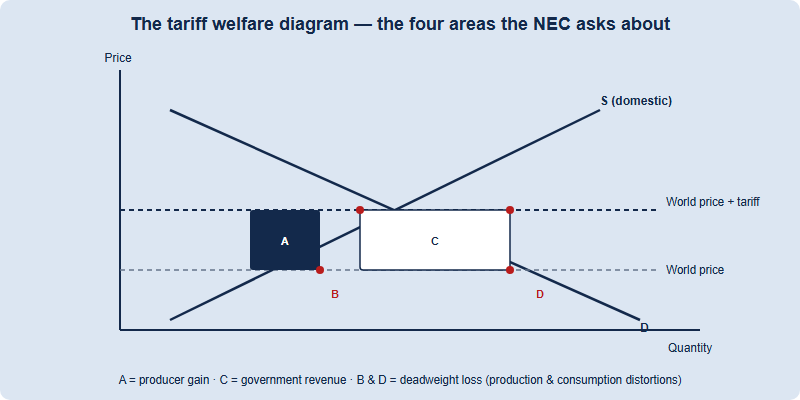
Here is what each lettered area means, in the order to recite them:
- Area A — producer surplus gain. Domestic producers now receive the higher tariff-inclusive price, and they also expand output as the higher price draws out marginal supply. This is a transfer to producers, not a loss to society.
- Area C — government tariff revenue. The rectangle equal to the tariff per unit multiplied by the quantity still imported. It is a transfer to the government. Under a quota, this area usually goes to the licence holders instead — the diagram is the same shape, the recipient changes.
- Triangle B — the production distortion. Higher-cost domestic units replace cheaper imports. Society pays more to make at home what it could have bought abroad. Nobody captures this; it is deadweight loss.
- Triangle D — the consumption distortion. The higher price chokes off consumption that was worth more to buyers than the world price. That lost surplus evaporates too. Also deadweight loss.
The headline result, and the most-tested sentence in the whole protectionism block: a tariff transfers surplus from consumers to producers and the government, but the two triangles B and D are a net loss that no party recovers. Consumers lose the most — their lost surplus equals A plus B plus C plus D — while producers gain only A and the government gains only C, leaving B and D as the deadweight loss. A student who answers “a tariff helps the country because producers and the government both gain” has missed that consumers fund all of it and society is left strictly worse off. The whole question turns on separating transfers (A and C, which move surplus around) from true losses (B and D, which destroy it).
Naming every gain and loss without slipping
Because the diagram crams four agents into one picture, NEC items test whether you can attribute each effect to the right party. The table below is the attribution map to memorise; the exact way a given exam scores these areas is set officially, so confirm the current format on the official CNEC channels.
| Party | Effect of an import tariff | Diagram area | Transfer or true loss? |
|---|---|---|---|
| Domestic consumers | Lose surplus — pay a higher price, buy less | A + B + C + D | The source of everything |
| Domestic producers | Gain surplus — higher price, higher output | A | Transfer (from consumers) |
| Government | Gains tariff revenue | C | Transfer (from consumers) |
| Society overall | Net welfare falls | B + D | Deadweight loss |
Read the table top to bottom and the accounting closes: consumers give up A + B + C + D; producers recover A and the government recovers C; the remaining B + D is gone. This is why economists call a small-country tariff inefficient — it is not that nobody benefits, it is that the winners' gains fall short of the losers' losses by exactly the two triangles. Common NEC stems built on this map include “Which area represents the deadweight loss of the tariff?”, “By how much does producer surplus rise?”, “Who bears the burden of an import tariff?” and “What is the change in total welfare?” Each is answered by pointing at the correct letters, which is why drilling the attribution beats re-reading the definition.
Two refinements separate strong candidates from average ones. First, the quota equivalence point: a quota that restricts imports to the same quantity as a tariff produces the same higher price and the same two deadweight triangles, but area C — the revenue rectangle — flows to whoever holds the import licences (often foreign exporters or domestic importers) rather than to the government. So a quota can be worse for the country than an equivalent tariff, because the nation may forfeit area C entirely. Second, the large-country caveat: the clean “tariffs always reduce welfare” result assumes a small country that cannot move the world price. A large enough importer can push the world price down and capture a terms-of-trade gain, which is the textbook exception. Know the small-country baseline cold first; flag the large-country case as the advanced wrinkle rather than the default.
The free-trade case and the arguments for protection
Protectionism questions are not only diagrams. The NEC also tests the arguments — both the economic case for free trade and the recognised reasons governments protect anyway — because a well-rounded competitor must evaluate, not just calculate. The free-trade case rests on the welfare logic above: open trade lets a country consume beyond its own production possibilities, channels resources to their comparative-advantage uses, lowers prices for consumers, and avoids the deadweight loss that barriers create. That is the efficiency argument, and it is the benchmark every protection measure is judged against.
Against that benchmark sit the standard arguments for protection, which the NEC expects you to state and then critique:
- Infant-industry argument. A new domestic sector may need temporary shelter to reach the scale where it can compete. The critique: protection is hard to remove once granted, and picking winners is error-prone.
- Protecting employment. Tariffs can preserve jobs in an import-competing industry. The critique: they raise costs for consumers and downstream industries, and the cost per job saved is often very high.
- National security / strategic goods. A country may keep critical capacity (food, defence inputs) at home regardless of cost. The critique: the label is easily over-used to justify ordinary protection.
- Anti-dumping and unfair competition. Responding to foreign goods sold below cost. The critique: genuine dumping is hard to prove and the remedy can become disguised protection.
- Government revenue. In some economies tariffs are a practical tax base. The critique: it is a distortionary way to raise revenue compared with broad taxes.
The exam reasoning the NEC rewards is balanced: state the argument, then weigh it against the deadweight-loss benchmark and the question of who actually pays. The applied and team rounds escalate this by combining the diagram with the debate — a single prompt might ask you to compute the deadweight loss and then judge whether an infant-industry justification holds. That is one integrated answer, which is why understanding the welfare areas underpins even the worded items. Where authority sits is worth restating: the CEE sets the official academic standard and the NEC rules, while the CNEC, run by Hanlin as the authorized China test center, runs the national round and the only official path from China to the global rounds. Any named question-setters or judges associated with the contest are organiser claims — confirm them officially rather than treat them as settled fact. The wider round overview sits on the CNEC site.
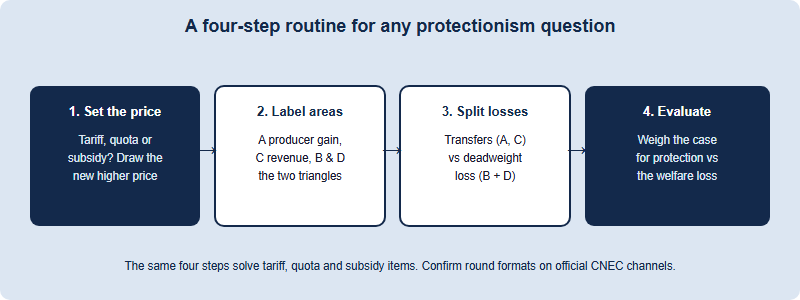
How to drill protectionism for the season
Like the rest of the world-economy strand, protectionism rewards reps over re-reading — the marks come from executing the diagram at speed. A focused practice block beats a vague “revise trade barriers” plan:
- Draw the tariff diagram from memory daily. Until you can place S, D, the world price, the tariff line and label A, B, C, D without hesitation, you are not ready for the welfare-area questions. This is the spine of the whole topic.
- Recite the four areas in fixed order. Producer gain, government revenue, production-distortion triangle, consumption-distortion triangle — every time, so the attribution never slips under time pressure.
- Separate transfers from deadweight loss out loud. For each diagram, say which areas merely move surplus (A, C) and which destroy it (B, D). The “who actually loses” questions hinge on this.
- Practise the quota-versus-tariff contrast. Same price, same triangles, different home for the revenue rectangle. It is a favourite catch and few candidates rehearse it.
- Pair one calculation with one argument each session. Compute a deadweight loss, then write a two-line evaluation of an infant-industry or employment justification. The team rounds combine the two, so rehearse them combined.
A note on division choice, because it shapes how you rehearse: the NEC's Pre division can be entered individually or as a group of 2–4, while the David Ricardo and Adam Smith divisions are teams of four. In a team it is worth designating who owns the world-economy desk so that diagram-heavy items like tariffs are answered with confidence; division rules and the current structure sit on the CNEC site, so confirm them before you commit. We make no guarantee about results or admissions outcomes — this is a study method, not a promise. But protectionism gives an unusually clean return on practice, because the entire topic radiates from one diagram you can draw in under a minute.
Frequently asked questions
What is the deadweight loss of a tariff?
The two triangles in the tariff diagram — the production distortion and the consumption distortion — representing surplus no party recovers. They are the net welfare cost.
Who gains and who loses from an import tariff?
Domestic producers and the government gain (transfers); consumers lose the most and fund all of it. Society is left worse off by the deadweight loss.
How does a quota differ from a tariff?
A quota produces the same higher price and same deadweight triangles, but the revenue rectangle goes to licence holders rather than the government, so it can be worse for the country.
Does the NEC test arguments for protection too?
Yes — infant industry, jobs, national security, anti-dumping and revenue. State each, then weigh it against the free-trade welfare benchmark. Confirm scope on official CNEC channels.
Published by the NEC / CNEC editorial desk, operated by Hanlin Education as the officially authorized China National Economics Challenge (CNEC) test center. The NEC is run by the Council for Economic Education, which sets the official rules — always confirm current dates, divisions, fees and awards on the official CNEC channels. Corrections are made within 7 working days.