
Comparative advantage and the gains from trade are the workhorse of the National Economics Challenge (NEC) world-economy section — the one trade idea that returns the most marks for the time you invest. The Council for Economic Education runs the NEC across micro, macro and world economy, and the world-economy block leans hard on a single skill: reading a two-good, two-country opportunity-cost table and reasoning to a trade outcome. Master that and you have unlocked the most predictable family of trade questions.
Why comparative advantage is the world-economy workhorse
The NEC, organised by the Council for Economic Education (CEE, founded 1949) and taken by roughly 10,000 US students a year, tests world/international economy alongside micro and macro. Within that world-economy strand, trade theory is the densest scoring zone, and comparative advantage is its spine. The reason is structural: comparative advantage is a self-contained, fully calculable idea. Give a student a small table of output or input numbers and the entire chain — who should specialise in what, why both parties gain, what price range makes trade work — follows by arithmetic. That makes it ideal competition material, because it rewards a clean method rather than memorised current events.
For students in China, the official route into the NEC global rounds is the China National Economics Challenge (CNEC), run by Hanlin (SKT) as the officially authorized China test center since 2016, now across 20-plus provinces and 300-plus schools. As the authorized China round we see the same pattern every season: candidates who can recite the definition of comparative advantage but freeze when a table asks them to compute it. This guide closes exactly that gap. You can review the round structure on the NEC / CNEC home page, but the skill below is what converts the world-economy block from a guessing zone into reliable points. Note the boundary of this article: we cover trade-theory fundamentals only — tariffs, quotas and protectionism are a separate topic, and so is domestic micro.
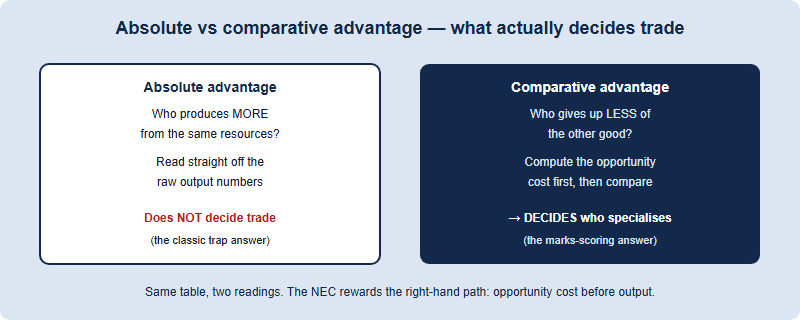
The first distinction to lock in is absolute versus comparative advantage, because NEC questions are built to punish students who confuse them. Absolute advantage means a country can produce more of a good with the same resources. Comparative advantage means it can produce a good at a lower opportunity cost — giving up less of the other good. Trade is governed by comparative, not absolute, advantage. A country can be worse at making everything in absolute terms and still gain from trade, because it is relatively less bad at one good. That counter-intuitive result is the single most-tested insight in the whole strand, and the table format exists precisely to test whether you reach for opportunity cost rather than raw output.
Reading an opportunity-cost table the NEC way
Here is a worked example in the format you will meet. Two countries can produce wheat and cloth. The numbers are the maximum units each can make per period if it devotes all resources to one good:
| Country | Wheat (max units) | Cloth (max units) | Opp. cost of 1 wheat | Opp. cost of 1 cloth |
|---|---|---|---|---|
| Country A | 100 | 50 | 0.5 cloth | 2 wheat |
| Country B | 60 | 60 | 1 cloth | 1 wheat |
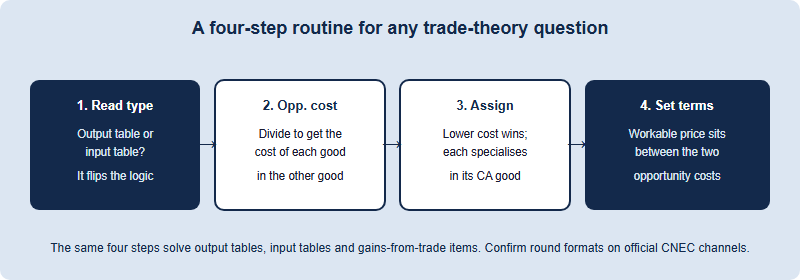
The method is mechanical, and that is the point — a reliable method beats clever intuition under time pressure. For each country, the opportunity cost of one unit of a good is “how much of the other good you give up,” found by dividing. Country A gives up 50 cloth to make 100 wheat, so 1 wheat costs 0.5 cloth; flip it and 1 cloth costs 2 wheat. Country B trades 60 for 60, so each good costs exactly 1 of the other. Now compare the costs, not the totals:
- Wheat: A's cost is 0.5 cloth, B's is 1 cloth. A gives up less — A has the comparative advantage in wheat.
- Cloth: A's cost is 2 wheat, B's is 1 wheat. B gives up less — B has the comparative advantage in cloth.
So each country specialises where its opportunity cost is lower: A makes wheat, B makes cloth, and they trade. Notice that Country A has the absolute advantage in both goods (100>60 wheat, and it is no worse placed overall), yet it should still import cloth from the country it out-produces. A student who answered “A makes everything because it's better at everything” has fallen for the designed trap. The whole question turns on the word comparative. Build the habit of writing the two opportunity-cost columns first, before you read the answer choices — it is faster than it looks and it immunises you against the obvious wrong option.
One practical tip for speed rounds: a quick cross-check is the ratio rule. If A's wheat-to-cloth output ratio differs from B's, comparative advantage exists and the country with the higher relative output in a good specialises there. When the ratios are identical, opportunity costs match and there are no gains from trade — an answer option the NEC sometimes hides in the set to catch over-eager students.
Setting the terms of trade — where the marks hide
Knowing who specialises is only half the question. The harder half is the terms of trade: the exchange rate between the two goods that makes trade beneficial for both. This is where mid-tier candidates lose marks, because the answer is a range, not a single number, and you have to state it correctly.
The rule: a trade benefits both parties only if the agreed price sits between the two countries' opportunity costs. Using the table above, the opportunity cost of cloth is 2 wheat in Country A and 1 wheat in Country B. So the workable terms of trade for cloth lie strictly between 1 and 2 wheat per cloth. At any price in that band, A pays less for cloth than making it itself (better than 2 wheat), and B receives more wheat for its cloth than it could produce alone (better than 1 wheat). Both gain. Outside the band, one party would rather not trade.
| Price of 1 cloth | Country A's view | Country B's view | Trade happens? |
|---|---|---|---|
| 0.8 wheat | Great deal (< its 2-wheat cost) | Worse than self-supply (< 1 wheat) | No — B refuses |
| 1.5 wheat | Cheaper than its 2-wheat cost | Better than its 1-wheat cost | Yes — both gain |
| 2.3 wheat | Worse than self-supply (> 2 wheat) | Excellent (> 1 wheat) | No — A refuses |
Read the table and the logic of the band becomes visible: the two opportunity costs are the floor and ceiling, and only a price between them leaves both sides better off than going it alone. Common NEC question stems built on this include “Which of the following terms of trade would benefit both countries?”, “What is the maximum price Country A would accept for cloth?”, and “By how many units does Country A gain if it trades at this price versus producing domestically?” The last variety asks you to quantify the gain — compute what A would have produced alone, what it gets through trade at the stated price, and subtract. Practising those three stems covers most of the terms-of-trade marks you will face.
A subtle point worth rehearsing: the closer the agreed price is to a country's own opportunity cost, the smaller its share of the gains and the larger the partner's. Questions sometimes probe this distribution — “which country captures more of the gains from trade at this price?” — and the answer is whichever country's opportunity cost is further from the agreed terms. It is the same arithmetic, asked from a different angle.
The question patterns the NEC reuses
Across the world-economy strand, trade-theory items recur in a small set of recognisable shapes. Learning to name the shape on sight tells you which tool to grab. The patterns below describe the type of reasoning a question demands; the exact format, weighting and round in which they appear are set officially, so confirm current specifics on the official CNEC channels.
- The output table. Numbers for two goods, two countries; you compute opportunity costs and assign comparative advantage. The trap is answering with absolute advantage.
- The input table. Same idea, but figures are hours or labour per unit rather than output per period. Here the lower number is better, so the comparison flips — comparative advantage goes to the country with the lower relative input cost. Read the table header carefully before you divide.
- The terms-of-trade range. Identify the band between the two opportunity costs and test candidate prices against it.
- The gains-from-trade calculation. Quantify how much each country consumes with versus without trade at a given price.
- The conceptual catch. A worded item with no table that tests whether you know trade follows comparative advantage, that absolute advantage in everything does not preclude beneficial trade, and that identical opportunity costs mean no gains.
The applied and team rounds raise the stakes by layering these on each other — a single prompt may give an input table, ask for the comparative-advantage assignment, then for the workable terms of trade, then for the size of one country's gain. That is one chain of reasoning, not four separate facts, which is why drilling the method until it is automatic matters more than re-reading the theory. The boundary still holds: these are pure trade-theory mechanics. When a question pivots to tariffs, subsidies or trade barriers, you have left this topic and entered protectionism, which carries its own logic.
Where authority sits is worth restating: the CEE sets the official academic standard and the NEC rules, while the CNEC, run by Hanlin as the authorized China test center, runs the national round and the only official path from China to the global rounds. Any named question-setters or judges linked to the contest are organiser claims — treat them as such and confirm officially rather than as settled fact. If you want to see how the world-economy block fits the wider competition, the round overview is on the CNEC site.
How to drill comparative advantage for the season
Trade theory rewards reps, not re-reading, because the marks come from executing a method at speed. A focused practice block beats a vague “revise trade” plan:
- Do ten tables a sitting, mixed. Alternate output and input tables so you train yourself to check the header first and flip the logic when needed. The input-table flip is the most common careless error.
- Always write the opportunity-cost columns. Even when an answer looks obvious, draw the two cost columns before choosing. It is your guard against the absolute-advantage trap and it is fast once it is habit.
- Practise stating ranges, not points. For every table, write the workable terms-of-trade band out loud as “between X and Y.” Examiners reward the boundary logic, and points-only answers leave marks behind.
- Quantify one gain per session. Pick a price inside the band and compute exactly how many units a country gains versus self-supply. This is the highest-difficulty variety and the one fewest candidates rehearse.
- Layer for the team rounds. Once the single-step versions are automatic, do chained prompts — assign, then set terms, then size the gain — under a timer, which mirrors how the applied rounds stack the idea.
A note on division choice, because it shapes how you rehearse: the NEC's Pre division can be entered individually or as a small group of 2–4, while the David Ricardo and Adam Smith divisions are teams of four. In a team, it is worth designating who owns the world-economy desk so trade tables are answered with confidence and speed; division rules and the current structure sit on the CNEC site, so confirm them before you commit. We make no guarantee about results or admissions outcomes — this is a study method, not a promise. But of all the world-economy material, comparative advantage gives the cleanest return on practice, which is why it earns the “workhorse” name.
Frequently asked questions
Does the NEC test absolute or comparative advantage?
Both appear, but trade outcomes are decided by comparative advantage — lower opportunity cost. Questions are built to catch students who answer with absolute advantage.
How do I find the terms of trade?
A workable price sits strictly between the two countries' opportunity costs for that good. Any price in that band leaves both sides better off than self-supply.
What is the difference between output and input tables?
Output tables show units produced (higher is better); input tables show hours or labour per unit (lower is better), so the comparison flips. Read the header first.
Is comparative advantage worth prioritising for the NEC?
Yes — it is the densest, most calculable part of the world-economy strand, so it rewards a clean method. Confirm current scope on official CNEC channels.
Published by the NEC / CNEC editorial desk, operated by Hanlin Education as the officially authorized China National Economics Challenge (CNEC) test center. The NEC is run by the Council for Economic Education, which sets the official rules — always confirm current dates, divisions, fees and awards on the official CNEC channels. Corrections are made within 7 working days.