
The National Economics Challenge (NEC) tests long-run growth as a question about capacity, not measurement. To earn the marks you must separate the four sources that lift the trend — more physical capital per worker, more and better labour (human capital), and the technology / total factor productivity that makes those inputs more productive — and never confuse that slow rise in potential output with a short-run business-cycle swing around it. Long-run growth is sustained real output per person, driven above all by productivity.
Growth means rising productivity, not just a rising level
The first thing NEC items reward is a precise definition. Long-run economic growth is the sustained increase in an economy's potential output — what it can produce at full employment of its resources — and the living-standards version of it is the rise in real GDP per capita. That per-capita framing matters: an economy whose output grows only as fast as its population is no richer per person, so questions that hand you total output and population growth are checking whether you divide before you judge. (How that real, per-person figure is built and why nominal numbers mislead is the accounting topic covered separately; here we take the measure as given and ask what moves it.)
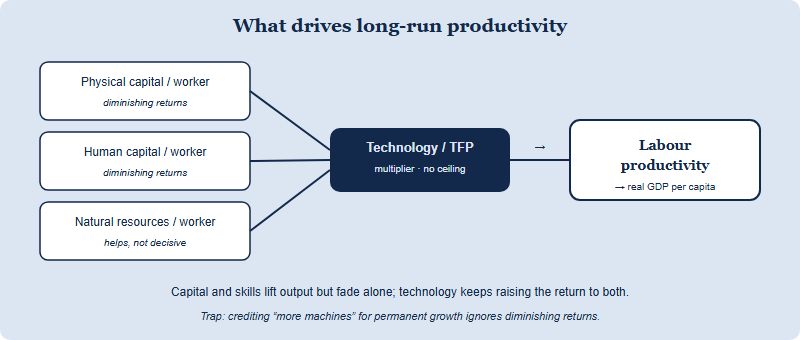
Behind almost every growth answer sits one idea: labour productivity, output per hour worked. Over decades, the single best predictor of a country's standard of living is how much each worker can produce, because what a nation can consume is ultimately limited by what it produces. NEC prompts test this by asking why productivity differs — and the disciplined answer names its determinants rather than gesturing at “hard work.” The recognised drivers are physical capital per worker, human capital per worker, natural resources per worker, and the technological knowledge that ties them together.
- Potential output (long-run): the full-employment capacity of the economy — the trend the cycle moves around.
- Real GDP per capita: the living-standards proxy, because it adjusts for both prices and population.
- Labour productivity: output per worker or per hour — the variable the four growth determinants all feed into.
The four sources of growth NEC wants you to name
A large family of NEC questions exists to check whether you can attribute a growth episode to the right source. Examiners describe a country's experience — a wave of factory investment, a schooling expansion, a new general-purpose technology — and ask which determinant of productivity it raised. Get the channel right and the evaluation marks follow.
- Physical capital per worker (capital deepening): more tools, machines, and infrastructure per worker raises output per worker. This is the most visible driver, but it runs into diminishing returns — each extra unit of capital adds less than the last when the workforce and technology are held fixed.
- Human capital per worker: the knowledge and skills workers embody through education, training, and health. Like physical capital, it must be accumulated, and it raises both productivity and the payoff to new technology.
- Natural resources per worker: land, minerals, energy, and climate. They help, but the canonical NEC point is that resources are neither necessary nor sufficient — resource-poor economies grow rich on productivity, and resource-rich ones can stagnate.
- Technological knowledge (and TFP): better ways of combining inputs. This is the only source that escapes diminishing returns and so, in the long run, the dominant driver of rising living standards.
You can see where these macroeconomics items sit alongside the micro and world-economy questions on the CNEC site; growth is the topic that connects domestic productivity to the trade and development questions in the world-economy section.
| Source of growth | What it raises | Diminishing returns? | NEC signal phrase |
|---|---|---|---|
| Physical capital per worker | Output per worker (capital deepening) | Yes — on its own | “invested in plant / machinery / infrastructure” |
| Human capital per worker | Skill, and the return to technology | Yes — on its own | “expanded schooling / training / health” |
| Natural resources per worker | Output, where resources are used | n/a — finite endowment | “resource-rich / resource-poor” |
| Technology & TFP | Productivity of all inputs | No — the long-run engine | “new process / innovation / R&D” |
Growth accounting: splitting growth into inputs and TFP
The strongest NEC answers reach for the framework economists use to attribute growth: growth accounting. The idea is that the growth of output can be decomposed into the growth contributed by extra capital, the growth contributed by extra labour, and a residual — the part no measured input explains — called total factor productivity (TFP). TFP is the “how well” term: the same machines and the same workers producing more because technology, organisation, and know-how improved. When an item asks why two countries with similar investment rates grew at different speeds, the residual — TFP — is usually the answer the examiners want named.
This is also where the Solow-style insight that NEC Critical Thinking prompts reward becomes useful: because capital alone runs into diminishing returns, simply raising the saving-and-investment rate lifts the level of output and growth for a while, but cannot sustain a permanently higher growth rate. Sustained per-capita growth must come from continuing technological progress — the source with no built-in ceiling. A favourite trap hands you a country that doubled its investment and asks whether it can grow fast forever; the disciplined response distinguishes a one-off level effect from a permanent growth effect. Attribute named theorists or models “per the standard growth framework” rather than overclaiming a single canonical authority.
- Capital's contribution: growth from a deeper capital stock — real but self-limiting.
- Labour's contribution: growth from more hours and more human capital.
- TFP (the residual): output growth left over — the technology-and-efficiency engine that explains lasting differences.
Catch-up growth and why convergence is conditional
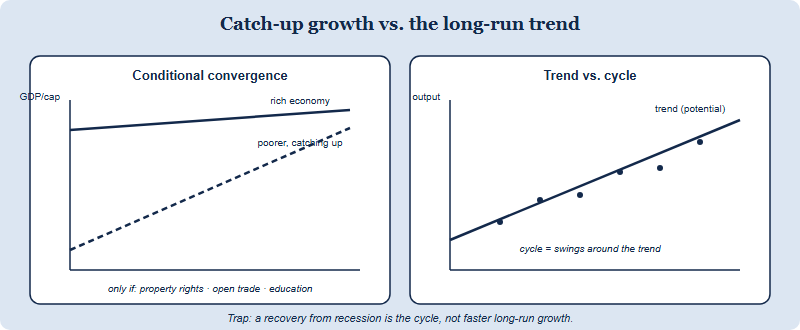
Growth questions with a world-economy flavour love the catch-up effect (convergence): poorer economies, starting with little capital per worker, can grow faster than rich ones because the early units of capital they add deliver the largest returns — and because they can adopt technologies the frontier already invented rather than inventing them. This is the mechanism behind the rapid growth of several developing economies, and NEC prompts use it to test whether you understand that high growth rates can reflect a low starting point, not a permanently superior system.
The mark-winning nuance is that convergence is conditional, not automatic. Catch-up happens only where the supporting conditions are in place: secure property rights and the rule of law, openness to trade and foreign investment, stable institutions, investment in education and infrastructure, and political stability. Where those are missing, poor countries can stay poor — the gap does not close on its own. So when an item asks why two equally poor countries diverged, the answer runs through institutions and policy, not luck. This is exactly the kind of evaluative reasoning the Critical Thinking and Econ Lab rounds reward, and it links the macro growth topic to the development and trade material in the world-economy section. You can map these connections against the format on the official CNEC channels.
Growth versus the cycle: the distinction examiners test hardest
The error that costs the most marks is mixing up long-run growth with the business cycle. Long-run growth is the slow, supply-side rise in potential output driven by the productivity sources above; it shifts the economy's capacity outward over years and decades. The business cycle is the short-run fluctuation of actual output around that trend — booms and recessions driven largely by swings in aggregate demand. An economy can be in recession (a cycle event) while its long-run growth potential keeps rising, and a burst of fast output as a country recovers from a slump is the cycle closing an output gap, not a permanent acceleration of growth.
NEC items probe this constantly: a prompt that describes unemployment falling as the economy rebounds is a cyclical story, while a prompt about rising educational attainment or a new general-purpose technology is a growth story. The policy split follows the same line and is worth stating cleanly, because it earns evaluation marks: demand-side fiscal and monetary policy mainly smooths the cycle, whereas the levers that raise the long-run trend are supply-side — incentives to save and invest, R&D and innovation support, education and human-capital policy, infrastructure, and institutions that protect property and competition. Keep the two questions “what moves actual output this year?” and “what raises potential output over a decade?” apart, and the round's growth items become predictable.
How to drill long-run growth for the NEC rounds
Growth rewards a small set of distinctions applied at speed, which fits the NEC format — the Qualifying Test and Quiz Bowl punish hesitation on definitions, while Critical Thinking and the Econ Lab reward the conceptual reads on productivity and convergence. A first-party drilling routine we use with CNEC teams:
- Lead every growth answer with productivity. Trace the story back to output per worker and name which determinant moved — capital, human capital, resources, or technology — rather than describing the symptom.
- Flag diminishing returns on sight. When a question credits “more investment” for permanent growth, separate the one-off level effect from a lasting growth effect, and point to technology / TFP as the durable engine.
- Run the trend-or-cycle check first. Before answering, label the prompt: is this a supply-side change in potential output (growth) or a demand-side swing in actual output (cycle)? The right policy lever follows from the label.
- Make convergence conditional. Pair any catch-up claim with the institutions and policies it depends on — property rights, open trade, education — so a question on divergence is answered with conditions, not luck.
Long-run growth is one slice of the macroeconomics the NEC tests, but it is the topic that explains why living standards differ across countries and over time, so the precision you build here pays off across the policy, world-economy, and development questions too. To see where these macroeconomics items sit in the wider format and timeline, confirm the current structure on the official CNEC channels before relying on any specific detail.
FAQ
What drives long-run economic growth in NEC questions?
Rising labour productivity — from physical capital, human capital, natural resources, and above all technology / TFP.
Why can't more investment alone sustain growth forever?
Capital faces diminishing returns; only continuing technological progress (TFP) raises growth without a built-in ceiling.
What is the difference between long-run growth and the business cycle?
Growth is the slow rise in potential output; the cycle is the short-run swing of actual output around that trend.
What is the catch-up effect?
Poorer economies can grow faster from a low capital base — but convergence is conditional on institutions and policy.
Published by the NEC / CNEC editorial desk, operated by Hanlin Education as the officially authorized China National Economics Challenge (CNEC) test center. The NEC is run by the Council for Economic Education, which sets the official rules — always confirm current dates, divisions, fees and awards on the official CNEC channels. Errors are corrected within 7 working days.