
NEC scoring is an aggregate: your result is the sum of points earned across the competition's seven rounds, not a single test score. Award tiers are then cut from the ranked total, with tie-break rules deciding teams that finish level. Knowing how points stack up, where ties are broken, and what actually separates one tier from the next tells you where marginal effort changes your placing — and where it doesn't.
Scoring is an aggregate, not one exam
The first thing to understand about the National Economics Challenge (NEC) — run by the Council for Economic Education (CEE, founded 1949) and taken by roughly 10,000 US students a year — is that its scoring is cumulative. The competition is built from seven rounds: the Qualifying Test, Super Econ, Quiz Bowl, Critical Thinking, Econ Lab, Econ Immersion and U20 Youth Voice. Each round generates points, and your standing is the total those points add up to. There is no single “the score” that decides everything; there is a running tally.
That structural fact reshapes how you should think about preparation. If scoring were one exam, you would pour every hour into that exam. Because it is an aggregate, the strategic question becomes: which rounds carry weight for our division, and where is our marginal point cheapest to earn? A team that is already strong on recall may gain more from one extra point in an applied round than from a tenth flawless practice quiz. The arithmetic of “where do the points come from” matters as much as the economics.
Two caveats frame everything below, and they are not throat-clearing — they are the fact-check guardrails. First, the exact point values, the weight of each round, and the cut-offs for each award tier are set officially and can change from season to season; treat any specific number you see floating online with suspicion and confirm current figures on the official CNEC channels. Second, this article explains the mechanics of how an aggregate score and its tiers work — it is deliberately not a “how to win” pep piece, and it makes no promise about results. For students in China, the official route into the NEC global rounds is the China National Economics Challenge (CNEC), run by Hanlin (SKT) as the officially authorized China test center since 2016, now spanning 20-plus provinces and 300-plus schools. You can review the round line-up on the NEC / CNEC home page before mapping your own scoring strategy onto it.
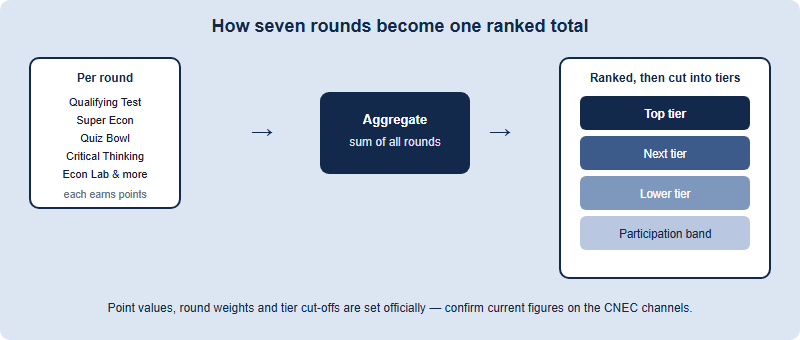
How points aggregate across the rounds
Because the rounds test different skills in different formats, they do not all behave the same way as point sources. It is worth separating them by how reliably you can bank points there, because that, not raw difficulty, should drive where you spend revision time. The grouping below describes the type of scoring behaviour each round tends to have; the precise marks, the number of items, and the round weights are official and should be confirmed before you plan around them.
| Round | Format | Scoring behaviour | Point reliability |
|---|---|---|---|
| Qualifying Test | Individual, written | Objective marks across the syllabus | High — most controllable |
| Super Econ | Timed retrieval | Speed-weighted accuracy | High, if drilled |
| Quiz Bowl | Live team buzzer | Points won and sometimes lost on the buzz | Variable — swingy |
| Critical Thinking | Team analysis | Rubric / judged reasoning | Medium — judgement-based |
| Econ Lab | Applied task | Working and output assessed | Medium |
| Econ Immersion | Scenario / experiential | Applied transfer assessed | Medium |
| U20 Youth Voice | Presentation | Communication, judged | Medium — rehearsable |
Read the table as a portfolio. The objective rounds — the written Qualifying Test and the speed-based Super Econ — are your reliable point base. Marks there are earned the way exam marks are earned: by coverage and accuracy, with little judgement involved. These are where a well-prepared team should expect to bank a predictable floor of points, which is exactly why neglecting them is so costly to an aggregate.
The live buzzer round, Quiz Bowl, is the volatile asset. It can add a large block of points or cost you them, depending on buzz timing and composure under a clock; two equally knowledgeable teams can post very different Quiz Bowl scores purely on coordination. The judged rounds — Critical Thinking, Econ Lab, Econ Immersion and U20 Youth Voice — sit in the middle: their points come from assessed reasoning, applied output and communication, which means they reward structure and rehearsal rather than raw recall. Because they are judgement-based, the difference between a competent and an outstanding submission is often a few marks, and those marks are precisely where two strong teams separate. We cover preparing for each round's format in our CNEC preparation resources; here the point is narrower — understand the shape of each round as a point source before you decide where your next hour goes.
One first-party observation from operating the China round: the most common scoring mistake we see is not weak economics, it is an unbalanced portfolio. Teams that pour everything into the knowledge rounds can post a strong objective subtotal and still slide down the aggregate ranking because their judged-round points lag the field. Since the final number is a sum, a single under-trained round acts as a drag on the whole total — and against closely matched teams, that drag is frequently what decides which tier you land in.
Tie-breaks: how level scores are separated
When an aggregate score is cut into ranked tiers, ties are inevitable — especially near a cut-off line, where many teams cluster. That is why tie-break logic exists, and why it deserves attention even though most candidates never think about it until they are on the wrong side of a boundary.
The precise tie-break rules the NEC uses are official and can vary by round, stage and season, so the rule for your competition must be confirmed on the official CNEC channels rather than assumed. What is useful to understand is the general logic such rules follow in aggregate academic competitions, so you can reason about it sensibly:
- A designated decisive round. Many formats break ties by leaning on a nominated round — often the individual written test or a head-to-head event — so that the team performing better there is ranked higher when totals match. If your competition does this, that round quietly carries extra weight beyond its face-value points.
- A head-to-head or play-off. Live formats sometimes resolve a tie with an additional buzzer exchange or tie-break question, which makes composure under sudden pressure a real, if rare, scoring factor.
- A component subtotal. Some schemes compare a particular section's subtotal — for instance the macro or international portion — to separate level teams.
The practical takeaway is not to memorise a rule we are explicitly not asserting; it is to recognise that where ties get broken can convert a “minor” round into a decisive one. A team sitting exactly on an award boundary may be promoted or held back by a tie-break that hinges on a single round's performance. That is a strong argument against treating any counted round as throwaway: you cannot know in advance which one will be asked to break your tie. Confirm your competition's actual tie-break procedure on the CNEC site so you are not surprised by it.
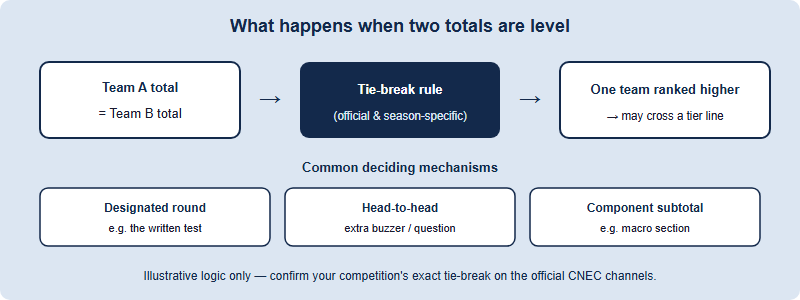
What actually separates the award tiers
Award tiers are bands cut from the ranked aggregate: above one threshold you reach the top tier, above the next the second, and so on, down to a participation band. The names of the tiers and the exact cut-offs are official and change by season and division — do not anchor to a specific number you read somewhere. What is durable, and worth internalising, is what tends to distinguish a higher-tier total from a lower one. In practice it is rarely a single heroic round.
Three patterns explain most of the separation between tiers:
- A high objective floor. Top-tier teams almost always bank near-maximum points in the controllable rounds — the written test and the speed round. These are the points you can secure with disciplined preparation, so failing to maximise them effectively forfeits a tier before the judged rounds even begin.
- No dead-weight round. The gap between tiers is often a counted round a team simply under-trained — a thin presentation, an unrehearsed buzzer, a shallow case response. Because the score is a sum, one weak round drags the total down by more than its difficulty suggests it should.
- Marginal quality in the judged rounds. Near the top, two teams may have near-identical objective subtotals, so the separation comes from the judged rounds, where a few marks for sharper structure, clearer reasoning or a more disciplined presentation decide the order. This is the zone tie-breaks live in too.
There is an important nuance about marginal points here. Early on, your cheapest points are usually in the objective rounds: closing syllabus gaps and building retrieval speed reliably converts hours into marks. Once that floor is high, the curve flattens — an additional practice quiz adds little — and the cheapest remaining points move to the judged rounds, where a rehearsed presentation or a tighter case write-up is worth more than another quiz. Reading where you sit on that curve is the genuinely strategic act, and it is downstream of understanding the scoring as an aggregate in the first place.
A note on division, because it changes which rounds you are even scored on. The NEC's Pre division is the entry tier and can be entered individually or as a small group of 2–4; David Ricardo is the intermediate tier and is a team of four; Adam Smith is the advanced tier, also a team of four. Since the counted rounds and their weighting can differ by division, your scoring strategy has to be built on your division's actual structure — confirm it on the official CNEC pages. On authority: the CEE sets the official academic standard and the NEC rules, while the CNEC, run by Hanlin as the authorized China test center, operates the national round and the only official path from China to the global rounds. Any named question-setters or judges associated with the contest are organiser claims and should be confirmed officially rather than treated as established fact. We make no guarantee about results or admissions outcomes; this is an explanation of how the scoring works, so you can plan with clear eyes rather than with a number someone invented online.
Frequently asked questions
Is the NEC scored as one test or across rounds?
Across rounds. Your result is the aggregate of points from the seven events, so a single under-trained round drags your whole total down.
How are tie-breaks decided in the NEC?
By official, season-specific rules — often a designated round, a head-to-head, or a component subtotal. Confirm your competition's exact rule on the CNEC channels.
What separates one award tier from the next?
Usually a high objective floor plus no weak round, with judged-round quality deciding the top. Exact tier cut-offs are official and change by season.
Which rounds give the most reliable points?
The objective rounds — the written Qualifying Test and the timed Super Econ — are the most controllable. Confirm current weights on official CNEC channels.
Published by the NEC / CNEC editorial desk, operated by Hanlin Education as the officially authorized China National Economics Challenge (CNEC) test center. The NEC is run by the Council for Economic Education, which sets the official rules — always confirm current dates, divisions, fees and awards on the official CNEC channels. Corrections are made within 7 working days.