
The National Economics Challenge (NEC) is a credible signal of academic rigor, applied economics ability and genuine teamwork — but it is evidence, not a verdict. It proves you can perform under exam pressure in micro, macro and world economics alongside three teammates. It does not prove you are admissible anywhere, and on its own it rarely moves a decision. Read honestly, it earns its place as one supporting line of proof.
What admissions readers actually do with an activity
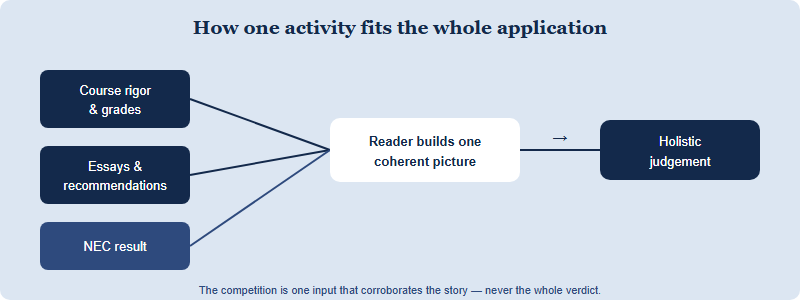
Selective admissions is not a points tally where each award adds a fixed number. Readers build a picture of who you are and ask whether your record is coherent: do your courses, your stated interests and your activities tell the same story? An economics competition matters to the extent that it corroborates a story you are already telling. If you write that you are drawn to economics, a strong NEC run is a fact that backs the claim. If economics appears nowhere else in your file, one competition line will not manufacture a narrative on its own.
That is the honest frame for everything below. The NEC is run by the Council for Economic Education (CEE), founded in 1949, and draws roughly 10,000 US students a year; from China, the official path is the China National Economics Challenge (CNEC), the national round Hanlin (SKT) has operated since 2016 across 20-plus provinces and 300-plus schools. Those facts give the activity standing. What they do not do is make the activity speak for itself — you do.
What the NEC genuinely proves
The value of the NEC as a signal comes from its format, not just its name. Because the competition spans microeconomics, macroeconomics and world economics, and runs through multiple round types, a strong result is hard to fake and demonstrates several distinct qualities at once.
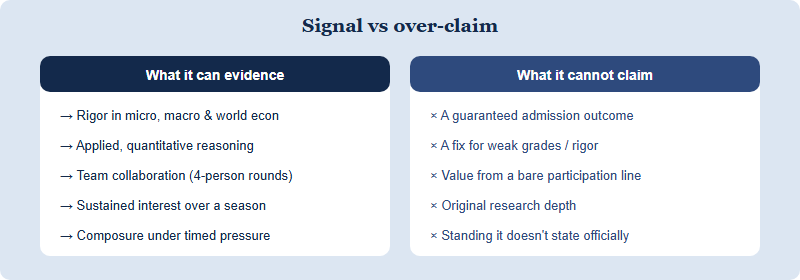
- Academic rigor under pressure. The Qualifying Test and timed rounds reward students who have actually worked through demand and supply, market structures, fiscal and monetary policy, and international trade — not memorised summaries. A good score is evidence you can think analytically when the clock is running.
- Quantitative and applied economics. Rounds such as the Econ Lab push beyond definitions into application — reading data, reasoning about models, and connecting theory to real-world problems. That is closer to what an economics degree asks of you than a single classroom grade can show.
- Genuine teamwork. The David Ricardo and Adam Smith divisions are contested by teams of four. Performing well means you can prepare, divide labour and reason collectively under stress — a collaboration signal that solo awards simply cannot send.
- Sustained, self-directed interest. Reaching and clearing the China National Round through CNEC, and progressing toward the NEC global rounds, shows commitment over a season rather than a one-afternoon dabble.
Notice that these are capabilities, phrased in terms a reader cares about. “Rigor, applied reasoning, collaboration and follow-through” travels into an essay or a recommendation far better than a bare line that says “participated in an economics competition.”
What it does not prove
Being candid about the limits is what makes the signal usable. Overclaiming is the fastest way to make a strong activity read as naïve.
- It does not guarantee admission anywhere. No competition does. Decisions turn on the whole file, fit and institutional priorities. Treat any “recognised by top universities” framing as marketing, not a promise — and confirm what is actually claimed on the official channels.
- It is not a substitute for grades or course rigor. A reader who sees a competition result but a thin transcript draws the obvious conclusion. The activity supplements your academic record; it cannot rescue it.
- A participation line is weak on its own. “Entered the NEC” without a result, a role, or anything you learned is close to noise. The signal lives in specificity — what you did, what you contributed, what changed in how you think.
- It does not prove research depth. The NEC is a test-and-team competition, not an independent research project. If your story needs original investigation, the NEC is a complement to that work, not a replacement for it.
How the divisions and rounds shape the signal
Different parts of the competition send different evidence, and a reader who knows economics can tell. The NEC runs three divisions and seven round types; matching what you did to what it demonstrates keeps your claims precise.
| Division / round | What it is (per official rules) | What it tends to signal |
|---|---|---|
| Pre | Entry level; individual or a team of 2–4 | Early, genuine curiosity; a credible first step into competitive economics |
| David Ricardo | Intermediate; team of 4 | Solid command of core theory plus the ability to collaborate |
| Adam Smith | Advanced; team of 4 | Depth, breadth and composure at the most demanding level |
| Qualifying Test | Opening assessment of micro, macro & world economics | Analytical accuracy under timed multiple-choice pressure |
| Critical Thinking / Econ Lab | Applied reasoning and problem rounds | Moving from definitions to application — degree-style thinking |
| Quiz Bowl / Super Econ | Fast, competitive team rounds | Recall, decisiveness and coordination as a unit |
The practical takeaway: name the division and the round honestly, and describe what it required of you. “Anchored the macro questions for our Adam Smith team in the Econ Lab round” tells a reader far more than “won an award.” Always confirm the current division structure, round names and rules on the official CNEC channels, since formats are set by the organiser and can change.
Turning the activity into usable evidence
If you take the signal-not-verdict view seriously, your job is to translate the experience into specifics a reader can use. A few honest moves do most of the work:
- Lead with a capability, not a label. Tie the NEC to something concrete you can now do — reason about policy trade-offs, read economic data, argue a model’s limits.
- Show a role. What did you own on the team? Preparation, a topic area, strategy between rounds? Roles are memorable; “member” is not.
- Connect it forward. Let the competition point at what you want to study or build next. A signal that explains a direction is worth more than one that just sits there.
- Stay within what is true. Report your division, your result and your contribution accurately. Do not borrow the competition’s prestige to imply a standing you cannot state. Honesty is itself a signal — and the only durable one.
Used this way, the NEC is genuinely worth it for an economics-leaning applicant: it gives you real material to write about and a credible context for your interest. For the official China path, formats and the route to the global rounds, see the CNEC home page, and review the season structure and the competition divisions and rounds before you commit to a level.
Frequently asked questions
Does winning the NEC guarantee admission to a top university?
No. It is supporting evidence of rigor and economics ability; decisions rest on your whole file. Confirm any “recognition” claim on the official CNEC channels.
Is it worth entering if I only reach the Pre division?
Yes, if economics is your direction. The Pre level credibly shows early, genuine interest — what matters is how specifically you describe what you did.
What does the NEC prove that a solo award can’t?
Team-based rounds (David Ricardo and Adam Smith are teams of four) evidence real collaboration under pressure, which individual competitions cannot show.
Will the NEC replace weak grades or research?
No. It supplements your transcript and complements research; it cannot substitute for course rigor or original investigation.
Published by the NEC / CNEC editorial desk, operated by Hanlin Education as the officially authorized China National Economics Challenge (CNEC) test center. The NEC is run by the Council for Economic Education, which sets the official rules — always confirm current dates, divisions, fees and awards on the official CNEC channels. Errors are corrected within 7 working days.