
You win the NEC Critical Thinking (CT) round by treating an open-ended economic prompt as a defensible argument, not a recital. Pick one clear thesis fast, build it as claim → mechanism → trade-off → conclusion, make your assumptions explicit so they survive questioning, and present with structure and composure. CT rewards reasoning you can defend under pressure, not the volume of theory you can name.
Most NEC guides — including several already on our own site — survey all seven rounds and move on. This one stays on a single event: the Critical Thinking round, where recall-strong teams most often plateau. The National Economics Challenge is run by the Council for Economic Education (CEE, founded 1949) and draws roughly 10,000 students a year in the United States across microeconomics, macroeconomics and world economics. The China National Round (CNEC) has been operated by Hanlin (SKT) since 2016, across 20+ provinces and 300+ schools, and is the official path from China into the NEC global rounds. The economic standard below comes from the CEE; the exact CT format, weighting and timing for your division can change season to season, so confirm those on the official CNEC channels before you build a plan around them.
What the Critical Thinking round actually asks of you
Critical Thinking is the round that moves a team off recall and onto reasoning: you are handed an open-ended economic problem and asked to apply principles to it, not to reproduce a definition. The content stays inside the same syllabus as every other round — micro, macro and international economics — but the delivery is different. You are graded on the quality of your argument: whether your logic is coherent, whether your evidence supports your claim, and whether your conclusion follows from your reasoning. A team that can list every market failure but cannot build one clean cause-and-effect chain will lose to a team that says less but defends it better.
That shift trips up exactly the students who do best on the knowledge rounds. Plenty of Chinese international-school students arrive with excellent textbook economics and strong exam habits, clear the Qualifying Test comfortably, and are then surprised that CT does not reward “knowing more.” It rewards judgement under a clock: choosing a framework, committing to a position, and explaining a chain of effects cleanly enough that a sceptical listener follows it. Because the precise task design and any presentation element can vary by year and division, treat the method below as the durable part and verify the mechanics on the official CNEC pages.
Structure an economic argument under time
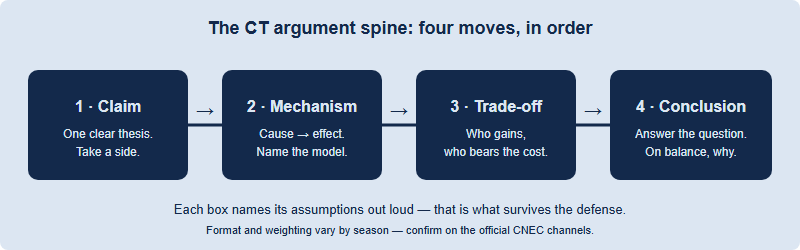
Under a clock, the failure is almost never “not enough knowledge” — it is a sprawling, unstructured answer that touches five ideas and lands on none. The fix is a fixed spine you can drop any prompt into: claim → mechanism → trade-off → conclusion. Open with a single thesis that takes a side. Explain the mechanism as an explicit cause-and-effect chain and name the model you are using (supply and demand, elasticity, the multiplier, comparative advantage). Then surface the trade-off — who gains, who pays, what is given up. Finally, return to the question and answer it on balance. Judges can follow that shape even when the economics is hard.
Budget your minutes before you write a word. A practical split that travels well: spend the first slice choosing your thesis and framework, the bulk building the mechanism and trade-off, and a reserved final slice on the conclusion and a fast self-check. The single highest-leverage habit is committing to one framework early instead of hedging across three — a focused argument with one well-defended model beats a buffet of half-developed ones. Resist the urge to demonstrate range; CT rewards depth on one line of reasoning, not breadth.
| Phase | What you are doing | Common mistake | The fix |
|---|---|---|---|
| Read & decide | Find the real question; pick a thesis | Restating the prompt; staying neutral | Commit to one side in a single sentence |
| Frame | Choose one economic model to drive it | Naming three frameworks, using none | Pick the one that yields a clear mechanism |
| Build | Lay out cause → effect, then the trade-off | Asserting outcomes with no chain | Show each step; state who bears the cost |
| Land | Answer on balance; flag your key assumption | Trailing off without a verdict | One conclusion sentence + the assumption it rests on |
Frame trade-offs and defend your assumptions
Trade-offs are where Critical Thinking separates strong teams from textbook ones. Economics is the study of choices under scarcity, so any answer that claims a policy is simply “good” without naming what it costs is incomplete on its face. Train yourself to finish every claim with the other half: a minimum wage may raise incomes for some workers and risk reduced hours for others; a tariff may protect a domestic industry and raise prices for consumers and invite retaliation. You do not have to resolve the tension perfectly — you have to show you can see it. Naming the trade-off is itself evidence of economic maturity, and it pre-empts the most obvious challenge a judge can throw at you.
Every economic argument rests on assumptions, and in CT the difference between a fragile answer and a robust one is whether you say yours out loud. Are you assuming demand is elastic? That the market is competitive? That there are no major externalities? State it, then defend it: “I'm assuming demand here is relatively price-elastic, because this is a discretionary good with close substitutes — if that held differently, the effect would shrink.” A hidden assumption is a weakness a judge can expose; a stated and justified assumption is a strength. The strongest CT teams pre-empt the obvious challenge before it is asked, which also signals composure — and composure is half of what the round is testing.
Present and defend: delivery is part of the score
However a given season delivers the Critical Thinking round, the same delivery principles apply: a brilliant argument communicated as a mumbled, rambling stream loses to a clear argument delivered with structure and conviction. Signpost out loud — “My claim is X; the mechanism is Y; the main trade-off is Z; so on balance, my answer is W.” That signposting does double duty: it keeps you on your own spine, and it makes you easy to follow and easy to score. If your team presents together, assign who owns the claim, who owns the mechanism, and who fields questions, and rehearse the handoffs so they are seamless rather than a scramble.
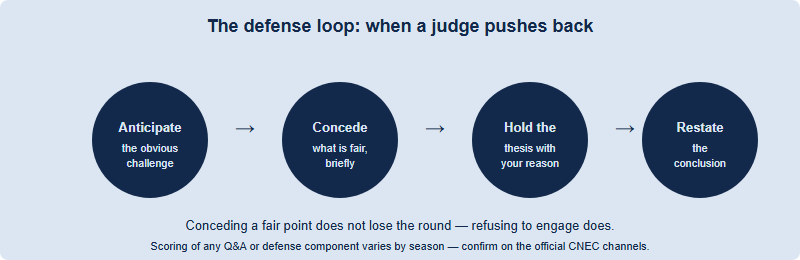
When you are challenged, run the defense loop rather than freezing: anticipate the obvious objection, concede the part that is genuinely fair, then hold your thesis with your strongest reason and restate your conclusion. Conceding a fair point does not weaken you — refusing to engage, or pretending a real trade-off does not exist, does. The most transferable part of all this is that universities reward exactly these moves: interviews, supervisions and seminars all test whether you can build a position, defend it gracefully, and change your mind on evidence. The best CT preparation is repeated case write-ups under time, defended out loud, with a coach or teammate poking holes — which is precisely the structure our CNEC preparation resources are built around.
First-party note from running the China round. The most predictable place we see teams gain or lose ground is the Critical Thinking defense, not the knowledge rounds. Students who can ace a multiple-choice paper often under-rehearse speaking their reasoning aloud, so the first time they defend a thesis is on the day — and it shows. Teams that practise the spine and the defense loop weeks in advance, and rehearse handling pushback calmly, walk in with a real edge. Allocating deliberate time to CT delivery — not just CT content — is one of the highest-leverage decisions a team makes on the path through the China round.
Frequently asked questions
What is the NEC Critical Thinking round?
An open-ended event where a team applies economic principles to a problem and defends a structured argument, rather than recalling definitions. It rewards reasoning, not memorisation.
How should I structure a CT answer under time?
Use a fixed spine: claim → mechanism → trade-off → conclusion. Commit to one thesis and one framework early instead of hedging across several.
How do I defend my assumptions when challenged?
State them out loud and justify them. Anticipate the obvious objection, concede what is fair, then hold your thesis with your strongest reason and restate your conclusion.
How is the Critical Thinking round scored and timed?
Format, weighting and any presentation or Q&A element can change by season and division. Confirm the current CT rules on the official CNEC channels.
Published by the NEC / CNEC editorial desk, operated by Hanlin Education as the officially authorized China National Economics Challenge (CNEC) test center. The NEC is run by the Council for Economic Education, which sets the official rules — always confirm current dates, divisions, fees and awards on the official CNEC channels. Any errors are corrected within 7 working days.