
If you are applying to study economics at Oxford, Cambridge or another UK G5 university, the honest way to use the National Economics Challenge (NEC) is as evidence of how you think — not as a trophy. UK admissions tutors read for genuine intellectual engagement, so the value of NEC sits in what you did with it: the micro, macro and world-economy reasoning you practised, what surprised you, and where it sent your reading next. This guide shows how to do that without overclaiming.
What UK economics admissions actually reward
UK G5 economics admissions (Oxford, Cambridge, LSE, Imperial, UCL) are course-focused and academic. The dominant signals are your predicted grades, any required admissions test, and — for the parts you control in writing — a personal statement that demonstrates supercurricular engagement: structured learning beyond the syllabus that connects to the degree. Crucially, the UK personal statement is read as an academic argument for your suitability, not a CV of achievements.
This matters for how you frame NEC. The NEC is run by the Council for Economic Education (CEE), founded in 1949, and covers microeconomics, macroeconomics and the world/international economy; roughly 10,000 US students take part each year. From China, the official route is the China National Economics Challenge (CNEC), the official China National Round operated by Hanlin (SKT) since 2016 across 20+ provinces and 300+ schools — the only official path from China to the NEC global rounds. Those are useful facts to name accurately. But a tutor does not award a place for a competition badge; they award it for the thinking the badge implies you can do.
| What a tutor reads for | Weak NEC use (avoid) | Strong NEC use (do this) |
|---|---|---|
| Genuine curiosity | "I competed in NEC, a prestigious contest." | "Preparing the macro round, I couldn't reconcile the Phillips curve with stagflation, so I read…" |
| Analytical habit | "I learned a lot about economics." | "Quiz Bowl forced me to define elasticity precisely under time pressure, which exposed how loosely I'd used it." |
| Reading trail | Lists the competition and stops. | Names the idea that NEC sparked, then the book/paper it led to. |
| Honesty | Implies a guaranteed edge or ranking inflation. | States the role accurately (division, team or individual) and what was learned. |
Where NEC belongs in the personal statement
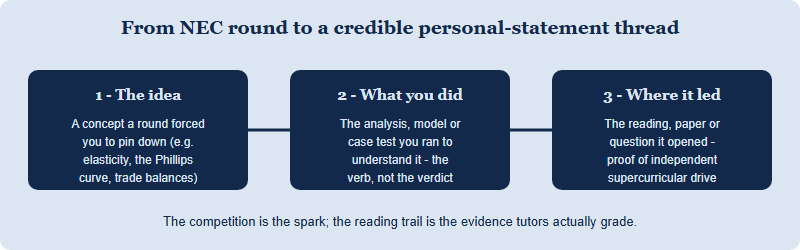
Think of NEC as a launchpad sentence, not a paragraph about itself. The structure that works is: specific economic idea you met → what you did to understand it → where it took your thinking. One or two well-developed threads beat a list of five name-drops. Tutors at Oxbridge in particular tend to discount unexplained accolades and reward the follow-through.
The NEC has three divisions you can reference precisely — Pre (entry level, individual or a team of 2–4), David Ricardo (intermediate, team of 4) and Adam Smith (advanced, team of 4) — and seven rounds: the Qualifying Test, Super Econ, Quiz Bowl, Critical Thinking, Econ Lab, Econ Immersion and U20 Youth Voice. Naming the actual round that stretched you (say, the Critical Thinking case, or the data work in Econ Lab) is far more convincing than calling the whole thing "rigorous." You can read the round-by-round breakdown on the CNEC site and always confirm the current format on the official CNEC channels before you write a specific claim.
A practical template you can adapt:
- Hook the idea: "NEC's world-economy round pushed me to model why a currency depreciation can fail to improve a trade balance."
- Show the work: "I traced the Marshall–Lerner condition and tested it against a recent current-account case."
- Point onward: "That sent me to a chapter of Krugman's International Economics and an FT data piece, which reshaped how I read trade headlines."
Notice what this avoids: no "won," no "top," no implied guarantee. It is checkable, personal and academic — exactly the register UK tutors trust.
What NEC signals vs other line items
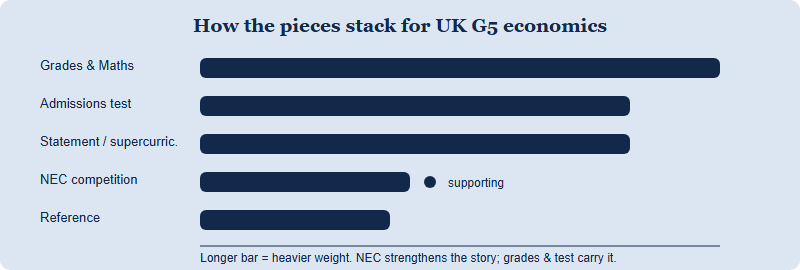
It helps to be clear-eyed about relative weight. For UK G5 economics, line items roughly stack like this — and NEC plays a supporting, not starring, role.
| Application element | Relative weight (UK economics) | What it proves |
|---|---|---|
| Predicted/achieved grades (esp. Maths) | Decisive | You can cope with a quantitative degree |
| Required admissions test (e.g. course-specific) | High, where required | Aptitude under exam conditions |
| Personal statement & supercurriculars | High | Genuine, self-driven engagement |
| NEC / economics competitions | Supporting | Applied micro/macro reasoning & teamwork |
| Reference | Supporting | Third-party view of your potential |
Read across that table and the strategy is obvious: NEC should amplify the quantitative and supercurricular story, not substitute for grades or test prep. Its distinctive contribution versus an essay competition is breadth-under-pressure across micro, macro and world economy, plus a teamwork dimension that solo writing does not show. If you have also done an economics essay competition, you can pair them honestly — the test contest shows you reason fast and broadly; the essay shows you argue in depth. (We cover that contrast in our companion piece comparing test-and-team contests with the long essay.)
Honest language: the lines to use and the lines to avoid
Overclaiming is the fastest way to lose a tutor's trust, and it is easy to do by accident. Keep these rules:
- State your role accurately. Say whether you competed individually or as a team of four, and in which division. Do not imply a national ranking you did not earn, and never describe results before they are official — confirm them on the official CNEC channels.
- Attribute organiser claims as claims. If you mention that the NEC is associated with prominent economists or question-setters, write "per the organiser" rather than asserting it as established fact.
- Drop the guarantee vocabulary. No competition "secures" or "guarantees" an Oxbridge or G5 offer. Phrases like "recognised by top universities" are not how tutors talk; let the reasoning speak.
- Make it specific or cut it. A vague "prestigious" sentence is worse than no mention. If you cannot tie NEC to a concrete idea and a next step, leave it out.
Used this way, NEC becomes a small but persuasive part of an academic case — and it stays factually clean if an interviewer probes it. You can verify divisions, rounds and the current China timeline any time on the official CNEC pages; the CEE sets the academic rules, and Hanlin runs the China National Round.
A short pre-submission checklist
- Have I tied NEC to one specific economic idea, not just named the contest?
- Does the sentence show a verb (what I analysed/modelled/read), not just an outcome?
- Is every factual claim about role, result or format accurate and confirmable on the official CNEC channels?
- Have I removed all guarantee or ranking-inflation language?
- Does NEC support my grades-and-supercurricular story rather than carry it?
If you want the underlying structure of the competition while you draft, start from the CNEC home page and the round breakdowns, then write only what you can defend.
FAQ
Does NEC guarantee an Oxbridge or G5 economics offer?
No. UK offers rest on grades, any required test and a genuine academic case. NEC is a supporting signal, not a guarantee.
Where should NEC go in a UK personal statement?
As a launchpad: name one idea a round forced you to grasp, what you did with it, and the reading it led to.
Can I name the NEC divisions and rounds?
Yes, if accurate: Pre, David Ricardo and Adam Smith divisions, plus the seven rounds. Confirm current details on the official CNEC channels.
Is NEC better than an economics essay competition for the UK?
They show different things — NEC shows broad reasoning under pressure; essays show depth. Used honestly, they pair well.
Published by the NEC / CNEC editorial desk, operated by Hanlin Education as the officially authorized China National Economics Challenge (CNEC) test center. The NEC is run by the Council for Economic Education, which sets the official rules — always confirm current dates, divisions, fees and awards on the official CNEC channels. Errors are corrected within 7 working days.