
Market structures — perfect competition, monopolistic competition, oligopoly and monopoly — are the backbone of NEC’s microeconomics pillar. They appear as fast calculation questions in the multiple-choice rounds, as strategic-reasoning prompts in the discussion rounds, and as the analytical lens behind many applied scenarios. This guide maps where each structure tends to surface, what depth of command NEC rewards, and a four-step training sequence for teams preparing through the CNEC pathway in China.
Why market structures punch above their weight in NEC
NEC, run by the Council for Economic Education (CEE) in the United States since its origins as a national challenge, splits its subject coverage across microeconomics, macroeconomics and the world economy. Within the micro slice, market structures do disproportionate work. There are two reasons for this.
First, market structures are where the standard toolkit of microeconomics comes together. A single question about a monopolist’s output decision can simultaneously test cost curves, marginal analysis, elasticity intuition and welfare reasoning. Question writers like topics that compress several concepts into one prompt, and no micro topic compresses more than this one.
Second, market structures scale in difficulty. The same family of ideas can be asked as a definition-level question for a newer competitor, a diagram-and-calculation question for an intermediate one, or a game-theory strategy problem for an advanced team. That makes the topic usable across NEC’s division ladder — from Pre, through David Ricardo, up to the Adam Smith advanced division, where the analytical ceiling is highest.
One caveat before we go further: NEC does not publish a fixed question-by-question topic quota, and the mix shifts from year to year. Treat everything below as a preparation map built from the structure of the competition, not a guaranteed blueprint — and confirm the current season’s format details on the official pages at councilforeconed.org and the official CNEC schedule.
The spectrum: what NEC expects for each structure
The most useful mental model is a spectrum running from many small price-taking firms to a single price-setting firm. Competitors who memorise four disconnected boxes tend to freeze when a question blends features; competitors who understand the spectrum can place any scenario on it and reason from there.
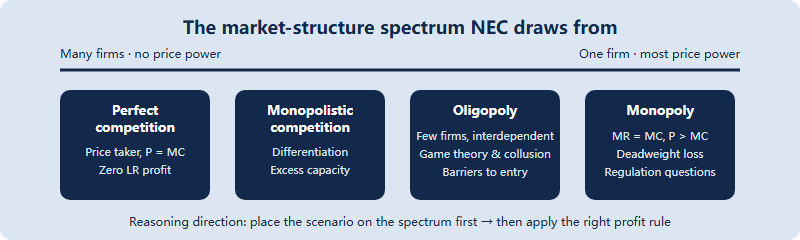
Here is the working depth we recommend for each structure, expressed as the concrete skills a team should be able to perform under time pressure:
| Structure | Must-do skills under time pressure | Typical question style |
|---|---|---|
| Perfect competition | Read P = MR = MC; find shutdown point vs break-even point; predict long-run entry/exit adjustment | Fast multiple choice with a cost table or diagram |
| Monopolistic competition | Explain differentiation and excess capacity; contrast short-run profit with long-run zero-profit tendency | Concept identification and “which statement is true” items |
| Oligopoly | Solve a 2×2 payoff matrix for dominant strategies and Nash equilibrium; reason about collusion incentives and breakdown | Payoff-matrix calculations plus open-ended strategy discussion |
| Monopoly | Apply MR = MC then price off the demand curve; identify deadweight loss; evaluate regulation and price discrimination | Multi-step calculation and welfare-evaluation prompts |
Perfect competition and monopoly: the calculation workhorses
In the timed multiple-choice settings — the Qualifying Test that opens the season and the knowledge-heavy team rounds described in our walkthrough of the seven NEC rounds — perfect competition and monopoly are the two structures most likely to arrive with numbers attached.
The perfectly competitive firm is the cleanest possible calculation environment: price equals marginal revenue, so every question reduces to reading a cost table or curve correctly. The traps are almost always at the decision margins. Can you distinguish the shutdown condition (price below average variable cost) from the exit condition (price persistently below average total cost)? Can you tell that a firm making a short-run loss should still produce as long as price covers variable cost? Chinese international-school students who have taken AP or A-Level economics usually know these rules; the NEC difference is speed. A rule you can state in ten seconds must become a rule you can apply in twenty.
Monopoly questions add one step and one trap. The step: profit-maximise where marginal revenue equals marginal cost, then read price off the demand curve — not off the MR curve. The trap: that final price-reading step is precisely where rushed competitors lose points, because the MR-intersection quantity is correct but the price they select belongs to the wrong curve. In our CNEC training sessions, this single error pattern shows up repeatedly in first mock exams and is almost completely trainable away with a week of deliberate drilling — a genuinely cheap improvement in expected score.
Welfare analysis rides along with monopoly: consumer surplus, producer surplus and deadweight loss relative to the competitive benchmark. Expect evaluation-flavoured items too — natural monopoly, average-cost versus marginal-cost pricing regulation, and the trade-offs of breaking up versus regulating a dominant firm. These are exactly the blended micro-plus-policy prompts that also feed the open-ended rounds.
Oligopoly and game theory: where strategic reasoning is scored
Oligopoly is different in kind, not just in degree. Firms are interdependent, so the profit-maximising rulebook gives way to strategic reasoning — and that makes oligopoly the natural home for game theory.
The core testable object is the 2×2 payoff matrix. A well-prepared competitor should be able to do all of the following in under two minutes: identify each player’s dominant strategy if one exists, find the Nash equilibrium (or equilibria), spot whether the equilibrium is collectively suboptimal, and explain why a cartel agreement in that situation is unstable. That last step — connecting the matrix to the economics of collusion and cheating — is what separates a memorised technique from real understanding, and open-ended prompts reward exactly that connection.
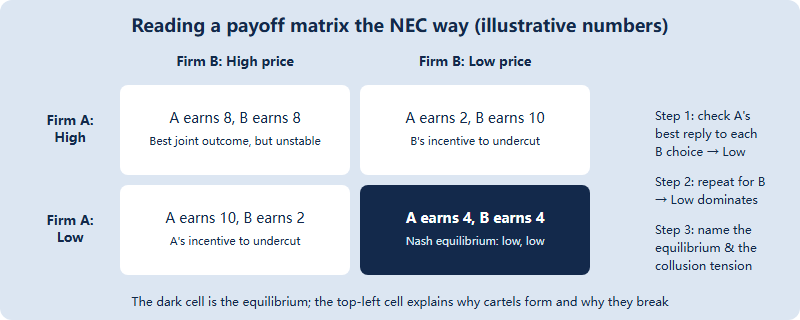
Beyond the matrix, oligopoly is also where NEC-style questions touch antitrust and competition policy, price leadership, and non-price competition. When a scenario names a small number of large firms — airlines, telecoms, platform companies — your first move should be to classify it as oligopoly and then decide whether the question wants a strategic (game-theory) answer or a welfare (policy) answer. Misreading which of the two is being asked is a common and avoidable error.
Monopolistic competition: the structure students under-train
Monopolistic competition gets the least study time on most teams, partly because it involves fewer calculations. That is a mistake. It is the structure that best matches most real consumer markets — cafes, apparel, apps — and it carries a distinctive set of testable claims: product differentiation as the source of limited price power, short-run profits eroded by entry, the long-run tangency outcome with zero economic profit, and excess capacity as the efficiency cost of variety.
Because the claims are verbal rather than numerical, they appear in “which of the following is true” formats where near-miss distractors punish fuzzy understanding. The efficient fix is a compare-and-contrast table: for each of the four structures, write one line each for number of firms, entry barriers, price power, long-run profit and efficiency outcome. A team that rebuilds that table from memory weekly will stop losing these points within a month.
A four-step training sequence for the CNEC season
Based on our experience running CNEC preparation for China-based teams, here is a sequence that fits into roughly four to six weeks alongside schoolwork:
- Step 1 — Rebuild the spectrum (week 1). Each teammate produces the four-structure comparison table from memory, then the team merges versions and fixes disagreements. Disagreements are the syllabus for week 1.
- Step 2 — Drill the two calculation engines (weeks 2-3). Timed sets on perfectly competitive firm decisions and monopoly MR = MC problems, always including the price-off-the-demand-curve step and the shutdown/exit distinctions. Target: 90 seconds per item without accuracy loss.
- Step 3 — Add the strategy layer (week 4). Payoff-matrix drills using the three-step method in the diagram above, then verbal extensions: why does the cartel break, what changes with repeated interaction, what would a regulator care about?
- Step 4 — Blend and randomise (weeks 5-6). Mixed sets where the first task is classification. This mirrors competition conditions, where nobody tells you which chapter a question comes from. If your team divides subject ownership, the micro specialist should lead here — but every member needs baseline competence, because team rounds do not wait for the specialist.
If you are choosing where this topic matters most, note that the advanced division raises the ceiling: deeper theory and more demanding applications are exactly what the Adam Smith track is for. And if you are weighing NEC against essay-based economics competitions, market structures illustrate the difference well — NEC rewards fast, precise application of this toolkit rather than a single long argument, a contrast we unpack in NEC versus the economics essay prizes.
FAQ
Do I need calculus for NEC market-structure questions?
No. NEC works with tables, diagrams and arithmetic marginal comparisons. What you need is speed and precision with MR = MC logic, not derivatives.
How much game theory is enough?
Confident 2×2 payoff-matrix analysis — dominant strategies, Nash equilibrium, collusion incentives — covers the great majority of what appears. Go deeper only after that is automatic.
Which division needs the deepest market-structure preparation?
All divisions touch the topic, but the Adam Smith advanced division demands the most analytical depth. Check current division definitions on the official CNEC pages before registering.
Is the exact topic weighting published?
No fixed per-topic quota is published, and the mix varies by year and round. Prepare the full spectrum and confirm current format details on councilforeconed.org.
Published by the NEC (CNEC) editorial desk, operated by Hanlin Education for China-based international-school students. Official rules are set by the competition organisers and change yearly — confirm current details on councilforeconed.org and the official CNEC pages. Factual errors reported to us are corrected within 7 working days.