
IB Economics is one of the best launchpads for NEC: its microeconomics, macroeconomics and global-economy units map almost one-to-one onto NEC’s three subject pillars. But the fit is not perfect — NEC demands more speed, more quantitative fluency and some US-convention knowledge the IB course does not drill. This guide maps the IB syllabus unit by unit onto NEC, flags the genuine gaps, and lays out a two-year Diploma Programme timeline for competing through the CNEC pathway.
Why IB students are structurally well placed for NEC
NEC, organised in the United States by the Council for Economic Education (CEE), splits its content across microeconomics, macroeconomics and the world economy, and delivers it through a ladder of team rounds — from a multiple-choice Qualifying Test through applied rounds like Critical Thinking and the Quiz Bowl, which we walk through in our guide to the NEC rounds.
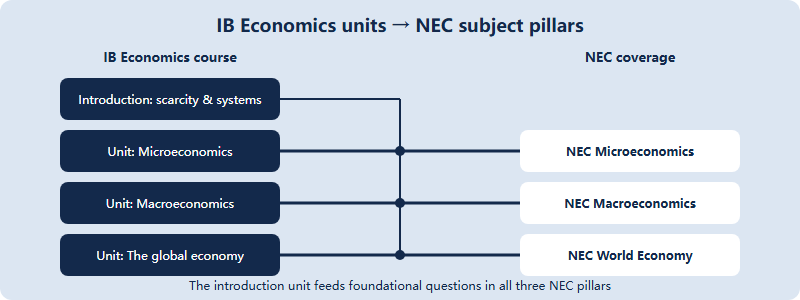
The current IB Economics guide organises the course into an introduction plus three big units — microeconomics, macroeconomics and the global economy — taught through real-world issues. That architecture is strikingly close to NEC’s own three-pillar split. Where AP students take separate micro and macro courses and A-Level students follow a theme sequence, IB students study all three NEC pillars inside a single integrated course. In our CNEC preparation work with China-based international schools, IB candidates typically arrive with the broadest baseline coverage of any curriculum group — their gaps are of depth and speed, not breadth.
Two honesty notes before the mapping. First, IB syllabus details are set by the IB and revised periodically — check the current subject guide your school teaches from. Second, NEC does not publish a fixed topic-weighting table, and formats evolve; confirm the current season’s structure on councilforeconed.org and the official CNEC schedule pages before you build a plan around any of this.
The unit-by-unit map
Here is how the IB course content lines up against what NEC rounds actually ask for:
| IB Economics area | NEC pillar it feeds | Fit | What NEC adds beyond IB treatment |
|---|---|---|---|
| Introduction: scarcity, choice, PPC, economic systems | Foundations used across all three pillars | Strong | Faster recall; definition-level precision under a clock |
| Microeconomics: demand/supply, elasticities, government intervention, market failure, market power | Microeconomics | Strong | More calculation drills (surplus areas, elasticity arithmetic, MR = MC problems) at multiple-choice speed |
| Macroeconomics: AD-AS, unemployment, inflation, growth, monetary and fiscal policy | Macroeconomics | Strong | US institutional framing (the Federal Reserve rather than a generic central bank); money-market and banking mechanics in more computational form |
| The global economy: trade, protectionism, exchange rates, balance of payments, development | World economy | Strong | Current-events awareness and data interpretation on live international questions |
| Internal assessment (commentaries) | Critical Thinking / applied rounds | Partial | The IA’s “apply theory to a news article” habit transfers directly to open-ended prompts — but NEC wants it spoken and fast, not written over weeks |
The four real gaps IB students must close
Gap 1: speed. IB assessment gives you extended time to construct diagrams and evaluate. NEC’s knowledge rounds are rapid-fire. The same student who writes an excellent 800-word IB response can freeze on a 60-second multiple-choice item. The fix is unglamorous: timed drills, weekly, until the standard applications (elasticity arithmetic, AD-AS shock direction, monopoly pricing) run on autopilot. Our round-by-round walkthrough shows which rounds are pure speed and which reward slower reasoning.
Gap 2: US institutional convention. IB deliberately teaches a country-neutral macroeconomics. NEC-style material leans on US framing — the Federal Reserve, its policy tools, US fiscal institutions. None of this is conceptually hard for an IB student; it is vocabulary and institutional detail you must add deliberately rather than assume.
Gap 3: quantitative depth beyond your level. The IB splits some quantitative content by level, with HL students doing more calculation work than SL students. Competition questions do not ask which level you take. SL students in particular should audit the calculation list — surplus areas, index numbers, exchange-rate arithmetic, simple multiplier logic — and backfill anything their level did not drill. HL students have less to backfill but still need the speed layer from Gap 1.
Gap 4: breadth of applied topics. NEC’s applied rounds range across live economic questions — data challenges, open-ended problems, current international developments — that go beyond any school syllabus. IB students actually hold an advantage here: the internal assessment trains exactly the “theory meets news article” reflex these rounds want. The adjustment is format, not skill: practise doing it aloud, in a team, in minutes instead of over a writing cycle.
Timing NEC around the Diploma Programme
The two-year DP has a rhythm — content builds through DP1, internal assessments cluster in the middle, and final exams dominate the end of DP2. NEC’s season also has a rhythm: qualifying stages come earlier in the cycle, with national and global stages later. Exact CNEC season dates change every year, so confirm the current calendar on the official CNEC schedule pages before committing — but the planning logic below holds across years.
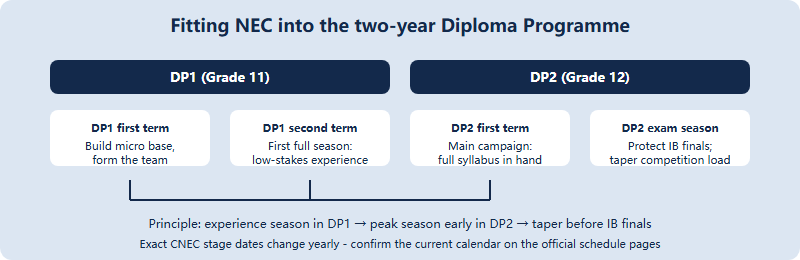
Three planning principles fall out of this timeline:
- Compete once in DP1 if you can. A first season taken as deliberate practice — before university applications and final exams raise the stakes — is the single biggest predictor of a strong second season. Grade 11 IB students have covered enough micro by mid-year to be competitive in an entry or intermediate division.
- Make DP2’s first term your peak. By then you hold the whole IB syllabus, which means all three NEC pillars are at least taught. This is also when a serious team should consider whether the advanced tier fits — see our breakdown of who should attempt the Adam Smith division.
- Never let the competition collide with IB finals. If a given year’s global-stage timing overlaps your May exam session, decide in advance which takes priority. For most students the answer is the Diploma — and an honest plan beats a mid-season crisis.
SL vs HL, and choosing your division
Level and division interact, but not mechanically. HL students carry more quantitative training and an extra layer of theory, which shortens their path to the advanced division. SL students are not locked out of anything — they simply have a slightly longer backfill list, mostly calculations and policy detail. Division choice should follow three variables in order: how much of the syllabus you have actually covered so far, how much weekly preparation time the team can sustain, and how experienced your four members are as a unit. Team-size and division rules are set by the organisers and can change; confirm the current requirements on the official CNEC registration pages rather than assuming.
One final framing point. IB Economics rewards extended written evaluation; NEC rewards fast, precise, team-based application. They are complements, not substitutes — and the combination reads well precisely because the two formats certify different skills. If you are weighing NEC against essay competitions such as the LSESU or HIEEC prizes, that test-versus-essay distinction is the heart of the choice, which we examine in NEC versus the economics essay competitions.
FAQ
Is IB Economics enough on its own to do well at NEC?
It covers most concepts but not the speed, US institutional detail or full calculation depth. Expect several weeks of targeted supplementation on top of coursework.
Can SL students compete, or is HL effectively required?
SL students compete successfully. They mainly need to backfill quantitative drills and some policy detail that HL covers in more depth. No IB level is required by the competition.
When in the IB should I first attempt NEC?
DP1 is the ideal first season: enough micro is in place by mid-year, and the stakes are low. Treat DP2’s first term as your peak campaign, then taper before finals.
Do IB students need a separate textbook for NEC?
Usually a US-convention supplement helps for macro institutions and speed drills, alongside your IB materials. Choose based on your division and gaps rather than buying everything.
Published by the NEC (CNEC) editorial desk, operated by Hanlin Education for China-based international-school students. Official rules are set by the competition organisers and change yearly — confirm current details on councilforeconed.org and the official CNEC pages. Factual errors reported to us are corrected within 7 working days.