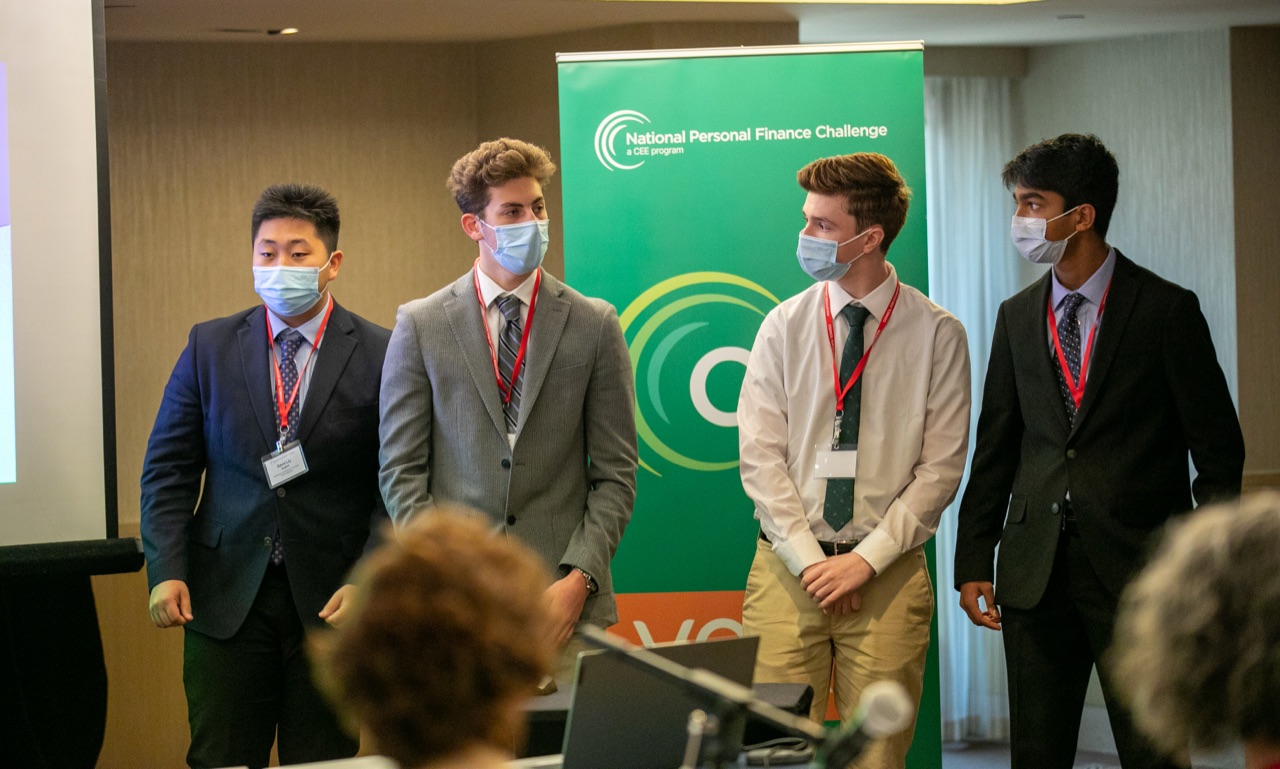
Before any NEC preparation plan matters, you need a team — and for the David Ricardo and Adam Smith divisions that means assembling four committed students, usually with a school advisor behind you. This guide covers the part most preparation articles skip: how to recruit the right teammates at a Chinese international school, how to pitch the competition to your school, and what a new team should actually do in its first four weeks together.
Why team formation decides more than talent
NEC is structured as a team competition. Under the division structure used on the CNEC pathway, the entry-level Pre division has allowed individual or small-group participation, while the David Ricardo and Adam Smith divisions are built around four-person teams — always confirm the current team-size rules for your season on the official CNEC registration pages, since these details are set by the organisers and can change.
That four-person structure has a consequence many first-time captains underestimate: your weakest link is on the scoresheet. NEC’s rounds range from individual knowledge tests to fully collaborative challenges — the Quiz Bowl and Critical Thinking formats we describe in our walkthrough of the NEC rounds all reward teams whose members can operate independently and hand off smoothly. A team of three strong economists and one passenger performs closer to the passenger’s level than captains expect, because the collaborative rounds expose gaps in real time.
The encouraging flip side: a well-chosen, well-run team of solid-but-not-brilliant students routinely outperforms a collection of individually stronger students who never trained together. Team formation is not administrative overhead before the real work. It is the first strategic decision of your season.
The composition to recruit for
Do not recruit four copies of yourself. NEC’s subject split — microeconomics, macroeconomics, world economy — plus its round formats reward a mix of profiles. Here is the composition we see work most often in CNEC-bound school teams:
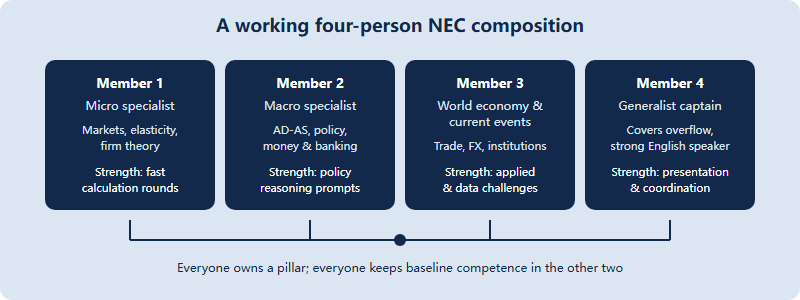
Three recruiting criteria matter more than current economics knowledge:
- Reliability over brilliance. A teammate who attends every session for five months beats a star who drifts away in month two. Ask candidates directly what they will drop to make weekly practice — the answer tells you everything.
- English processing speed. NEC is conducted in English. At a Chinese international school your candidates’ written English is usually fine; what varies is how fast they parse dense question stems aloud under pressure. A short timed reading exercise during tryouts reveals this quickly.
- Complementary temperament. Collaborative rounds need at least one calm decision-maker who can arbitrate when two members disagree with 20 seconds left. If all four of you are debaters, appoint a tie-break rule before you need it.
Getting your school on board
Most Chinese international schools are receptive to academic-competition proposals, but a specific, low-burden pitch succeeds far more often than an enthusiastic vague one. Registration on the CNEC pathway runs through official channels and typically involves a school-side coordinator or advisor — confirm the current registration process, dates and any fees on the official CNEC pages rather than relying on last year’s hearsay, because logistics are updated each season.
Your pitch to a potential advisor (an economics or business teacher is the natural choice) should answer four questions in one page:
| Question the school will ask | What your one-page answer should contain |
|---|---|
| What is this competition? | NEC is a long-running US economics competition organised by the Council for Economic Education; the CNEC pathway is its officially authorised route for students in China, with national-stage results connecting to the global stage. |
| What does the school have to do? | Name an advisor, support registration through the official channels, and provide a weekly practice room. Emphasise the low teacher workload: students run their own preparation. |
| What is the academic value? | Team-based application of the school’s existing economics curriculum (IB/AP/A-Level all map onto it), plus public-speaking and data-analysis practice in the applied rounds. |
| What are the risks and costs? | Be honest: time commitment across the season, plus any registration costs per the official fee schedule — quote the official pages rather than guessing numbers. |
Two practical notes from schools we work with. First, propose a term-length trial rather than a permanent club — schools say yes faster to reversible commitments. Second, if your school already fields teams for other competitions, frame NEC as the economics counterpart to what exists, and be precise that NEC is a test-and-team format rather than an essay prize — the distinction we detail in NEC versus the economics essay competitions is genuinely useful in a staff-room conversation, because teachers often assume all economics competitions are essay contests.
The first four weeks: from four students to one team
New teams waste their first month in one of two ways: pure socialising with no measurement, or premature grinding on advanced content before anyone knows the baseline. Run this sequence instead:
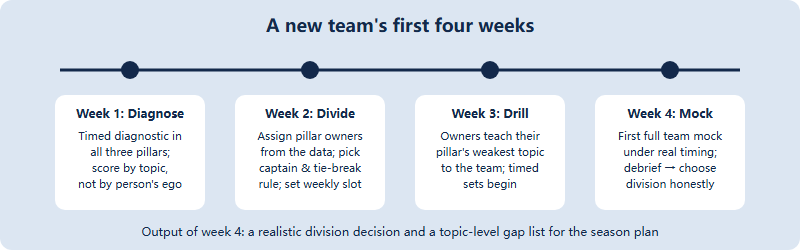
The week-4 output matters most: an honest division decision. New teams overreach. If your diagnostic and first mock say the team is not ready for the advanced tier, enter the level you can genuinely compete at and treat the season as a build year — the step-up logic, and who the top tier actually suits, is exactly what we cover in our Adam Smith division breakdown. A strong result in the right division teaches your team more, and reads better, than a bruising outing in the wrong one.
Common formation mistakes we see every season
- Recruiting on friendship alone. Friends make great teams when the reliability and skill-mix boxes are also ticked. When they are not, nobody wants to be the one who says so in February.
- Skipping the advisor. Teams that treat the school as a formality discover late that registration, scheduling and travel approvals all run smoother with an engaged teacher. Bring your advisor in during formation, not at the deadline.
- No exit ramp. Agree upfront what happens if someone needs to step back — a named substitute or an understudy who trains with the team. Four-person divisions leave no slack for a mid-season vacancy, and substitution rules are governed by the official regulations, so know them early.
- All content, no format. Teams that only study economics and never rehearse the round formats get outscored by teams that trained the handoffs. Format practice is not optional garnish; in the collaborative rounds it is the difference.
FAQ
How many people do I need for an NEC team?
The David Ricardo and Adam Smith divisions are built around four-person teams; entry-level participation has allowed smaller groups. Confirm current team-size rules on the official CNEC pages.
Do we need a teacher advisor?
Practically yes: registration on the CNEC pathway runs through school-side coordination, and an engaged advisor smooths scheduling and approvals. An economics teacher is the natural fit.
Can students from different grades form one team?
Division eligibility rules are set by the organisers and depend on the season’s regulations. Check the current grade and division criteria on the official pages before finalising your roster.
What if we can only find three committed people?
Recruit a fourth as an understudy while you train as three, and check which division options fit smaller rosters in the current rules. Do not carry a passenger just to reach four.
Published by the NEC (CNEC) editorial desk, operated by Hanlin Education for China-based international-school students. Official rules are set by the competition organisers and change yearly — confirm current details on councilforeconed.org and the official CNEC pages. Factual errors reported to us are corrected within 7 working days.