
The David Ricardo division is the National Economics Challenge (NEC) track built for students who are new to economics — specifically, first-time competitors who have taken no more than one economics course. Run by the Council for Economic Education, it lets beginners compete on fair footing instead of against seasoned Advanced Placement or IB students. This guide explains who qualifies, what a season looks like, and how first-timers can prepare well.
What the David Ricardo division is — and who it is for
Named after the classical economist David Ricardo, this division exists to solve a simple fairness problem: a student in their first economics class should not have to buzz against a competitor who has already sat two years of Advanced Placement macro and micro. The Council for Economic Education therefore reserves David Ricardo for students competing in the NEC for the first time who have taken no more than one economics course. If that describes you, this is almost certainly your entry point.
The subject matter is the same economics that runs through the whole competition — microeconomics, macroeconomics, and the world economy — but the expectation is that you are building these ideas from the ground up rather than reviewing them. As the team that operates the officially authorised China National Economics Challenge (CNEC) test centre, we see the same pattern every season: the students who thrive in David Ricardo are not the ones who already knew the most, but the ones who started early, studied consistently, and were honest about what they did not yet understand.
One caution before you register: eligibility categories and their exact wording are set by the organiser and can change from season to season. Treat the description above as the working definition, and confirm the current eligibility rules on the official CNEC pages before you lock in a division.
A word on the one-course rule, because it trips people up. It exists to keep the field level, not to police you: the point is that David Ricardo is for students who are genuinely early in their economics journey. If you have sat only your school’s introductory course, or taught yourself the basics from a textbook, you are squarely the intended competitor. If you have already completed Advanced Placement or IB economics, that experience belongs in a higher division. When in doubt, be honest with yourself and check the official wording — entering the division that matches your real experience is both the fair choice and the one most likely to end well.
David Ricardo, Adam Smith or Pre: choosing your division
NEC is organised into divisions so that students compete against peers at a similar stage. Beyond David Ricardo, the Adam Smith division is designed for advanced students — those in Advanced Placement, IB or honours economics — and for returning competitors, while a Pre-level track offers a gentler, foundational entry point in seasons and regions where it runs. The right choice is the honest one: pick the division your experience actually matches, not the one that sounds most impressive.
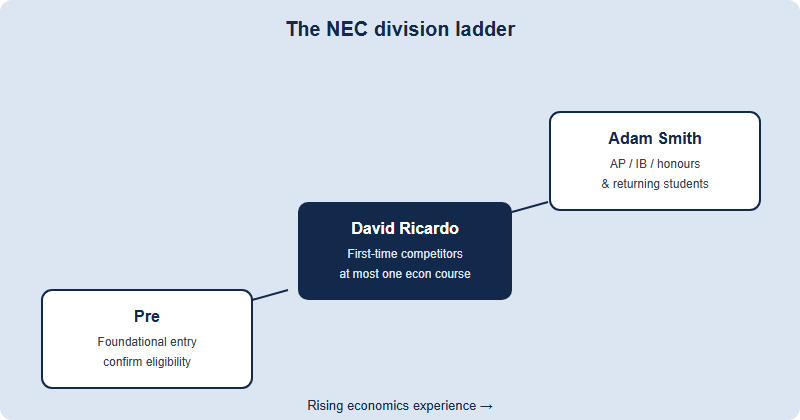
| Division | Best for | Prior economics | Typical students |
|---|---|---|---|
| Pre | Younger or brand-new students easing in | None expected | Early high school (confirm eligibility) |
| David Ricardo | First-time NEC competitors new to economics | No more than one economics course | Students in or just after a first econ class |
| Adam Smith | Advanced and returning competitors | AP / IB / honours or prior NEC | Experienced economics students |
If you are torn between David Ricardo and Adam Smith, read our guide to the Adam Smith division to see the step up in expectation. Most first-timers should start in David Ricardo, do well, and graduate into Adam Smith in a later season once they have real competition experience behind them.
What a David Ricardo season actually looks like
Whichever division you enter, NEC is a team competition with a written test at its core and a set of live, collaborative rounds beyond it. Across the season you will meet a written Qualifying Test that anchors your knowledge, and then the live rounds the 2027 outline lists — Critical Thinking and the Quiz Bowl, with the OX-BP Debate Sessions and U20 Youth Voice at the global round — that reward speed, applied reasoning and teamwork. We break each of these down in our round-by-round explainer of the NEC rounds; the important point for a first-timer is that content mastery and calm teamwork both matter.
Teams are supported by coaches — the Council for Economic Education describes local teams working with instructors and economics professionals — so you are not expected to figure everything out alone. Exact team sizes, the number of rounds you will face, and the season calendar are set by the organiser and differ between the United States programme and the China National Economics Challenge, so confirm the current structure and dates for your season on the official CNEC pages rather than assuming they match another year or country.
It helps to picture the season as an arc rather than a single event. Early on, the emphasis is on building and testing knowledge; as you advance, the live rounds ask you to apply that knowledge faster and as a group. The coach relationship is what makes this manageable for beginners. A good coach does not hand you answers — they help you spot gaps, structure your revision, and rehearse the team rounds so nothing on the day is a surprise. First-timers who treat their coach as a study partner, arriving with specific questions rather than waiting to be taught, tend to improve fastest. That habit, more than raw talent, is what we see behind most strong David Ricardo runs.
How first-timers prepare: a beginner’s roadmap
The good news is that David Ricardo rewards structured beginners. You do not need obscure knowledge; you need the fundamentals held firmly and recalled quickly. The roadmap below is the sequence we most often see working for students new to economics.
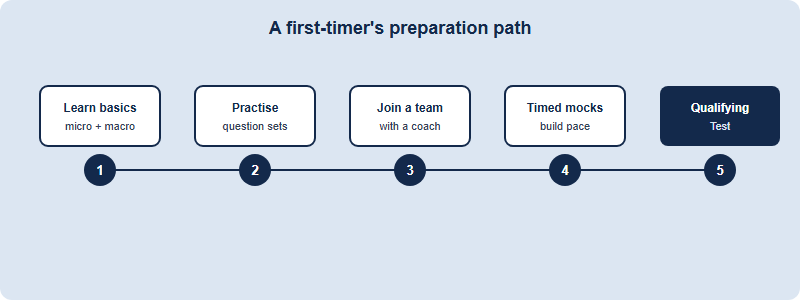
In practical terms: spend your first weeks getting the vocabulary and core models straight — supply and demand, opportunity cost, GDP, inflation, and how policy moves an economy. Then shift from reading to doing: work through practice questions until the basics feel automatic. Only after that does speed training pay off, because you cannot answer quickly what you do not yet understand. Finish with timed mock rounds so that the pace of the real test feels familiar rather than alarming.
How much time does this take? For a genuine beginner, a few focused hours a week over a couple of months is a realistic baseline, with more in the weeks before the Qualifying Test. You do not need expensive materials to start: a solid introductory economics textbook, a notebook for the core models, and a steady supply of practice questions will carry you a long way. Add your school economics teacher or a coach for feedback, and you have everything a David Ricardo competitor needs. The common mistake is not having too few resources — it is starting too late, when there is no longer time to turn reading into fast, reliable recall.
Five first-timer mistakes to avoid
- Registering for the wrong division to look impressive. Entering Adam Smith when you qualify for David Ricardo usually means being outmatched. Compete where your experience fits and win, then move up.
- Reading notes instead of testing yourself. Passive re-reading feels productive but fades fast. Self-quizzing and past-style questions are what make knowledge stick.
- Ignoring the world-economy pillar. Beginners often over-invest in micro and neglect international topics. NEC tests all three pillars, so cover trade and exchange rates too.
- Never rehearsing as a team. The live rounds reward coordination. A team that has practised together signals and recovers far better under pressure.
- Assuming last year’s dates and rules. Deadlines, fees and formats are set each season. Confirm the current details officially rather than trusting an old blog post or a friend’s memory.
Handled well, a David Ricardo season is one of the best first steps a Chinese international-school student can take into competitive economics: it is fair, it is genuinely educational, and it sets up a stronger run in the Adam Smith division later. If you are still weighing whether a test-and-team competition suits you at all, our comparison of NEC and the major economics essay prizes lays out the difference in what each rewards.
Frequently asked questions
Who can enter the David Ricardo division?
Students competing in the NEC for the first time who have taken no more than one economics course. Confirm the current eligibility for your season on the official CNEC pages.
Can I move up to Adam Smith later?
Yes. The Adam Smith division is designed for advanced and returning competitors, so David Ricardo is a natural first step before you progress.
Do I need to finish an economics course before entering?
No. David Ricardo is built for newcomers; a first course or self-study of the basics is enough to start preparing meaningfully.
Is David Ricardo a team event?
NEC is played in teams, and coaches support each squad. Confirm the exact team-size rule for your division and season on the official pages.
Published by the NEC (CNEC) editorial desk, operated by Hanlin Education for China-based international-school students; official rules are set by the competition and change yearly — confirm current details on councilforeconed.org; corrected within 7 working days.