
Quiz Bowl is the fast, head-to-head round of the National Economics Challenge (NEC), where teams answer rapid economics questions and speed matters almost as much as knowledge. It is one of the rounds the organiser lists for 2027, and it rewards instant recall, broad coverage across the pillars, and disciplined teamwork. This guide explains, in general terms, how Quiz Bowl fits the NEC finals and gives a concrete training plan; confirm the exact format and scoring each season on the official pages.
Where Quiz Bowl sits among the seven NEC rounds
The National Economics Challenge, run by the Council for Economic Education, is far more than a single exam. Its season pairs a written Qualifying Test with live rounds — Critical Thinking and the Quiz Bowl, with the OX-BP Debate Sessions and U20 Youth Voice at the global round — each testing a different skill. We walk through all of them in our round-by-round explainer of the NEC rounds. Quiz Bowl is the one most students remember, because it is the most visibly competitive: two teams, a stream of questions, and very little time to think.
That format changes what preparation looks like. For the written test you can afford to reason slowly and check your logic. In Quiz Bowl, the answer either surfaces in a couple of seconds or the moment passes. As the team operating the officially authorised China National Economics Challenge (CNEC) test centre, we consistently see that Quiz Bowl separates squads not by who knows the most economics, but by who can retrieve what they know fastest and coordinate cleanly under pressure.
What Quiz Bowl demands: speed, breadth and nerve
Three qualities decide Quiz Bowl performance, and they are trainable. Speed is automatic recall — definitions, formulas and cause-and-effect chains that come to mind without deliberation. Breadth is coverage across all three pillars, because you cannot choose the topic and a single blind spot can cost a run of points. Nerve is the composure to buzz when you are sure and hold when you are not, rather than panicking into a wrong answer.
It helps to know, in general terms, the kinds of prompts that reward fast recall. Definitional questions ask you to name a concept from its description; numerical ones ask for a quick calculation or the direction of an effect; and application questions describe a short scenario and ask what follows. You will not know in advance which pillar a question comes from, which is exactly why breadth matters: a team strong in macro but shaky on international trade will stall the moment a world-economy prompt lands. Rather than trying to be equally fast at everything, most teams pair broad coverage from everyone with a designated specialist for each pillar, so there is always one member whose instinct fires first.
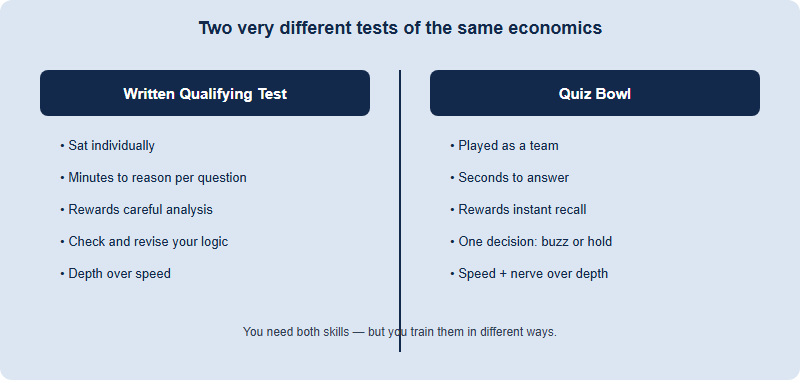
Notice what this means for the essay-style competitions students sometimes weigh NEC against. In an economics essay prize you are rewarded for slow, original, written argument; Quiz Bowl rewards the opposite reflexes. If you enjoy the pressure of fast recall, that is a genuine reason to lean toward NEC.
A four-week Quiz Bowl training plan
You cannot cram reflexes the night before. The plan below builds speed on top of knowledge over four focused weeks. It assumes you already have a working grasp of the fundamentals; if not, secure those first, because speed drills on shaky content simply make you fast at being wrong.
| Week | Focus | Drills | Team target |
|---|---|---|---|
| 1 | Automatic recall of core terms | Flashcards; 30 rapid-fire terms a day across the pillars | Answer core definitions in under three seconds |
| 2 | Coverage with no blind spots | Rotate micro, macro and world-economy sets each session | Every pillar covered by at least one strong member |
| 3 | Buzzer discipline | Timed head-to-head practice with a partner or coach | Buzz only when confident; cut careless wrong buzzes |
| 4 | Full simulation | Run complete Quiz Bowl-style rounds end to end | Consistent scoring and clear, silent team signals |
A useful rule during week one and two: if a term takes you longer than a breath to recall, it goes back on the flashcard pile. The goal is not to know a definition eventually, but to know it instantly. By weeks three and four the bottleneck shifts from knowledge to decision-making, which is where buzzer discipline earns its place.
Keep the sessions short and frequent rather than long and rare. Fifteen focused minutes of rapid-fire recall every day beats a single two-hour cram, because speed is built by repetition, not by marathon effort. If your team can meet only weekly, assign daily solo drills between meetings and reserve your time together for the head-to-head practice that a group is actually needed for. Treat attendance like training for a sport: consistency compounds, and the team that drills a little every day will out-pace one that relies on last-minute intensity every time.
Buzzer discipline and team signals
The single most common way strong teams lose Quiz Bowl points is buzzing on hope. A confident, correct buzz scores; a rushed, wrong buzz can hand the moment — and potentially points — to the other side. Because penalty and scoring rules differ by season, confirm them officially; but whatever the rules, a team that decides in advance who covers which topic will out-buzz a team of four soloists guessing over one another.
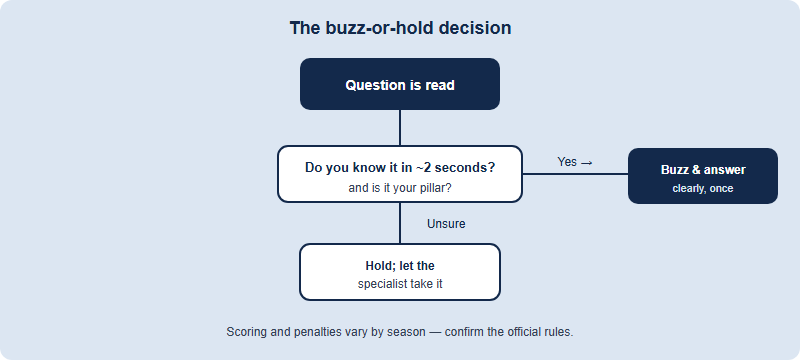
Agree your signals before the round, not during it. Many teams assign a quiet cue — a hand on the table, eye contact with the captain — so that when two members both think they know the answer, one defers instantly instead of both talking over the buzz. Advanced squads in the Adam Smith division face faster, deeper questions, so this coordination matters even more the higher you climb.
The mental side is easy to underrate. Quiz Bowl compresses decisions into seconds, and the emotion that follows a wrong buzz — the embarrassment, the urge to redeem it immediately — is precisely what produces a second mistake. The teams that hold their nerve treat every question as independent: the last one is gone, the next one is all that exists. Building that reset into practice, so it fires automatically under real pressure, is as much a part of preparation as any flashcard.
How to run realistic Quiz Bowl mocks
Training only transfers if your practice looks like the real thing. Build mocks that reproduce the pressure, not just the content:
- Use a real clock and a real buzzer substitute. Even a shared keyboard key or a bell forces the buzz-or-hold decision that flashcards alone never train.
- Play head-to-head. Answering into empty air is easy; answering when another team might beat you is the skill you actually need.
- Mix the pillars unpredictably. Do not group all the macro questions together. Randomising topics trains the team to switch specialists on the fly.
- Debrief every mock. Log which questions you missed on speed versus knowledge. Speed misses need more drills; knowledge misses send you back to the notes.
- Rehearse recovery. After a wrong buzz, the next question is the one that matters. Practise resetting quickly so one mistake does not become three.
One more habit separates teams that peak on the day from teams that only peak in practice: rotate who leads. If the same person always answers first in mocks, the group never learns to cover for a quiet round from its strongest member. Deliberately run sessions where your usual anchor sits back, so every member has felt the pressure of carrying a stretch of questions. Then, when the real round comes and someone freezes for thirty seconds, a team that has practised this way simply picks up the slack instead of unravelling.
Done consistently, this turns Quiz Bowl from the round students fear into the round they look forward to. Speed, breadth and nerve are not fixed talents — they are habits, and four weeks of deliberate practice is enough to make real, visible progress before the season’s live rounds.
Frequently asked questions
Is Quiz Bowl one of the NEC rounds?
Yes. Quiz Bowl is one of the rounds the organiser lists for 2027 and is known for its fast, head-to-head team format. See our round-by-round guide for how the rounds connect.
How is Quiz Bowl different from the written test?
The written Qualifying Test rewards careful analysis; Quiz Bowl rewards instant recall and speed. You need both, but you train them differently.
How do I get faster at Quiz Bowl?
Drill core terms daily until recall is automatic, then practise timed head-to-head rounds so speed and buzzer discipline become habits.
Does a wrong answer cost points in Quiz Bowl?
Scoring and penalty rules are set each season by the organiser. Buzz when confident and confirm the current scoring on the official pages.
Published by the NEC (CNEC) editorial desk, operated by Hanlin Education for China-based international-school students; official rules are set by the competition and change yearly — confirm current details on councilforeconed.org; corrected within 7 working days.