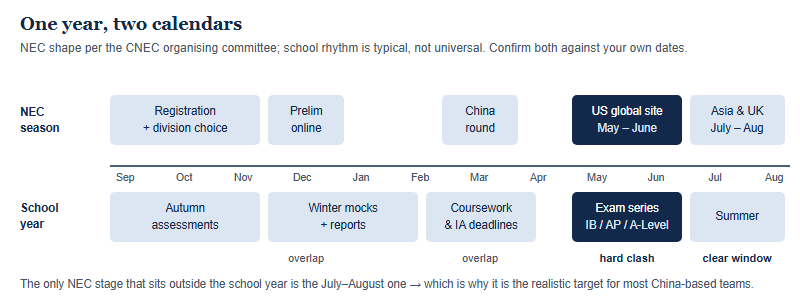
Three of the four NEC stages land on or beside a school pressure point. Registration runs September to November, the preliminary round falls mid-to-late December, the China round is in March, and the global sites sit in the US in May–June and in Asia and the UK in July–August. Planning a season is not about finding free time. It is about choosing which collisions you accept.
The two calendars, laid over each other
Students plan NEC as though the season were the only calendar in play. It never is. Every international curriculum in China runs on a broadly similar rhythm: autumn assessments, a winter mock series, a February-to-April coursework crunch, and a May–June external examination series. The NEC season slots into the same twelve months, and the overlaps are not evenly distributed — one of them is severe, two are manageable, and one window is genuinely clear.
December: the preliminary round meets mock season
The preliminary is an online test in mid-to-late December, which is the same fortnight most international schools use for winter mocks or end-of-semester assessments. The good news is that this is the mildest of the three collisions, for a reason worth understanding: the preliminary tests the same core economics your school is already assessing.
CEE’s published rules for its own 2026 Online National Semi-Finals describe the shape of a written NEC round clearly: 45 minutes for 45 four-option multiple-choice questions, with content covering microeconomics, macroeconomics and international economics, and with “books, notes, calculators or other support materials including but not limited to searching the internet” not allowed. Whatever your own round’s format turns out to be — formats are set by the competition and change yearly — that is revision-shaped work, not project-shaped work. It stacks with mock preparation instead of competing with it.
The practical consequence is that December is the wrong month to start and the right month to peak. If your economics revision for mocks begins in late November, the preliminary is close to free. If NEC preparation begins in December from a standing start, you have created a second syllabus during your busiest fortnight.
March: the China round meets the coursework crunch
March is a real collision, and it is different in kind from December. The China round is a live, in-person, team event, and the school pressure it meets is not revision but deadlines: IB internal assessments and extended essays, A-Level coursework, AP practice-exam season beginning, and — for Year 12 — the first serious wave of university-application preparation.
Deadlines and events collide badly because neither can be moved. A mock can be revised for in compressed time; an IA due on a Friday cannot be part-submitted. This is where teams lose members, and in our own coaching it is the most common reason a December success does not convert into a March appearance.
Two things reduce the damage. First, find out your school’s February and March internal deadlines before you commit to a team in the autumn, and tell your teammates what yours are. Second, understand that the live rounds are rehearsal-based rather than knowledge-based — the reasoning is trained, then performed under a clock. Our walkthrough of the rounds sets out which stages demand rehearsal time and which only demand revision, which is exactly the information you need to budget March honestly.
May to August: two global stops with completely different costs
This is the decision most families get wrong, because “global round” sounds like one thing and is in fact two very differently priced options in your calendar.
| Stop | Window | What it collides with | Who it realistically suits | Hidden costs |
|---|---|---|---|---|
| US site | May – June | The IB, AP and A-Level examination series, which all run across May and June | Students not sitting external exams that session, or in a year group below the exam years | Long-haul travel and visa lead time during exam term; confirmation deadlines land while you are revising |
| Asia site | July – August | Summer programmes and family travel only | Most China-based students, including exam-year students who have just finished | Competes with summer research or internship plans; shortest flights of the three |
| UK site | July – August | Summer programmes and family travel only | Students already travelling to the UK, or targeting UK universities | Visa lead time; accommodation costs in peak season |
Global-site windows per the CNEC organising committee's 2026–27 briefing, following last season's pattern. Confirm the current season's stops, dates and routing officially before booking anything.
The May–June window deserves emphasis because the clash is total rather than partial. IB, AP and A-Level candidates all sit their main external series across those weeks; a Year 12 or Year 13 student cannot treat a competition trip in that window as spare time, and no amount of planning makes an exam moveable. For a data point on how tight that window is in practice: CEE’s rules place its own 2026 US National Finals in Atlanta on 27–29 May 2026, squarely inside the examination series.
The same CEE document is a useful warning about hidden micro-deadlines. It states that teams advancing to those 2026 National Finals “will be announced no later than April 28th, 2026, and must confirm their commitment to participate at National Finals, by an online registration form on May 1st, 2026 by 11:59 pm ET.” A three-day confirmation window that falls at the start of exam season is the kind of thing families discover too late. CEE also notes that it covers lodging and group meals for finals teams but “will not cover the cost of travel.” Those are CEE’s rules for its US competition and are reset yearly; treat them as a model of the kind of deadline to look for in your own route, not as your route.
The July–August stops are the structural answer for most China-based students, and that is not a consolation. It is the one window in the twelve months where a competition can have your full attention.
Choose the stop before you choose the workload
The single most useful reframe is this: you are not preparing for “NEC”. You are preparing to arrive at one specific stage in good condition, and every earlier stage is a qualification for it. Deciding which stage that is — in September, before you register — makes every subsequent workload question answerable.
Three worked cases:
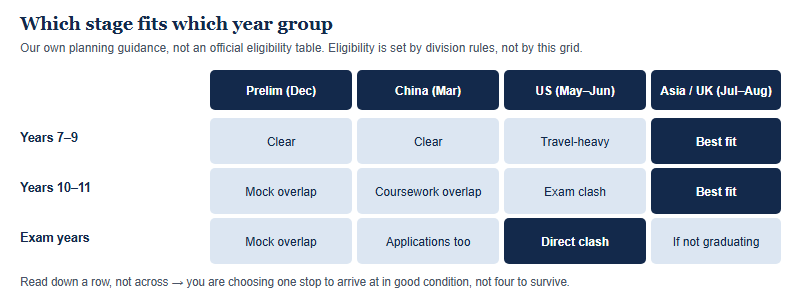
- A Year 8 student in the Pre division. Target: the July–August stop. Nothing in the school year genuinely blocks the route, so the constraint is content coverage rather than time. Work steadily from October and treat December as a checkpoint.
- A Year 11 student in David Ricardo. Target: the China round in March, and the summer stop if it comes. The binding constraint is February–March coursework. Front-load: heavy preparation October to December while the term is lighter, maintenance only from February.
- A Year 12 student in Adam Smith. Target: honestly assess whether a May–June stop is compatible with your exam session — usually it is not. Plan the season as December plus March, and be at peace with that. The Adam Smith content load is the heaviest of the entry divisions, and pairing it with an exam year is a genuine workload decision rather than a formality.
For calibration rather than promise: our own cohort competed at the 2026 Asia global site, with a de-identified tally of team golds, a team silver and team bronzes, plus a first place globally on an individual component. That is our own count, per Hanlin, not a CEE statistic, and results vary between cohorts and seasons. The relevant point here is structural, not competitive — the summer stop is the one many China-based students can actually attend without trading it against an examination.
When the calendar genuinely does not work
Sometimes the honest answer is that this is not your year. A Year 13 student sitting five subjects in the May series, writing applications in the autumn, and carrying an extended essay in the spring is not being lazy by declining a team commitment that peaks in March.
If that is you, the choice is not between NEC and nothing. It is between a fixed-date team competition and a format whose deadline you can position yourself. Economics essay prizes are individual, asynchronous, and written to a submission date rather than an event — a completely different shape of commitment for the same academic interest. We set the two side by side in our comparison of test-and-team versus the essay prizes.
And if it is your year, do the boring thing first: put both calendars on one page in September. Almost every avoidable NEC casualty we see is a student who planned the season without ever looking at their own school’s March.
Questions students and parents ask about timing
When does the 2026-27 NEC season actually run?
Per the CNEC organising committee: registration September to November, preliminary mid-to-late December, China round March, global sites May–August. Confirm officially.
Does the May–June stop clash with IB and AP exams?
Yes. IB, AP and A-Level all run their main external series across May and June, so exam-year students face a direct conflict.
Which stage is hardest to fit into a school term?
The March China round. It is a live team event landing beside coursework and internal-assessment deadlines, which cannot be compressed.
Is the December preliminary a heavy commitment?
Less than students expect. It is a timed written round on core economics, so it stacks with winter mock revision rather than competing with it.
Published by the NEC (CNEC) editorial desk, operated by Hanlin Education for China-based international-school students. Official rules are set by the competition and change yearly — confirm current details on councilforeconed.org and through the official CNEC channels. Errors are corrected within 7 working days.