Market-failure questions rarely ask you to define a term. They hand you a scenario — a fishery, a vaccine, a rent cap — and expect you to classify it and predict what happens next. The whole block reduces to four diagnostic questions: is the good rival, is it excludable, does a third party bear a cost or benefit outside the price, and is the price free to move. Get the classification right and the answer follows mechanically.
This is one of the highest-yield micro blocks precisely because it is compressible. Below is the diagnostic sequence, the two diagrams that carry most of it, and the traps that turn a student who understands the economics into a student who picks the wrong option under time pressure.
The diagnosis habit: classify before you calculate
Strong candidates do not read a market-failure scenario looking for a formula. They read it looking for a category, because the category determines the intervention and the intervention is usually what the question is really testing. Five categories cover almost everything you will meet.
| Failure | The tell in the scenario | What goes wrong | Standard interventions | The trap |
|---|---|---|---|---|
| Negative externality | A named third party bears a cost that appears in nobody’s price | Social cost exceeds private cost, so the market over-produces or over-consumes | Tax, regulation, tradable permits, assigning property rights | Assuming the answer is always a tax. Permits and regulation are on the menu, and a tax needs a measurable base |
| Positive externality | Benefits spill onto people who did not pay — vaccination, schooling, research | Social benefit exceeds private benefit, so the market under-provides | Subsidy, public provision, patents and grants for research | Reading “under-provision” as “the market failed to exist”. It exists; it is simply too small |
| Public good | Non-rival and non-excludable — street lighting, flood defence, national defence | Free-riding: nobody will pay for what they cannot be excluded from | Government provision funded by taxation | Calling anything government-funded a public good. State-run hospitals are rival and excludable |
| Common resource | Rival but non-excludable — ocean fisheries, congested roads, shared aquifers | Over-use, because each user ignores the cost imposed on the rest | Quotas, licences, congestion charges, defined property rights | Confusing it with a public good. The difference is rivalry, not ownership |
| Information asymmetry | One side knows something the other cannot verify — used cars, insurance | Adverse selection before the deal, moral hazard after it | Disclosure rules, warranties, licensing, screening and signalling | Mixing the two: adverse selection is hidden characteristics, moral hazard is hidden behaviour |
Two disciplines make this table usable at speed. First, name the third party out loud — if you cannot say who bears the uncompensated cost, you are probably not looking at an externality at all. Second, decide whether the spillover attaches to production or consumption, because that determines which curve moves in the diagram and therefore which way the welfare loss points.
The goods matrix, and the mistake almost everyone makes
Rivalry and excludability are independent properties, and crossing them gives four categories rather than the two most students carry in their heads. A good is rival if one person’s use reduces what is left for everyone else. It is excludable if a supplier can practically stop non-payers from consuming it.
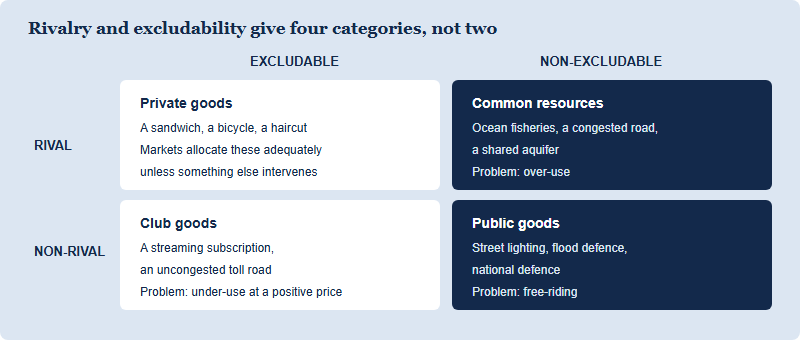
The mistake is the one flagged in the table: treating “public good” as a synonym for “something the state pays for”. A public hospital bed is rival, because one patient occupying it excludes another, and it is excludable, because admission can be refused. It is a publicly funded private good. Meanwhile a privately built flood barrier protecting a whole coastline is a public good regardless of who paid. Definitions run on the properties of the good, never on the identity of the payer.
Externalities: read them as a gap, not as a word
An externality is a gap between private and social valuations, and every question about one is asking you to locate the gap and read its direction. There are four cases, and it is worth being able to produce an example of each without hesitating.
- Negative production externality. A plant discharges into a river. Marginal social cost sits above marginal private cost, so the free-market quantity exceeds the social optimum: the market over-produces, and the welfare loss sits on the units produced beyond the optimum.
- Positive production externality. A firm’s research spills into its industry. Social cost sits below private cost, so output is below the optimum.
- Negative consumption externality. Congestion, or noise from late-night venues. Marginal social benefit sits below marginal private benefit, so consumption is above the optimum.
- Positive consumption externality. Vaccination and schooling are the standard cases. Social benefit exceeds private benefit, so consumption is below the optimum — the classic justification for subsidy or public provision.
Once you have named the case, the intervention menu is wider than most students assume. Taxes and subsidies are the familiar tools, and we treat tax incidence and welfare wedges as a topic in their own right elsewhere on this site. But regulation sets a quantity directly; tradable permits set the quantity and let the market discover the price of abatement; and where property rights are well defined and bargaining is cheap, the parties may internalise the externality themselves without any state action at all — the insight associated with Coase. Adam Smith division candidates should expect to be pushed on why a permit scheme might beat a tax when the regulator knows the target quantity but not the abatement cost. Our guide to what the Adam Smith division demands sets out the depth expected in the advanced track.
Price controls: binding is the only word that matters
Price-control questions are the fastest marks in this block and the most reliably dropped, because students answer the question they expected rather than the one printed. The sequence is always the same: locate the controlled price relative to equilibrium, and only then read off the gap between quantity demanded and quantity supplied.
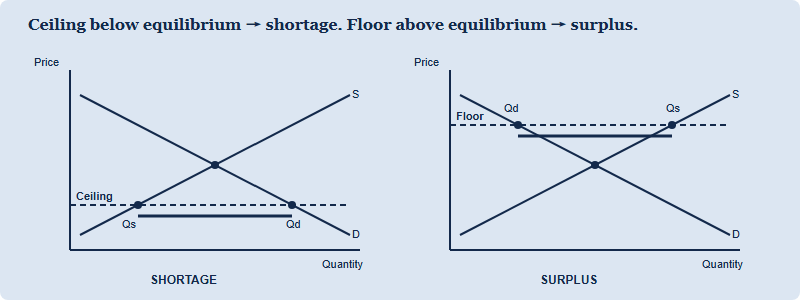
Two consequences follow from a binding ceiling that examiners like because they are not visible in the diagram. Rationing has to happen by something other than price, so you get queues, waiting lists, allocation by relationship, and secondary markets. And because the controlled price squeezes the return on supply, quality tends to erode over time — the standard illustration is maintenance in a rent-controlled housing stock.
On the floor side, the minimum wage is the recurring case, and it is worth carrying the nuance rather than the slogan. In a competitive labour market, a binding minimum wage produces excess supply of labour in the covered sector. Where a single large employer has wage-setting power — a monopsony — a minimum wage set within the right range can raise both the wage and employment, because it removes the employer’s incentive to restrict hiring in order to hold wages down. A candidate who can state both cases, and say which assumption separates them, is doing exactly what the advanced material rewards.
The traps that cost marks under time pressure
- Non-binding controls. A ceiling above the equilibrium price changes nothing. This is the single most common deliberate distractor in the whole topic.
- “Market failure” read as market collapse. It means the allocation is inefficient, not that trade has stopped. Under-provision is still provision.
- Forgetting government failure. Intervention carries information costs, administrative costs and unintended consequences. Scenario questions frequently want the qualification, not the enthusiasm.
- Merit goods confused with public goods. Education and healthcare are usually rival and excludable; the argument for intervening is positive externalities plus imperfect information, not non-excludability.
- Free-riding confused with the tragedy of the commons. Free-riding is a failure of excludability; over-use is a failure that needs rivalry as well. Both are non-excludable, only one is rival.
- Jumping to a tax. Ask whether the externality can even be measured. If it cannot, a quantity instrument or a regulation is often the more defensible answer.
Where this block actually shows up across the rounds
The Qualifying Test is the round that decides your December, and the organiser describes it as principally objective questions covering microeconomics, macroeconomics and international economics. Topic-level weightings are not published, so treat any percentage you see quoted for market failure with suspicion and confirm the syllabus scope on the official channels rather than from a revision list.
The team rounds use this material differently, and knowing which is which changes how you rehearse it. At the China national round, Critical Thinking is a case your team researches and writes up before defending it to judges; at the global round the same round name covers a timed closed-book policy analysis, also ending in a defence. Market-failure framing is the workhorse in both, because most policy cases reduce to identifying the failure and arguing about the instrument. The Quiz Bowl, by contrast, rewards recall speed: the four goods categories and the four externality cases need to be automatic, not reconstructed. Our stage-by-stage guide to the 2027 rounds sets out which round appears at which stage.
It is worth noting what this format is not. NEC rewards fast, correct classification and a defensible instrument choice under time constraints — it does not reward the extended single argument that wins an economics essay prize, which is a genuinely different skill on a different calendar. We set out that contrast in our comparison of NEC against the essay competitions. If you are preparing for both in one year, prepare this block twice, in two different registers.
Frequently asked questions
What makes something a public good?
It must be both non-rival and non-excludable. Who funds it is irrelevant — state-funded hospital beds are rival and excludable, so they are private goods.
Why does a price ceiling sometimes do nothing?
Because it is non-binding. A ceiling set above the equilibrium price leaves the market clearing exactly where it already was.
Is a tax always the right answer to a negative externality?
No. Regulation, tradable permits and clearer property rights are alternatives, and a tax needs a measurable base to work.
How much of the Qualifying Test covers market failure?
Topic weightings are not published. The organiser describes the paper as covering micro, macro and international economics; confirm scope officially.
Published by the NEC (CNEC) editorial desk, operated by Hanlin Education for China-based international-school students. Official rules are set by the competition and change yearly — confirm current details on councilforeconed.org and through the official CNEC channels. Errors are corrected within 7 working days.