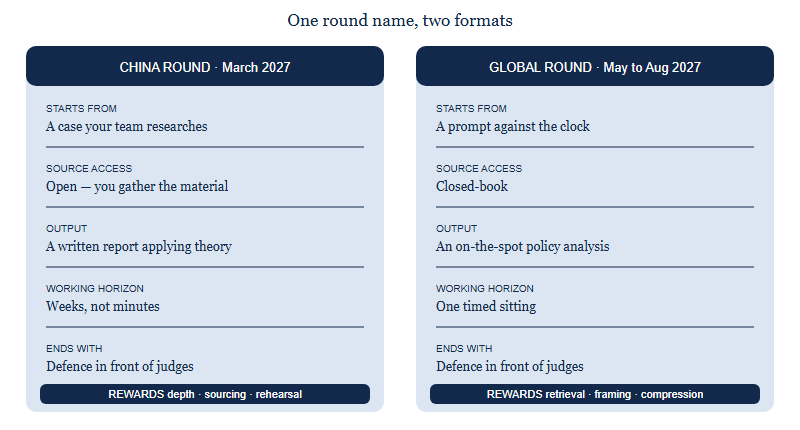
Critical Thinking appears twice in the 2027 outline — once at the China national round in March, once at the global round in the summer — and the two are different formats sharing a name. At the China round your team researches a case, gathers its own material and writes a report. At the global round it is a timed, closed-book policy analysis. Both end in a defence in front of judges. Preparing thoroughly for one does not prepare you for the other.
Almost every team we see plans for the first version and assumes the second is the same thing with a tighter deadline. It is not. Open research and closed-book analysis are close to opposite disciplines: one rewards how well you can find, filter and organise material over weeks; the other rewards what you can retrieve and compress from your own head in a single sitting. This piece sets out what the outline says about each, and what changes in your preparation between March and July.
What the 2027 outline actually says
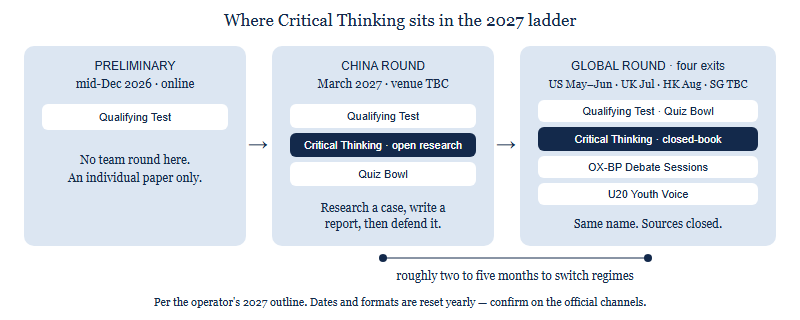
Start with placement, because it disposes of the most common misconception. The 2027 programme lists five rounds, and Critical Thinking is not one of the things that happens in December. The preliminary in mid-December is an individual written paper — the Qualifying Test. Critical Thinking first appears at the China national round in March 2027, and returns at the global round. Our stage-by-stage guide to the 2027 rounds sets out the full matrix of which round runs where.
The outline then describes the round in two clauses that most readers skim past. At the China round, the team works from a case, gathers its own material and applies economic theory to produce a report. At the global round, the same round name covers a timed closed-book policy analysis. In both, the team finishes by presenting and answering judges’ questions.
| Dimension | China national round — March 2027 | Global round — May to August 2027 |
|---|---|---|
| You start from | A case your team researches | A prompt released against the clock |
| Source access | Open — you gather your own material | Closed-book |
| Working horizon | Long enough to research, draft and revise | A single timed sitting |
| Primary artefact | A written report applying theory to the case | An on-the-spot policy analysis |
| What can be divided | Research, drafting, checking, rehearsal — genuinely parallel work | Only the live sitting itself, under one clock |
| Ends with | Presentation and defence to judges | Presentation and defence to judges |
| Rewards | Depth, sourcing discipline, a defensible evidence base | Retrieval speed, framing, compression under pressure |
| Punishes | Assertion without evidence; a report nobody rehearsed | Dependence on material you cannot open |
One number worth holding carefully. In the rules the Council for Economic Education published for the 2026 finals, the Critical Thinking round gave teams a short preparation window from a blank deck, then a fixed presentation slot and a fixed question slot, with no research and no notes. That is the shape of the closed-book regime, and it is a fair guide to what the global round feels like. It is not a 2027 guarantee: competition rules are reset each year, so confirm the current timings on the official channels before you rehearse against a stopwatch.
Open research and closed book train opposite muscles
It is tempting to treat the difference as one of scale — the same task, less time. That framing will cost you. Four things genuinely invert.
- Where the constraint sits. In the research regime, the binding constraint is judgement: there is far more material than you can use, and the skill is discarding most of it. In the closed-book regime the constraint is inventory: there is only what you already carry, and the skill is deploying it fast. A team that trains only on abundance is helpless under scarcity.
- What division of labour buys you. Over weeks, four people genuinely do four people’s work — parallel research, parallel drafting, one person checking. In a single timed sitting, coordination is a cost, not a multiplier. Teams that have never rehearsed the compressed version lose their first several minutes deciding who is doing what.
- What counts as evidence. With sources open, an unsupported claim is a weakness the judges will find. With sources closed, nobody expects a citation — they expect a mechanism. “Because demand for this good is price-inelastic, the tax falls mainly on consumers” is a complete piece of evidence in the closed-book regime and a starting point in the research regime.
- What the defence probes. After a researched report, judges push on your sources, your selection and your assumptions. After a timed analysis, they push on the reasoning itself, because the reasoning is all there is. The questions sound different because they are testing different things.
Preparing for March: the research regime
The March round is the one your team meets first, and the one where preparation habits either form or fail to. Three disciplines matter more than the rest.
Frame the question before you gather anything. The single most common failure in a researched case is a report that describes a situation thoroughly and answers no question. Before anyone opens a source, the team should be able to finish this sentence in one line: the question we are answering is whether X should do Y, and the answer turns on Z. If Z is not an economic mechanism — an elasticity, an externality, a constraint, an incentive — the frame is not yet economics.
Keep a source ledger from day one. Not a bibliography — a working table with four columns: the claim, where it came from, how confident you are, and what would change your mind. This is what makes the defence survivable. When a judge asks “where does that figure come from and how old is it?”, a team with a ledger answers in four seconds and a team without one improvises. The ledger also exposes the report’s weakest link before the judges do, which is precisely what you want.
Rehearse the report as a spoken argument, not as a document. A report you have written is not a report you can defend. The reliable test is to have one team member state the whole argument in ninety seconds without slides, from memory, and have the others interrupt. If it cannot survive that, the structure is wrong, not the delivery. Adam Smith division teams should expect the deepest push here — our guide to what the advanced track demands sets out the level of theoretical precision expected.
Preparing for the summer: the compression regime
The closed-book version cannot be prepared by researching harder. It is prepared by building an internal toolkit and drilling retrieval. What actually transfers:
- A small set of reusable frames. Most policy prompts collapse into a handful of shapes: a market failure and the choice of instrument; a trade-off between efficiency and equity; a short-run versus long-run tension; a policy whose incidence lands somewhere other than where it was aimed. A team that can classify a prompt into a frame within two minutes has bought itself the whole rest of the clock.
- Breadth over depth. In the research regime, depth on one mechanism wins. In the closed-book regime, you cannot choose the topic, so a narrow team gets caught. The fix is unglamorous: rotate practice prompts across micro, macro and international economics rather than rehearsing a favourite.
- Pre-assigned roles that survive panic. Decide in advance who frames, who builds the economic core, who handles the counter-argument, and who watches the clock. Then rehearse with those roles fixed. The point is not efficiency; it is removing one decision from a moment when nobody has spare attention.
- A rehearsed concession. Every analysis has a soft spot. Naming it yourself — “this depends on the assumption that supply can respond within the year; if it cannot, our conclusion weakens here” — reads as command of the argument rather than as a hole in it, and it steers the defence onto ground you have already thought about.
A note on what this is not. The researched report is the closest NEC comes to an essay competition, and the resemblance misleads people. An essay prize rewards one sustained argument developed at length by one author over months; the March round rewards a team producing a defensible applied analysis and then standing behind it live. If you are preparing for both in the same year, do not let the habits bleed — we set out the contrast in our comparison of NEC against the essay competitions.
The sequencing mistake, and the turnaround that causes it
Here is the pattern worth planning against. A team qualifies in December, spends February and March building a genuinely good researched case, performs well at the China national round — and then has somewhere between two and five months before a global round that tests a skill they have never rehearsed. The four 2027 exits are listed as the United States in May and June, the United Kingdom in July, Hong Kong in August, and Singapore to be confirmed. On the earliest of those, the turnaround from March is short, and it overlaps the period when most international-school students are sitting IB, AP or A-Level papers.
Two adjustments follow, and neither costs much time. First, run one closed-book rehearsal before the China round, not after it. A single timed sitting in February — prompt released cold, no sources, fixed clock, someone playing judge — tells your team more about its actual weaknesses than three more weeks of research would. It also reframes the March preparation, because you discover which mechanisms you can genuinely retrieve and which ones you only recognise when you see them written down.
Second, harvest the researched case into retrievable form. When the March report is finished, spend one session converting it into a one-page skeleton: the frame, the three or four mechanisms it relied on, the two counter-arguments, the concession. That page is closed-book inventory. The research was expensive; leaving it in a fifteen-page document that you will never be allowed to open is the waste.
One last framing note, since students ask what any of this is worth beyond the competition itself. What a Critical Thinking result actually does in an application file is corroborate the rest of it. An admissions reader who sees an economics-heavy transcript, an activity list built around economics, and essays that argue in economic terms is looking for something external that agrees with all three. A team result that required you to research a case, write it up and defend it live is exactly that kind of external check — it is believable because it is hard to fake, and it cross-validates claims the file is already making. That is the mechanism. It is not a formula, and no single result carries a file on its own.
Frequently asked questions
Does Critical Thinking run at the December preliminary?
No. The 2027 outline places Critical Thinking at the China round and the global round, not at the preliminary, where the Qualifying Test is the individual written paper. Critical Thinking starts at the China round in March.
Can we bring our March report to the global round?
The global-round format is described as closed-book, so plan on carrying nothing. Confirm the current rules on the official channels.
Is the closed-book version just a shorter version of the same round?
No. Open research rewards selecting from abundance; closed-book rewards retrieving from memory. They need separate rehearsal.
How long do we get in the timed format?
Timings are reset each season and are not something to assume. Rehearse the discipline, and confirm the current clock officially.
Published by the NEC (CNEC) editorial desk, operated by Hanlin Education for China-based international-school students. Official rules are set by the competition and change yearly — confirm current details on councilforeconed.org and through the official CNEC channels. Errors are corrected within 7 working days.