Labour-market questions look like ordinary supply and demand until they are not. The demand for workers is derived — nobody wants a welder for their own sake, they want what the welder produces — and almost every distinctive result in this block follows from that single fact. Once you internalise it, questions about wage gaps, unions, automation and the minimum wage stop being separate topics and become one mechanism seen from different angles.
This is a block that rewards structure over memory, and it is under-prepared by most students because school syllabuses often reach it late in the year. Below: the demand side, the supply side and its famous trap, why identical-looking workers earn different wages, and the one market structure where the standard conclusions reverse.
Labour is a derived demand, and that is the whole trick
A firm hires an extra worker for exactly one reason: the worker adds more to revenue than to cost. That comparison is the engine of the entire block, and it has an immediate consequence that examiners like. Because demand for labour is derived from demand for output, anything that changes the product market changes the labour market — without anything happening to workers at all.
Get into the habit of asking, on every labour question, whether the shock arrived through the product market or the labour market. A collapse in demand for coal reduces the demand for miners even if miners are unchanged in every respect. A subsidy for electric vehicles raises demand for battery engineers. This diagnostic is worth more marks than any formula in the topic, because it tells you which curve moves and therefore which direction wages and employment go.
It also generates the standard qualification that strong answers include: labour demand is derived, so a policy aimed at workers can be undone by the product market, and a policy aimed at the product market lands on workers whether or not that was the intention.
The demand side: marginal revenue product, and what shifts it
The firm’s demand curve for labour is its marginal revenue product (MRP): the extra revenue generated by one more worker. It is the marginal physical product of that worker multiplied by the marginal revenue that extra output brings in. A profit-maximising firm hires up to the point where MRP equals the marginal cost of hiring — in a competitive labour market, the wage.
Two reasons the curve slopes downward, and you should be able to give both:
- Diminishing marginal returns. With capital fixed in the short run, each additional worker adds less physical output than the last, so MPP falls.
- Falling output price, where the firm has market power in its product market. Selling more requires a lower price, so the revenue per unit falls as output rises — MRP falls faster than MPP alone would imply. In perfect competition the price is fixed, so this second channel is absent, which is why MRP and the value of the marginal product coincide there and diverge elsewhere.
Shifters of labour demand are worth carrying as a short list: demand for the final product; labour productivity (training, technology, management); the price and productivity of substitute inputs, principally capital; and anything that changes the non-wage cost of employing someone, such as payroll taxes or mandated benefits.
The elasticity of labour demand is the part students most often skip, and it is the part that decides whether an intervention costs jobs. Labour demand is more elastic when the product itself has elastic demand, when labour is a large share of total cost, when capital substitutes easily for labour, and over longer time horizons. This is why the honest answer to “does a higher wage floor cost jobs?” is always conditional: it depends on how easily this particular employer can substitute away, and how fast.
The supply side, and the trap that catches good students
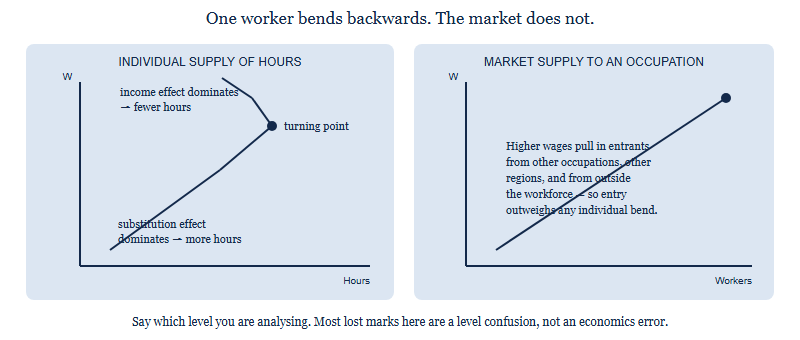
Market supply of labour to an occupation slopes upward for the obvious reason: a higher wage draws workers in from other occupations, other regions and out of non-participation. Shifters include the wage available in comparable jobs, the non-monetary characteristics of the work, training and qualification requirements, migration, demographics, and how mobile workers actually are between places and skills.
The trap is the individual supply curve, which need not slope upward at all. A worker facing a higher wage experiences two opposing pulls. The substitution effect makes leisure more expensive relative to work, encouraging more hours. The income effect makes the worker richer at any given number of hours, and since leisure is a normal good, encourages fewer. At low wages the substitution effect usually dominates and hours rise. At high enough wages the income effect can dominate and hours fall — producing the backward-bending individual supply curve.
Students lose marks by generalising this to the market. A backward bend for one worker does not make the market supply curve bend, because the market curve also reflects entry: higher wages bring in people who were not in this occupation at all. Keep the two levels separate and say which one you are talking about.
Why two workers earn different wages
Wage-differential questions are common because they can be asked about anything — nurses and bankers, the same job in two cities, men and women in the same firm. They are answerable with a short taxonomy, and the discipline is to name the mechanism rather than gesture at fairness.
| Cause | Mechanism | Typical scenario cue | Which curve it works through |
|---|---|---|---|
| Human capital | Education, training and experience raise MPP, so MRP is higher | Qualification requirements, years of training, licensing | Demand up, and supply restricted by the training barrier |
| Compensating differential | Unpleasant, risky or unsociable work must pay more to attract the same people | Night shifts, offshore work, remote postings | Supply — fewer workers willing at any given wage |
| Scarce talent | Inelastic supply of a rare ability meets demand that scales with audience or output | Elite performers, specialist surgeons, star engineers | Supply is near-vertical, so demand shifts land on wages |
| Immobility | Workers cannot or will not move between regions or occupations, so gaps persist | Housing costs, family ties, non-transferable skills | Supply fails to adjust, so the differential does not close |
| Bargaining power | Unions, professional bodies or a single dominant employer shift who captures the surplus | Collective agreements, one large local employer | Neither curve — it changes where the wage settles between them |
| Discrimination | Pay differs for reasons unrelated to productivity | Identical roles, identical output, different pay | Demand is artificially depressed for one group |
Two habits raise the quality of an answer here. First, check whether the comparison holds productivity constant. A raw pay gap between two occupations is not evidence of anything on its own, because the jobs differ. Second, when a differential persists over years, ask what is stopping it from being competed away — the answer is almost always a barrier to entry or a form of immobility, and naming that barrier is the substance of the question.
Monopsony, unions, and the minimum-wage result that flips
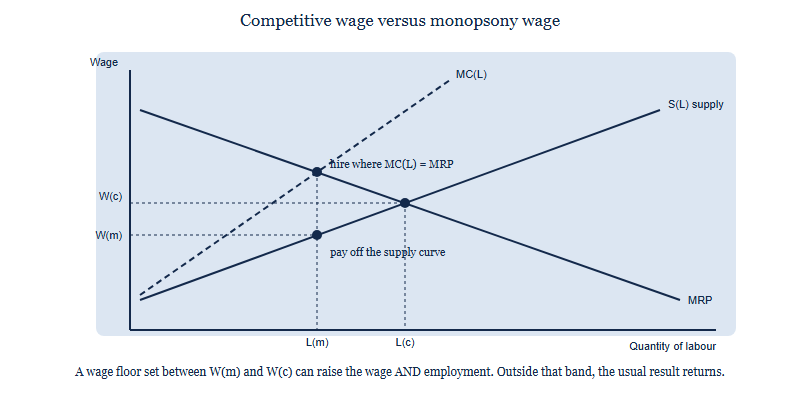
A monopsonist is a dominant buyer of labour — the one large hospital, mine or plant in a local labour market. Because it faces the upward-sloping market supply curve directly, hiring one more worker means raising the wage for everyone already employed. The marginal cost of labour therefore lies above the supply curve and rises faster than it.
The firm still hires where marginal cost equals MRP, but it then pays only the wage that supply requires at that quantity. Compared with a competitive market, employment is lower and the wage is lower. That two-step — choose quantity on one curve, read price off another — is the whole diagram, and it is the step candidates fumble.
The famous consequence is that a minimum wage set between the monopsony wage and the competitive wage can raise both the wage and employment, because it removes the employer’s incentive to restrict hiring in order to hold wages down. This is not a general claim that minimum wages raise employment. Set the floor above the competitive wage and the ordinary result returns; and if labour demand is elastic, the employment loss is larger. A candidate who can state the competitive case, the monopsony case, and the assumption that separates them is doing exactly what the advanced material rewards — our guide to what the Adam Smith division demands sets out that expected depth.
Unions are the mirror image: a collective seller facing employers. A union raises wages by restricting supply, by bargaining directly, or by raising productivity through training and lower turnover. Where a union faces a monopsonist — bilateral monopoly — theory no longer pins down a single wage; the outcome depends on relative bargaining power. Saying so is the correct answer, not a dodge.
The traps, and where this block shows up across the rounds
- Treating labour demand as ordinary demand. It is derived. Always identify whether the shock came through the product market.
- Generalising the backward bend to market supply. Individual hours can fall; market supply still rises with entry.
- Reading the monopsony wage off the wrong curve. Quantity comes from MC(L) equals MRP; the wage comes from supply at that quantity.
- Answering “does a minimum wage cost jobs?” with a slogan. The honest answer names the market structure and the elasticity of labour demand.
- Confusing a wage gap with discrimination. Rule out human capital, compensating differentials and hours first — then discrimination is a residual worth arguing about.
- Forgetting the long run. Substitution towards capital and adjustment of training pipelines both take time, so short-run and long-run answers differ.
Across the rounds, this material behaves in three distinct ways. The Qualifying Test is the individual paper that runs at every stage, and the organiser describes it as principally objective questions across microeconomics, macroeconomics and international economics; topic weightings are not published, so treat any percentage you see quoted for factor markets with suspicion and confirm the scope officially. In the Quiz Bowl, what matters is that the MRP definition and the monopsony two-step are automatic rather than reconstructed under a clock. And in Critical Thinking, labour is unusually productive territory, because minimum wages, automation, migration and skills shortages are the kinds of policy case we most often see teams asked to analyse — and each of them turns on an elasticity somebody has to name. Our stage-by-stage guide to the 2027 rounds sets out which round appears where.
It is worth being clear about what the format rewards. NEC asks for fast, correct classification and a defensible instrument choice under time pressure — not the extended single argument that wins an economics essay prize, which is a genuinely different skill on a different calendar. We set out that contrast in our comparison of NEC against the essay competitions. If you are entering both this year, learn labour markets twice: once as a diagram you can produce in forty seconds, once as an argument you can sustain for a thousand words.
Frequently asked questions
What does “derived demand” mean?
Firms hire workers for what they produce, not for their own sake. So demand for labour moves when the product market moves.
Why does an individual labour supply curve bend backwards?
Above some wage the income effect outweighs the substitution effect, so the worker buys more leisure and supplies fewer hours.
Can a minimum wage ever raise employment?
Yes, under monopsony, if set between the monopsony wage and the competitive wage. Above that band the usual job losses return.
How much of the paper covers labour markets?
Topic weightings are not published. The paper is described as covering micro, macro and international economics; confirm scope officially.
Published by the NEC (CNEC) editorial desk, operated by Hanlin Education for China-based international-school students. Official rules are set by the competition and change yearly — confirm current details on councilforeconed.org and through the official CNEC channels. Errors are corrected within 7 working days.