The operator’s academic preparation system, hosted at webloom.cn, is set out in the 2027 outline as five stages: a diagnostic start, foundations, systematic study, targeted drilling, and a full mock. Each stage has its own named resource — Prep Test, Must-know Concepts, the Online Course and Reading List, the Test Bank, and Mock CNEC. Read as a menu it looks generous. Read correctly it is a diagnosis, and the order is the point.
Almost nobody works through it in order. In our own coaching, the overwhelmingly common pattern is to open the Test Bank on day one, because drilling questions feels like progress in a way that reading concepts does not, and then to run a mock in week three to see how it is going. Both moves feel productive and both destroy the information the system exists to give you. This piece is about diagnosing which rung you are genuinely standing on, and what it costs to stand on the wrong one.
The five stages, as the outline sets them out
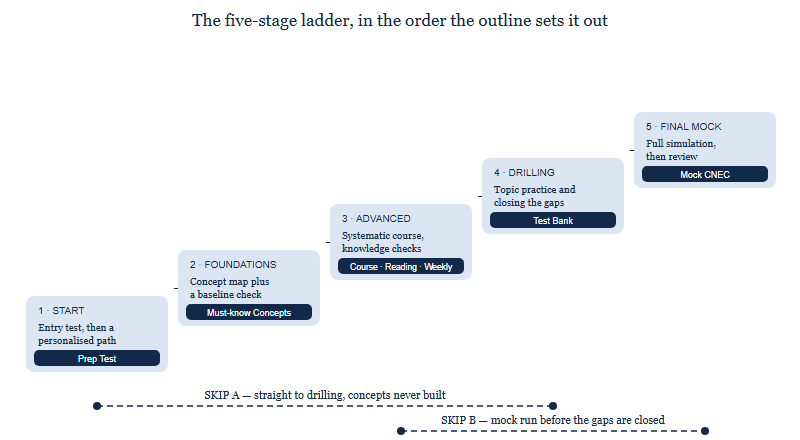
Here is the ladder in the operator’s own sequence, with the resource attached to each stage and our own reading of what each stage is for; confirm the current stage descriptions on webloom.cn.
| # | Stage | Stated purpose | Core resource | What it is really measuring |
|---|---|---|---|---|
| 1 | One-click start | Entry assessment, then confirming a personalised study path | Prep Test | Where you actually are — not where your school report says you are |
| 2 | Foundations | Building the concept map, plus a baseline assessment | Must-know Concepts | Whether the vocabulary and definitions are secure enough to build on |
| 3 | Advanced study | Systematic course work, with knowledge checks | Online Course, Reading List, Econ Weekly | Whether you can connect concepts into mechanisms and read the real world with them |
| 4 | Targeted drilling | Topic-by-topic practice and closing the remaining gaps | Test Bank, including topic-level sets | Whether a known weakness has actually been repaired |
| 5 | Final mock | Full simulation, then review and optimisation | Mock CNEC | Whether everything holds together under a real clock |
Notice what the last column does. Every rung produces a different kind of information, and each one is only interpretable if the rungs below it are secure. A Test Bank score is meaningless as a measure of readiness if you have not built the concepts, because you cannot tell whether a wrong answer means “I do not know this” or “I know this and misread the question” — and those need completely different repairs. A mock score is meaningless if half your topics are still unbuilt, because you will simply measure the size of a gap you already knew about, at the cost of your one clean simulation.
Why the ladder is a diagnosis and not a menu
The stages are not five equally valid places to start. They are ordered because each one answers a question that the next one assumes has been answered. Stage 1 exists to place you honestly; stage 2 exists so that stage 3 has something to build on; stage 4 exists to repair specific named weaknesses; stage 5 exists to test integration and pacing, which are the only things a full simulation is uniquely good at measuring.
This matters more for NEC than for a school exam, because of who enters. Division thresholds are assessed on what economics you had studied before September 2026 — and the test is which courses you had taken, not how deeply you absorbed them. Two students can qualify for the same division and still be a long way apart, which means teammates genuinely belong on different rungs. Treating the ladder as a shared schedule — “we are all on the Test Bank this month” — guarantees that it is wrong for at least one of them.
The practical consequence: run the placement individually even if you drill as a team. Teams are for the rounds that are actually collective. The Qualifying Test, which is the paper that decides your December and reappears at later stages, is an individual written paper — a team average hides exactly the person who needs stage 2. Our stage-by-stage guide to the 2027 rounds sets out which parts of the competition are individual and which are not.
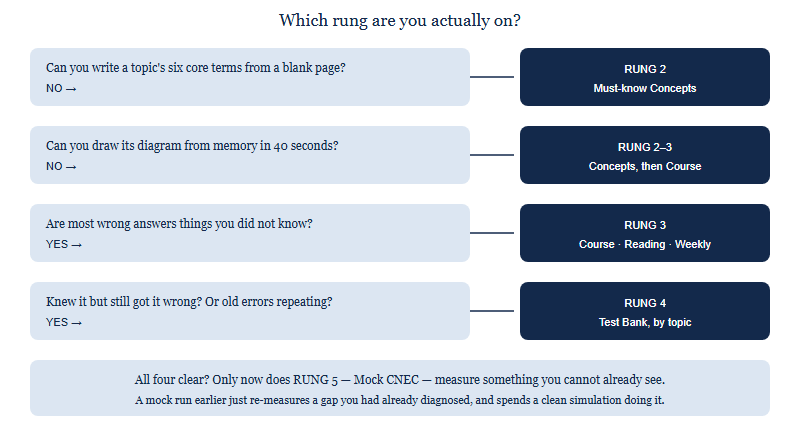
Which rung are you actually on? Four honest tests
These take about forty minutes in total and are more reliable than any self-assessment, because each one is pass or fail rather than a feeling.
- The blank-page test (rung 2). Take one topic you believe you know. On a blank page, write the definitions of its six core terms and the relationships between them, without opening anything. If you produce fragments rather than a structure, you are on rung 2, whatever your school grade says.
- The forty-second diagram test (rung 2 to 3). Draw the standard diagram for that topic from memory, correctly labelled, in forty seconds. Recognising a diagram when you see it and producing one under a clock are different skills, and only the second one is worth marks.
- The error-cause test (rung 3 versus rung 4). Take twenty questions you got wrong recently and sort them into two piles: did not know and knew but got it wrong anyway. If the first pile is bigger, you belong on rung 3 and drilling will not help you. If the second pile is bigger, rung 4 is exactly right — your problem is technique, and technique responds to volume.
- The repeat-topic test (rung 4 to 5). Pick a topic you have already drilled. Do a fresh set. If the same category of error reappears, the gap is not closed and you are still on rung 4. Only when a drilled topic stops producing its old error is there anything for a mock to measure.
The two expensive misuses
Misuse one: the Test Bank as a substitute for concepts. Drilling is the most satisfying activity in the whole system, because it generates a number every session and the number usually goes up. But volume only repairs technique. If the underlying concept is missing, drilling teaches you the answers to the specific questions you have seen, which is a fragile kind of knowledge that collapses the moment the wording changes. The tell is easy to spot: your score improves on repeated sets but does not transfer to fresh ones. When you see that pattern, the correct move is to go down the ladder, which almost nobody does voluntarily.
Misuse two: the mock run too early. A full simulation is uniquely good at exposing pacing, stamina, decision-making under time pressure, and the order in which you attack a paper. It is a poor instrument for measuring knowledge, because a topic list already does that better and cheaper. Running it while large parts of the syllabus are unbuilt produces a low score whose cause you already knew, and it burns something genuinely scarce: a clean, unseen full-length simulation is a limited resource, and it is most informative once the content is broadly in place.
There is a third, quieter misuse worth naming. Stage 3 lists a Reading List and Econ Weekly alongside the Online Course, and these are the first things students drop when they get busy — they feel like enrichment. They are not. The team rounds ask you to apply theory to live cases, and current-affairs fluency is the raw material for that. Dropping the reading is a decision to be worse at Critical Thinking specifically, taken without noticing that you have taken it. That is the depth the advanced track expects, and our guide to what the Adam Smith division demands sets out the standard.
What “finished with this rung” actually looks like
Vague exit conditions are why students stall. Define each rung’s finish line as an observable behaviour, not as time served or material covered.
- Rung 1 is finished when you can name your three weakest topics and are not guessing. If you cannot name them, the placement has not happened yet, however many resources you have opened.
- Rung 2 is finished when the blank-page and forty-second-diagram tests pass across your weak topics, not just your favourite one.
- Rung 3 is finished when you can explain a mechanism in one sentence that names cause and effect — and when you can connect a news story from the week to a mechanism you have studied.
- Rung 4 is finished when a topic you have drilled stops generating its old error category on fresh questions. Not when you have completed the set.
- Rung 5 is finished when the review is done, not when the mock is sat. The score is the least useful thing a mock produces; the pattern of where time was lost is the useful thing.
One scheduling note without turning this into a calendar. The preliminary runs online in mid-December, so a student registering this autumn has a defined and fairly short runway, and the returning-user discount on the entry fee is stated as running to 23:59 on 9 October 2026. The point of the ladder is not to fit five stages into the weeks available; it is to make sure the weeks you have are spent on the rung that will actually move your score. A student on rung 2 in October who spends November drilling has wasted November.
What the outline does not say
Being straight about the limits of this material is part of using it well. The outline names the five stages and the resources attached to each. It does not, in the material we are working from, specify how long each stage is expected to take, whether the resources differ by division, what access conditions apply, or how many attempts any assessment allows. Treat any confident answer you read on those points — including from a well-meaning schoolmate — as unverified, and confirm the current arrangements on webloom.cn and the official CNEC channels.
It is also worth keeping the ladder in proportion. It prepares you for a test-and-team competition: fast, correct classification under a clock, and defensible reasoning in front of judges. That is a genuinely different skill from the sustained single argument an economics essay prize rewards, and a student attempting both in one season should not assume one set of preparation serves the other — we set out the contrast in our comparison of NEC against the essay competitions.
Frequently asked questions
Can I start at the Test Bank if I already study economics at school?
Run the placement first. School coverage rarely matches the competition scope, and drilling cannot repair a missing concept.
When should we run the first Mock CNEC?
Once drilled topics stop repeating their old errors. Earlier, it re-measures a gap you already knew about.
Should a team work through the ladder together?
Drill together if you like, but place each student individually — the Qualifying Test is an individual paper and averages hide people.
How long does each stage take?
The outline does not state durations, and they will vary by starting point. Confirm current arrangements on the official channels.
Published by the NEC (CNEC) editorial desk, operated by Hanlin Education for China-based international-school students. Official rules are set by the competition and change yearly — confirm current details on councilforeconed.org and through the official CNEC channels. Errors are corrected within 7 working days.