Per the CNEC 2027 student handbook, the Pre division paper has been re-pitched closer to IGCSE level and is set at 28 microeconomics questions plus 8 macroeconomics questions. For an IGCSE Economics student that is mostly good news: the paper has moved towards ground your course already covers. The catch is balance. The split is far more micro-heavy than your school exams, and a few principles-level tools are missing from at least one IGCSE specification.
Below: how Cambridge IGCSE Economics (0455) and Pearson Edexcel International GCSE Economics (4EC1) map onto that paper, who counts as an IGCSE student under the September 2026 division line, and a twelve-week plan to the mid-December preliminary.
What the 2027 handbook changes, and what it leaves unsaid
The rows below come from the CNEC 2027 student handbook, the Bloom registration platform and the 2027 programme outline, as circulated through our organising channels in September. Where a detail is marked not stated, we have not seen an official figure, so do not practise under a guessed format.
| Item | 2027 position | Where it comes from | What it means if you study IGCSE |
|---|---|---|---|
| Level of the Pre paper | Re-pitched closer to IGCSE level | CNEC 2027 student handbook | Your course is the natural starting point, not a detour |
| Composition | 28 microeconomics questions plus 8 macroeconomics questions | CNEC 2027 student handbook | Micro is about 78 per cent of the 36 questions described |
| Subject scope | Microeconomics and macroeconomics; confirm on the official CNEC channels whether international economics and current affairs are also listed for the other divisions | 2027 programme outline | Your trade and exchange-rate units are the lowest priority for this paper |
| Who the Pre description fits | Before September 2026: no economics course, or only introductory IGCSE economics | 2027 programme outline | Judged on what you had studied before that date, not on registration day |
| Entry format | Individually, or a team of two to four; an individual entry to the preliminary carries no team honour, and the China and global stages need a team | 2027 programme outline and handbook | Settle the teammate question before registration closes |
| Dates | Registration closes 30 November 2026 at 23:59; online preliminary in mid-December 2026; China round in March 2027, venue to be announced | Handbook, Bloom and outline | About twelve weeks from mid-September to the paper; confirm the time zone on Bloom |
| Preliminary fee | RMB 698 per person, with an RMB 50 returning-user reduction until 23:59 on 9 October 2026 | 2027 programme outline | The RMB 80 early-bird reduction closed on 31 August 2026 |
| Not stated in what we have seen | Time allowed, marks per question, any penalty for wrong answers, calculator rules | No official figure yet | Confirm on the official CNEC channels before you start timed practice |
One reading note on the composition row. The 2027 outline runs the individual Qualifying Test at the preliminary, the China round and the global round alike, but we have not seen a statement that Pre papers at the later stages keep the same 28/8 split. Treat the split as a planning figure for the preliminary, and use our stage-by-stage guide to the CNEC rounds for what follows December.
Are you an IGCSE student under the September 2026 line?
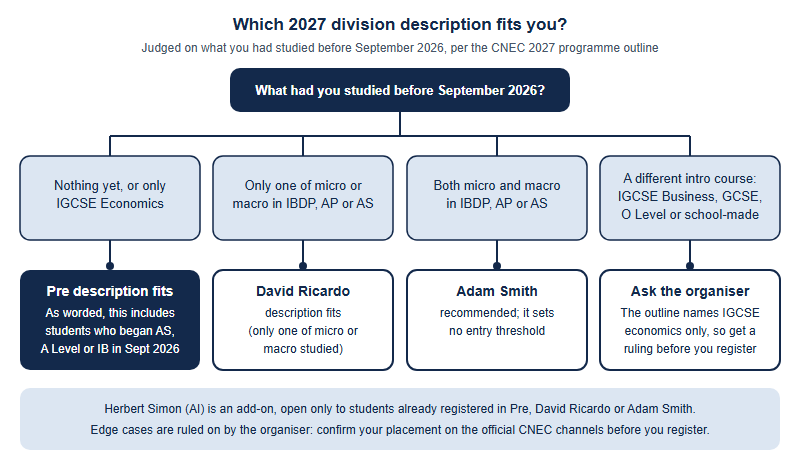
Per the 2027 outline, division thresholds are assessed against what you had studied before September 2026, not against the course you happen to be taking on the day you register. As an authorised CNEC test centre, this is a question we field every registration season, and the rule sorts most IGCSE students cleanly. Four situations cover almost everyone.
- You are studying IGCSE Economics now, and the course began before September 2026. Before the line you had taken only introductory IGCSE economics, which is the Pre description.
- You finished IGCSE Economics and began AS Level, A Level or the IB Diploma in September 2026. Before the line you still had only IGCSE, so the Pre description fits as it is worded. Adam Smith sets no entry threshold. The David Ricardo description refers to students who had studied one of microeconomics or macroeconomics within IBDP, AP or AS, which does not literally describe you, so ask the organiser if you are weighing it. Eligible is not the same as best: by December you will have a term of post-16 economics behind you, and a paper pitched near IGCSE may stretch you less than a step up would. What the advanced track expects is set out in our Adam Smith division guide.
- You completed IGCSE plus AP Microeconomics or AP Macroeconomics before September 2026. Having studied one of the two within AP matches the David Ricardo description rather than Pre.
- Your introductory course was not IGCSE Economics. IGCSE Business Studies, a GCSE or O Level in economics, or a course your school designed itself are not named in the outline. Ask for a ruling before you register rather than after.
Whichever box you land in, select the division explicitly when you register on Bloom, and check that your confirmation shows it.
The unit-by-unit map: Cambridge 0455 and Edexcel 4EC1 against a 28/8 paper
Both routes cover the core of a micro-and-macro paper, but they are built differently. Cambridge IGCSE Economics (0455) is organised into six topics, from the basic economic problem through to international trade and globalisation, and pairs a multiple-choice paper with a structured-questions paper. The Pearson Edexcel International GCSE Economics specification splits the course into two papers of equal weight, Paper 1 on Microeconomics and Business Economics and Paper 2 on Macroeconomics and the Global Economy, each lasting 1 hour 30 minutes for 80 marks.
| IGCSE content (Cambridge topic / Edexcel section) | Pre block it feeds | Fit | What to watch |
|---|---|---|---|
| The basic economic problem / 1.1.1 The economic problem: scarcity, opportunity cost, the production possibility curve | Micro, foundations | Strong | Read curve shifts and opportunity cost straight off a diagram, without redrawing it |
| The allocation of resources / 1.1.3 Demand, supply and market equilibrium and 1.1.4 Elasticity | Micro, the core of the 28 | Strong | Edexcel already asks you to calculate price, supply and income elasticities; get those calculations to mental-arithmetic speed |
| Market failure within The allocation of resources / 1.1.5 The mixed economy, 1.1.6 Externalities and 1.2.6 Government intervention | Micro | Strong | Public goods, externalities and policy responses: know the mechanism, not only the definition |
| Microeconomic decision makers / 1.2 Business economics: production, costs, revenue and profit, economies of scale, competition, the labour market | Micro | Good, one gap | The Edexcel specification never uses marginal cost or marginal revenue. Principles-level micro reasons at the margin, so learn that vocabulary at least to recognition level |
| Government and the macroeconomy / 2.1 Government and the economy: objectives, fiscal, monetary and supply-side policy | Macro, the 8 | Good, one gap | The Edexcel specification does not use the aggregate demand and aggregate supply model. If an item is framed in those terms, you need the basic shifts |
| Economic development (Cambridge) | Mostly outside a micro-and-macro paper | Partial | Growth, employment and living standards overlap with macro aims; revise the overlap, not the whole topic |
| International trade and globalisation / 2.2 The global economy | Outside the micro-and-macro scope described for Pre; confirm on the official CNEC channels | Low for this paper | Revise it last; it becomes central when you step up a division |
What the map cannot show is where marks actually go. In our experience preparing IGCSE-stage students for objective papers, marks are lost more often to speed, and to switching topics inside one sitting, than to content never met. Both IGCSE routes train extended written answers alongside objective items, while a 36-question paper of the kind the handbook describes rewards deciding quickly and moving on, though the question format is not stated in what we have seen — confirm it on the official CNEC channels.
What 28 and 8 do to your revision hours
Run the arithmetic before you plan. Twenty-eight of the thirty-six questions described are microeconomics, about 78 per cent. Macroeconomics is eight, about 22 per cent. On the Edexcel route your school exams give micro and macro half the marks each, and the Cambridge route does not divide its papers into a micro paper and a macro paper at all. Either way, the balance you revise by instinct is not the balance of this paper.
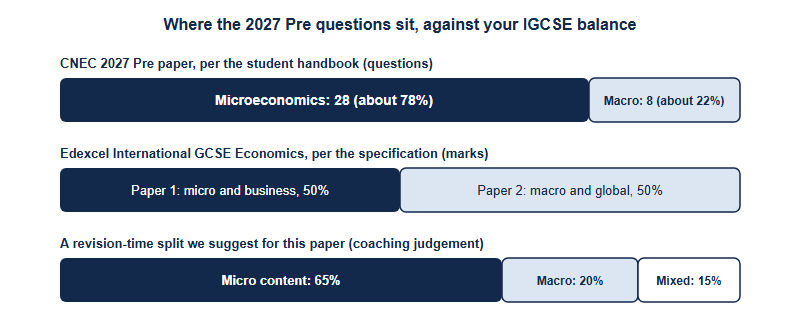
That does not mean skipping macro. Eight questions are still eight questions, and the macro block leans on policy content your course covers anyway, even if your school teaches it later in the course. What the split changes is sequencing. This is the order we use with IGCSE-stage students between mid-September and the preliminary:
- Weeks 1 and 2: diagnose. Sit the organiser's Prep Test, the first stage of the five-stage webloom preparation system, and sort every miss by IGCSE topic rather than by question number.
- Weeks 3 to 7: the micro core, in syllabus order. The economic problem, demand and supply, elasticity, market failure and intervention, then costs, competition and the labour market. Add the margin vocabulary (marginal cost, marginal revenue, marginal utility) at recognition level.
- Weeks 8 and 9: the macro block. Objectives, inflation and unemployment, and fiscal, monetary and supply-side policy, plus the basic aggregate demand and aggregate supply shifts if your specification skipped them.
- Weeks 10 and 11: mixed and timed. Shuffled sets from the Test Bank, with an error log kept by topic so that a recurring weakness shows up as a pattern.
- Week 12: one full Mock CNEC under exam conditions. Review it properly and stop adding new content.
Two calendar checks belong in week one. Registration closes on 30 November 2026 at 23:59, before the paper, so the team decision cannot wait until week eleven. And if your school enters you for a November exam series, set its dates against this plan now; the Edexcel specification lists June and November availability for both papers.
Solo entry or IGCSE classmates? Decide before 30 November
Per the 2027 materials, Pre is the only main division you can enter on your own, and only at the preliminary. Two consequences follow. An individual preliminary entry carries no team honour, and the China and global stages need a team, which for Pre means two to four students. We have not seen a published route for building a team after a solo preliminary, so if you want the later stages to stay possible, register as a team.
IGCSE classmates make unusually practical Pre teams. You share a syllabus, a teacher's vocabulary and an exam calendar, so a joint plan costs almost nothing to coordinate, and you can divide revision topics between you and test each other on them.
Individual accuracy still sits underneath every team result, because the Qualifying Test is the one round the 2027 outline runs at every stage. For calibration rather than promise: at the 2026 global round's Asia site, Hanlin students took two team golds, one team silver and three team bronzes, and one of our students ranked first worldwide on the individual Qualifying Test. That is our own de-identified count, and results vary by student and by season.
The work also carries forward. Later on, a Pre result can sit in the same application file as your IGCSE Economics grade. Admissions readers check awards against transcripts, and when a competition result and a course grade in the same subject point the same way, each makes the other more believable.
Frequently asked questions
How many questions are on the 2027 CNEC Pre paper?
Per the CNEC 2027 student handbook, 28 microeconomics and 8 macroeconomics questions. Confirm timing and scoring on the official CNEC channels.
I finished IGCSE Economics and started AS Level in September 2026. Can I enter Pre?
Thresholds are assessed on study before September 2026, when you had only IGCSE, which matches the Pre description. Confirm with the organiser.
Does the 2027 Pre paper include international economics?
The 2027 outline lists micro and macro for Pre. Whether international economics and current affairs are listed for the other divisions is best confirmed on the official CNEC channels.
Can I enter the Pre division on my own?
At the preliminary, yes, but with no team honour. Per the 2027 materials, the China and global stages need a Pre team of two to four.
Published by the NEC (CNEC) editorial desk, operated by Hanlin Education for China-based international-school students. Official rules are set by the competition and change yearly — confirm current details on councilforeconed.org and through the official CNEC channels. Errors are corrected within 7 working days.