
On the National Economics Challenge (NEC), unemployment questions reward a narrow, precise skill: knowing that not all joblessness is the same. Frictional and structural unemployment make up the natural rate and persist even at full employment; only cyclical unemployment moves with the business cycle. The students who score highest do not memorise definitions — they read labour data, classify the cause, and explain which policy can (and cannot) fix it.
The three types every NEC item assumes you know
The NEC, run by the Council for Economic Education (CEE, founded 1949), tests microeconomics, macroeconomics, and the world economy. Within the macro block, unemployment is one of the highest-yield topics because it connects to inflation, GDP, and policy in almost every direction. The first thing an item will test is whether you can name the cause of joblessness, not just observe that it exists.
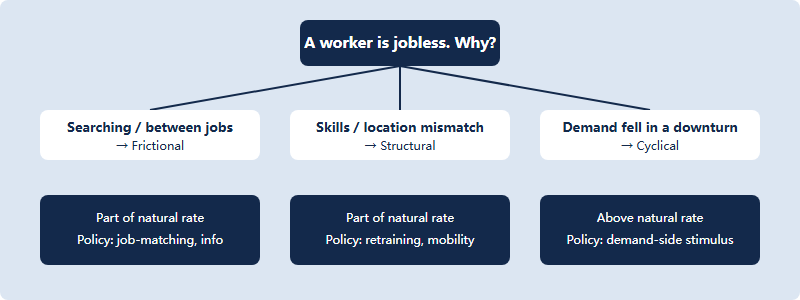
- Frictional unemployment — people between jobs or entering the labour force for the first time (a graduate searching, a worker who quit to find a better fit). It is short-term, healthy, and exists even in a booming economy because matching workers to jobs takes time.
- Structural unemployment — a mismatch between the skills or location of workers and the jobs available (factory automation, an industry moving offshore, coding replacing a manual role). It is longer-lasting and is not cured by spending alone; it needs retraining, mobility, or education.
- Cyclical unemployment — joblessness caused by a downturn in the business cycle, when aggregate demand falls and firms lay workers off. This is the type that demand-side policy (fiscal stimulus, lower interest rates) is designed to reduce.
A fourth type, seasonal unemployment (ski instructors in summer, retail staff after the holidays), appears in some items but is usually adjusted out of the headline figure. The classic NEC trap is a scenario where a region's mills close permanently: a careless student labels it cyclical and recommends a stimulus package. The correct read is structural — and stimulus will not bring those specific jobs back.
The natural rate and full employment
A point that separates strong NEC competitors from the rest: full employment does not mean zero unemployment. Because frictional and structural unemployment never disappear, economists define full employment as the level where cyclical unemployment is zero. The unemployment rate at that point is the natural rate of unemployment — the sum of frictional and structural unemployment.
This single idea unlocks a whole family of questions. If the actual unemployment rate is below the natural rate, the economy is overheating and inflationary pressure builds (the labour market is tight, wages rise). If actual unemployment is above the natural rate, there is a recessionary gap and cyclical unemployment is present. The gap between actual GDP and potential GDP is mirrored by the gap between actual and natural unemployment — a relationship often summarised by Okun's law, which links a rise in the unemployment rate to a proportional fall in output.
| State of the labour market | Unemployment vs natural rate | What an NEC item expects you to infer |
|---|---|---|
| Recessionary gap | Actual > natural | Cyclical unemployment present; demand-side policy can help |
| Full employment | Actual = natural | Only frictional + structural remain; no cyclical to remove |
| Overheating / boom | Actual < natural | Tight labour market; rising wage and price pressure |
The natural rate itself is not fixed. It can rise if structural change accelerates (technology, trade shocks) or if labour-market institutions slow re-matching; it can fall as workers retrain or job-search becomes more efficient. NEC scenarios that describe a long-run shift in the economy’s structure are often quietly asking you to reason about a changing natural rate, not a temporary deviation from it.
Reading the labour data: the numbers behind the headline
Unemployment data items are where careless reading costs the most marks, because the headline unemployment rate has a precise definition and a denominator that students routinely get wrong. Three quantities matter, and you should be able to define each in one sentence.
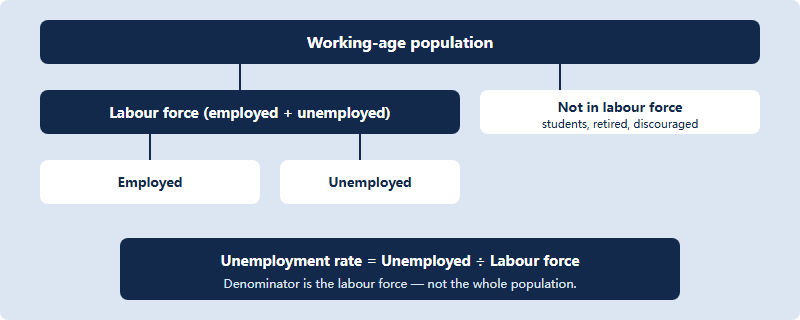
- Labour force = employed + unemployed. It does not include everyone of working age — only those working or actively seeking work.
- Unemployment rate = unemployed ÷ labour force, expressed as a percentage. The denominator is the labour force, never the whole population.
- Labour-force participation rate = labour force ÷ working-age population. It captures how many eligible people are in the market at all.
The most-tested subtlety is the discouraged worker. To be counted as unemployed, a person must be actively looking for work. Someone who gives up searching leaves the labour force entirely — which, paradoxically, lowers the measured unemployment rate even though no one found a job. This is why a falling unemployment rate can be misleading: an NEC item may pair a dropping unemployment rate with a dropping participation rate, and the correct interpretation is a weakening labour market, not a strengthening one. Always read the participation rate alongside the unemployment rate before drawing a conclusion.
A second subtlety is underemployment — part-time workers who want full-time hours, or graduates in jobs far below their qualifications. They are counted as employed, so the headline rate understates labour-market slack. When an item gives you a low unemployment rate but describes widespread part-time or low-skill work, it is testing whether you notice that the headline number is not the whole story.
How these concepts surface across NEC rounds
Unemployment is not confined to one part of the contest. In the Qualifying Test and Super Econ, it appears as multiple-choice items asking you to classify a type or compute a rate from given employment figures — speed and a clean denominator decide these. In Critical Thinking and the Econ Lab, you are more likely to get a data table or a short scenario and be asked to interpret why the labour market is behaving as it is and which policy fits. In the Quiz Bowl, a single sharp definition — the natural rate, the difference between cyclical and structural — can win a buzz.
For a fuller map of how the seven rounds work and where data-interpretation skills pay off, see the round breakdowns and preparation resources on the official CNEC site, and check the current division requirements before you build a practice plan around any one format.
A practical first-party tip from running the China round: candidates who treat unemployment as a vocabulary list plateau quickly, because the contest rarely asks for a bare definition. The students who improve fastest drill the judgment instead — given a labour-market scenario, classify the type, decide whether it sits inside the natural rate, and state the one policy that addresses it. Build a deck of 15–20 short scenarios, practise the classify-then-prescribe move, and unemployment questions become some of the most reliable marks in the macro block.
Frequently asked questions
Does full employment mean zero unemployment in NEC answers?
No. Full employment is when cyclical unemployment is zero; frictional and structural unemployment remain. That remaining level is the natural rate.
Why can the unemployment rate fall when no jobs were created?
If discouraged workers stop searching, they leave the labour force, shrinking the denominator and lowering the measured rate without any new hiring.
Which unemployment type does fiscal stimulus actually fix?
Mainly cyclical unemployment, by raising aggregate demand. Structural unemployment needs retraining and mobility; stimulus alone will not restore lost-industry jobs.
What are the official NEC divisions and rounds?
Three divisions (Pre, David Ricardo, Adam Smith) and seven rounds. Always confirm current rules, dates and format on the official CNEC channels.
Published by the NEC / CNEC editorial desk, operated by Hanlin Education as the officially authorized China National Economics Challenge (CNEC) test center. The NEC is run by the Council for Economic Education, which sets the official rules — always confirm current dates, divisions, fees and awards on the official CNEC channels. Any factual error here is corrected within 7 working days.