
The National Economics Challenge (NEC) tests inflation as a measurement-and-cause problem, not a headline. You have to know that the Consumer Price Index (CPI) tracks the cost of a fixed basket of goods relative to a base year, that inflation is the percentage change in that index, that any nominal figure must be deflated into a real one before you compare across time, and that the causes split cleanly into demand-pull and cost-push. The marks live in those distinctions.
What the CPI actually measures — and what it leaves out
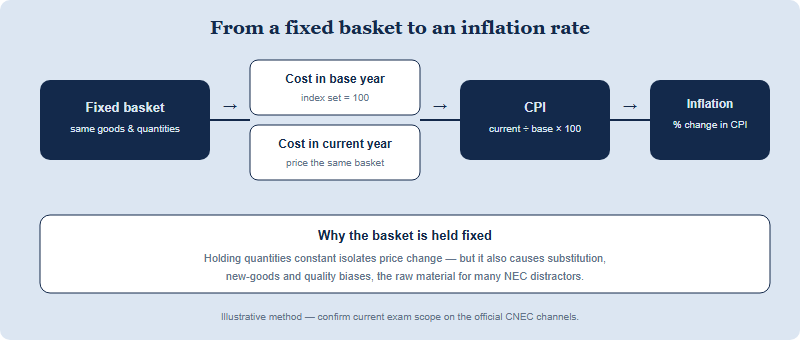
NEC items begin from a precise definition: the CPI measures the cost of a fixed market basket of goods and services that a typical urban household buys, expressed relative to a base year whose index is set to 100. It is a price index, not a spending total, so the basket is held constant on purpose — that is what lets you attribute a change in the index to changing prices rather than changing buying habits. A question that hands you basket quantities and two years of prices is checking whether you can compute the cost of that same basket twice and turn the two totals into an index.
From the index, inflation is the percentage change between two periods: take the new CPI, subtract the old, divide by the old, multiply by 100. The CEE, which founded in 1949 and sets the academic standard the NEC is built on, treats this as core macroeconomics alongside the micro and world-economy material; you can see where these topics sit in the official syllabus on the CNEC home page. The fixed-basket method is powerful but imperfect, and NEC distractors are often built from exactly the well-known biases the method carries:
- Substitution bias — a fixed basket cannot capture buyers switching away from goods whose prices rose, so it tends to overstate the true rise in the cost of living.
- New-goods bias — products that appear after the basket is set are slow to be included, so the index misses early variety and price gains.
- Quality-change bias — when a product gets better for the same price, part of the "price" is really paying for more quality; separating the two is hard and imperfect.
Two further distinctions earn marks. First, the CPI is not the GDP deflator: the CPI fixes the basket and covers what consumers buy (including imports), while the deflator reflects everything an economy produces and lets its weights change. Second, examiners often separate headline inflation from core inflation, which strips out volatile food and energy prices to show the underlying trend — knowing why a central observer would prefer the core measure is a standard discriminating item.
| Concept | What it is | The trap NEC sets |
|---|---|---|
| CPI | Cost of a fixed basket vs base year (= 100) | Treating it as total spending rather than a price index |
| Inflation rate | % change in CPI between two periods | Reporting the index level instead of its change |
| Core inflation | CPI excluding volatile food & energy | Confusing it with headline inflation |
| Substitution bias | Fixed basket ignores switching | Saying it understates, when it overstates |
Real vs nominal: deflating before you compare
The single most-tested inflation skill is converting a nominal value (measured in the prices of its own year) into a real value (measured in constant base-year prices). NEC questions routinely give you a nominal wage, salary, or revenue across several years and ask whether the worker is actually better off — a question you cannot answer until you strip out price changes. The mechanic is simple and worth drilling until it is automatic: real value = nominal value ÷ CPI × 100. A salary that rises in dollars while the CPI rises faster has fallen in real terms, and the whole point of the item is to catch students who stop at the bigger nominal number.
The same logic powers the idea of the real interest rate. The Fisher relationship that examiners lean on says the real interest rate is approximately the nominal interest rate minus the inflation rate — so a 6% nominal return during 4% inflation is only about 2% real. Closely related is the distinction between expected and unexpected inflation: when inflation is anticipated, contracts and wages adjust for it, but when it surprises the economy, it redistributes wealth — typically from lenders and fixed-income holders to borrowers, because debts are repaid in cheaper money. A strong answer names who wins and who loses, not just "prices rose."
- Deflating: divide any nominal figure by the CPI and multiply by 100 to express it in base-year purchasing power.
- Real interest rate ≈ nominal rate − inflation rate — the return after prices are accounted for.
- Unexpected inflation redistributes from creditors to debtors and erodes the value of fixed nominal incomes and savings.
A first-party note from running the China round: the recurring error our CNEC teams make is not the arithmetic — it is forgetting to deflate at all. Students compare two nominal numbers, declare a gain, and lose a mark that a single division by the CPI would have secured. We coach teams to treat "is this nominal or real?" as the first question on any cross-year comparison, before a calculator is touched.
| You are given… | To compare fairly, do this | Common mistake |
|---|---|---|
| Nominal wage across years | Divide by CPI × 100 each year | Calling a nominal rise a real raise |
| Nominal interest rate + inflation | Real ≈ nominal − inflation | Quoting the nominal return as the real one |
| An old price "in today's money" | Scale by the ratio of the two CPIs | Comparing raw prices across decades |
Why prices rise: demand-pull vs cost-push
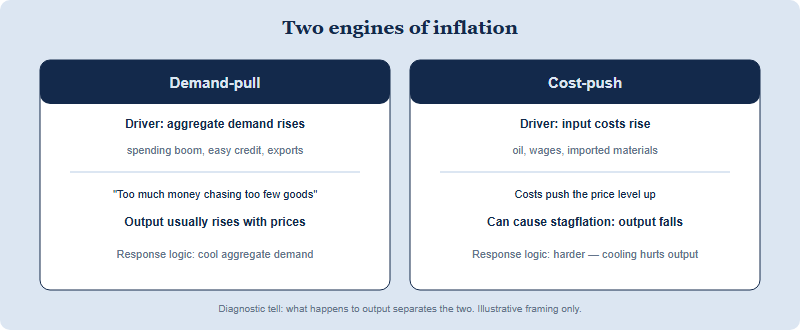
Once the measurement is solid, NEC items move to causes, and here the discriminating distinction is between demand-pull and cost-push inflation. Demand-pull inflation is "too much spending chasing too few goods": aggregate demand rises — from a spending boom, easy credit, or surging exports — and pulls the price level up as the economy presses against its capacity. Cost-push inflation works from the supply side: a rise in input costs such as oil, wages, or imported materials raises firms' costs and pushes the price level up even when demand has not grown. The classic exam signal that separates them is what happens to output: demand-pull tends to come with rising output, while cost-push can bring the worst case — stagflation, rising prices alongside falling output.
Questions often dress these up as short scenarios and ask you to diagnose which force is at work. A surge in consumer confidence and borrowing points to demand-pull; a spike in global energy prices feeding through to every sector points to cost-push. The reason examiners care is that the cause shapes the appropriate response, and that is the bridge to the policy half of the topic.
On responses, keep two things straight without straying into a full monetary-policy treatment. Broadly, demand-pull inflation can be cooled by reducing aggregate demand — tighter fiscal or monetary settings — whereas cost-push inflation is the harder case, because the same demand-cooling tools that fight rising prices can deepen the output fall that cost-push already caused. NEC rewards students who can state that asymmetry rather than reaching for one lever for every kind of inflation. The mechanics of which institution pulls which lever belong to the monetary- and fiscal-policy topics; here, the examinable point is matching the type of inflation to the logic of the response. For how these macro threads connect across the syllabus, see the CNEC editorial section.
How these items show up across the NEC rounds
Inflation is not confined to one part of the competition; it surfaces in different forms across the seven rounds — Qualifying Test, Super Econ, Quiz Bowl, Critical Thinking, Econ Lab, Econ Immersion and U20 Youth Voice — and the skill the round prizes changes the kind of inflation question it sets. In the timed multiple-choice rounds, expect crisp definition-and-calculation items: compute a CPI, find an inflation rate, deflate a wage, or pick the correct bias. In the analytical and applied rounds, expect a scenario you must diagnose and argue — identify whether a country faces demand-pull or cost-push inflation and reason about the trade-off any response faces.
For a China team preparing through CNEC — the official China National Round, operated by Hanlin (SKT) since 2016 across 20+ provinces and 300+ schools, and the only official path from China into the NEC global rounds — the practical implication is to train the two registers separately. Drill the calculations to reflex for the buzzer and multiple-choice formats, and practise structured verbal reasoning for the open rounds, where naming the cause and the trade-off out loud is what earns the marks. Round formats and weightings can change between seasons, so confirm the current structure on the official CNEC channels before you build a prep plan around it.
- Calculation register — CPI from a basket, inflation as a % change, deflating nominal to real, the real interest rate. Train these to reflex.
- Analytical register — diagnose demand-pull vs cost-push from a scenario, explain who gains and loses, and reason about the response trade-off.
- Vocabulary precision — headline vs core, expected vs unexpected, nominal vs real. Examiners build distractors out of these pairs.
FAQ
What is the difference between the CPI and the inflation rate?
The CPI is the index level — the cost of a fixed basket versus the base year. The inflation rate is the percentage change in that CPI between two periods.
How do I convert a nominal value into a real value?
Divide the nominal figure by the CPI and multiply by 100. That restates it in constant base-year prices so you can compare fairly across time.
How does NEC test demand-pull versus cost-push inflation?
Usually through a scenario you diagnose. Rising demand with rising output signals demand-pull; rising input costs, possibly with falling output, signals cost-push.
Why does the CPI overstate the cost of living?
Mainly substitution bias: the fixed basket ignores buyers switching away from goods that got pricier, so the index reports a larger rise than households truly face.
Published by the NEC / CNEC editorial desk, operated by Hanlin Education as the officially authorized China National Economics Challenge (CNEC) test center. The NEC is run by the Council for Economic Education, which sets the official rules — always confirm current dates, divisions, fees and awards on the official CNEC channels. Any factual error will be corrected within 7 working days.