
Deciding whether your child should enter the National Economics Challenge (NEC) comes down to three honest questions, not one: does the format fit how they think, can your family afford the time it really takes through a busy school term, and are your expectations about the outcome realistic? This guide is written for the parent making that call — how to judge fit, what to budget in hours, and what to ask before you commit.
Start with fit, not prestige
The most common mistake parents make is choosing a competition because it sounds impressive, then discovering it suits neither their child's strengths nor their schedule. The NEC, run by the Council for Economic Education (CEE, founded 1949), is a timed, test-and-team economics competition covering microeconomics, macroeconomics and the world/international economy. In the United States it reaches roughly 10,000 students a year. That format detail matters more than any ranking, because it tells you which children thrive in it.
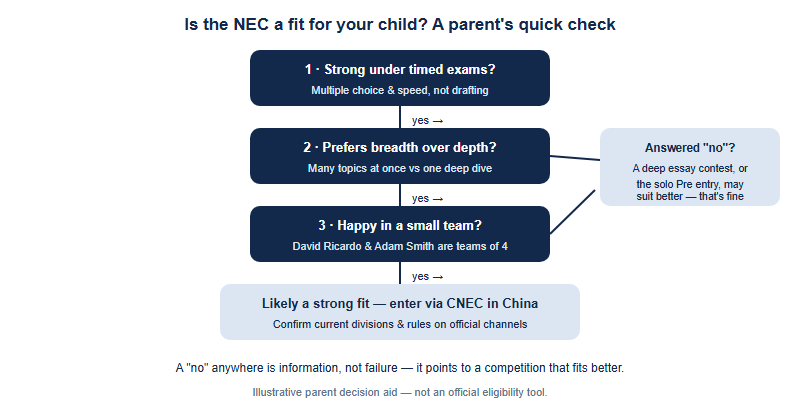
NEC rewards a particular profile: a student who is comfortable under exam conditions, enjoys breadth across several topics rather than going deep on one, and likes working as part of a small team. It is not an essay competition — there is no single long written piece to polish over weeks. So a child who shines through careful drafting but freezes on timed multiple choice may be happier elsewhere, while a quick, broad, exam-confident student who enjoys a buzzer round will likely love it. Before you weigh cost or hours, ask honestly whether this shape of competition matches your child. The flowchart below is a starting point for that conversation.
The real cost is time — budget it honestly
When parents ask about "cost," they usually mean the registration fee. That is the smaller number. Entry fees, payment method and any deadlines are set by the organiser and change by cycle and division, so confirm the current figures on the official CNEC channels rather than relying on a number you read in a forum. The cost that actually decides whether the season goes well is the one no invoice shows: your child's time, spread across a term that already contains IB, A-Level or AP coursework.
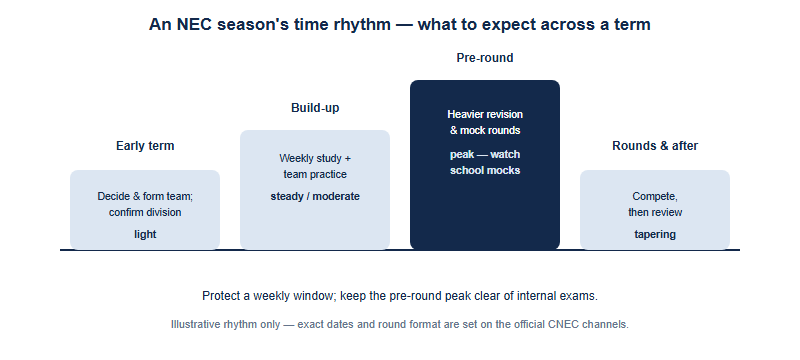
A realistic NEC season is not a single exam day. It is weeks of preparation across three subject areas, ideally with regular team practice, building toward the competition rounds. For a team-division entrant that typically means a recurring weekly commitment over a stretch of the school year, plus heavier revision close to the rounds. The honest planning question is not "can my child find one free afternoon" but "can my child protect a few hours most weeks for a couple of months without their grades slipping." The table below separates the costs you can see from the ones you have to plan for.
| Cost type | What it covers | How to plan for it |
|---|---|---|
| Registration fee | The entry cost per student or team, by division | Confirm the current amount, currency and payment method on the official CNEC channels — it varies by cycle |
| Weekly preparation time | Regular study across micro, macro and world economy, plus team practice | The biggest real cost; agree a protected weekly window before committing |
| Pre-round intensity | Heavier revision and mock rounds as the competition nears | Check it does not collide with mock exams or coursework deadlines |
| Optional coaching / materials | Any extra tutoring, books or practice resources you choose to add | Entirely optional; decide based on your child's starting level, not pressure |
| Travel (if applicable) | Any in-person rounds, depending on the format that cycle | Confirm the current round format and any in-person element on official channels |
Note that none of the figures above are fixed values we can quote for you, because the organiser sets and updates them. What this guide can give you is the shape of the commitment, so you arrive at the official registration page knowing which questions to verify. Map the preparation window against your child's school calendar — especially internal exams and assessment deadlines — before you say yes.
Set realistic expectations about the outcome
Parents naturally want to know "what does my child get out of this." The honest answer is that the dependable returns are educational, and the headline result — a top placement — is real but not something anyone can promise. No competition, NEC included, should be sold as a guaranteed route to a prize or to a university place. What you can reasonably expect, if your child commits to a proper season, is a set of durable gains:
- Genuine economics knowledge. Preparing for NEC builds real command of micro, macro and the world economy — foundations that help in school economics and beyond, whatever the result.
- Exam composure and teamwork. The timed rounds train speed and accuracy under pressure, and the team divisions build collaboration — transferable skills that outlast the competition.
- An honest interest signal. Sustained participation can show a university that a stated interest in economics is real. It is one credible signal among many — not a decisive factor on its own, and never a substitute for strong grades.
Frame success at home around effort and growth rather than a medal. A child who prepares seriously, performs honestly and comes away knowing more economics has had a successful season even without a top finish. That framing protects motivation, keeps the activity healthy, and is also simply the truthful picture: outcomes at the sharp end of any large competition are uncertain by design.
How entry works in China — and what to verify
For families in China there is one official route. The CNEC is the official China National Round, operated by Hanlin (SKT) since 2016 across 20+ provinces and 300+ schools, and it is the only official path from China onward to the NEC global rounds. NEC is organised by division so students can enter at a level that matches their experience: the Pre division (entry level) can be entered individually or as a team of 2–4, while David Ricardo (intermediate) and Adam Smith (advanced) are each a team of four. Choosing the right division is part of the fit decision — a younger or first-time entrant is often better served starting at Pre.
Beyond the division names, the specifics a parent needs to budget around — current dates and deadlines, the exact registration fee, the round format for the cycle, and the award structure — are all set by the organiser and updated each year. Treat the official CNEC site as the authority for those, and verify them before committing rather than acting on second-hand figures. The CEE sets the underlying academic standard for the NEC; the CNEC desk runs the China round.
Questions to ask before you commit
Run through this short checklist before you register. It is designed to surface the practical issues that decide whether a season is enjoyable or stressful — the questions a thoughtful parent should answer first.
| Ask yourself / your child | Why it matters |
|---|---|
| Does my child genuinely do well under timed, broad exams — or only when drafting at their own pace? | Decides whether NEC's test-and-team format fits, or whether an essay competition suits better |
| Can we protect a regular weekly study window for a couple of months? | The weekly time commitment is the real cost; a season fails when this is not protected |
| Does the preparation peak clash with school mock exams or coursework deadlines? | Avoids a collision that hurts both grades and competition prep |
| Which division actually fits my child's year and experience — Pre, David Ricardo or Adam Smith? | Entering at the right level keeps the experience motivating rather than discouraging |
| Have I confirmed the current fee, dates and round format on the official CNEC channels? | These change each cycle; budgeting on stale numbers leads to surprises |
| Are my expectations about the outcome realistic — valuing the learning, not just a prize? | Protects your child's motivation and keeps the activity healthy |
A first-party note from the CNEC desk
As the officially authorized China test center for the NEC, the pattern we see across cycles is that the families who have the best experience are the ones who decided on fit and time before they thought about prizes. The children who enjoy NEC are usually those who already like timed problem-solving and working in a team; the ones who struggle are often strong students pushed into a format that does not match how they work. We also see that a protected weekly study rhythm matters far more than any single intensive cram, and that starting in the right division — rather than the most advanced one a child can technically enter — keeps motivation high.
Our practical advice to parents is therefore simple: judge fit honestly with the flowchart above, budget the real (time) cost rather than just the fee, set expectations around learning, and verify every specific figure on the official channels. For current divisions, dates, fees and registration in China, see the CNEC homepage; the CEE sets the official academic standard, and any named question-setters or judges cited elsewhere are organiser claims you should confirm officially rather than take as fact.
Frequently asked questions
How do I know if NEC suits my child?
It fits children who do well under timed exams, like breadth across topics, and enjoy a small team. A deep-writing child may prefer an essay competition.
What does the NEC actually cost?
The visible cost is the registration fee, which varies by cycle and division — confirm it officially. The bigger real cost is weekly preparation time across a term.
Is NEC worth it for university applications?
It can be a credible signal of genuine economics interest, but it is one factor among many and never a guarantee of a place or a prize.
How does my child enter NEC in China?
Through CNEC, the official China National Round run by Hanlin since 2016 — the only official path to the NEC global rounds. Confirm dates and fees on the official CNEC site.
Published by the NEC / CNEC editorial desk, operated by Hanlin Education as the officially authorized China National Economics Challenge (CNEC) test center. The NEC is run by the Council for Economic Education, which sets the official rules — always confirm current dates, divisions, fees and awards on the official CNEC channels. Any errors will be corrected within 7 working days.