
If you are taking AP Microeconomics or AP Macroeconomics, you already carry a large share of the conceptual load the National Economics Challenge (NEC) tests — the Council for Economic Education runs the NEC across microeconomics, macroeconomics, and world/international economy. AP covers the first two well. The competition edge comes from closing three gaps AP leaves: international economy, speed, and team rounds.
Why AP Economics is a strong starting base for the NEC
The NEC, organised by the Council for Economic Education (CEE, founded 1949) and taken by roughly 10,000 US students a year, draws its core question pool from the same canon AP Economics teaches: marginal analysis, market structures, elasticity, fiscal and monetary policy, and national-income accounting. An AP Micro or AP Macro student is not learning the NEC syllabus from scratch — you are re-deploying material you already revise for a May exam into a different format. That is exactly why the AP route is efficient: the marginal cost of NEC prep, for an AP student, is low.
For students in China, the official path into the NEC global rounds is the China National Economics Challenge (CNEC), run by Hanlin (SKT) as the officially authorized China test center since 2016, now spanning 20-plus provinces and 300-plus schools. So the practical question is not “can I learn enough economics in time?” but “how do I turn the economics I already know into a score?” You can review the CNEC structure on the NEC / CNEC home page before mapping your coursework across.
There is also a timing advantage worth naming. AP Economics revision tends to peak in the spring before the May exams, and serious NEC preparation also benefits from sustained work over a season. For many AP students the two calendars overlap enough that a single, well-structured study habit serves both goals — you are studying the same supply-and-demand chapter once, then pointing it at two different finish lines. That is the core of the AP-student edge: not extra hours, but better-aimed ones. The rest of this guide is built on that idea — reuse the AP base, then add only the competition-specific layers.
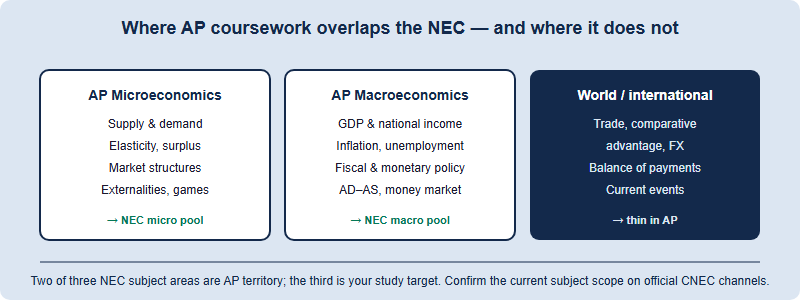
How AP topics map onto the NEC subject areas
The cleanest way to plan prep is to take the AP topics you have already studied and tag each one against the NEC subject area it serves. Most of the AP Micro and AP Macro curriculum transfers one-to-one. The table below is a planning guide, not a syllabus claim — always confirm the exact current content scope on the official CNEC channels — but it shows how little net-new economics an AP student needs.
| AP topic you already study | NEC subject area it feeds | Transfer for an AP student |
|---|---|---|
| Supply, demand, equilibrium, elasticity | Microeconomics | Direct — same concepts, faster questions |
| Consumer/producer surplus, deadweight loss | Microeconomics | Direct — reuse AP graphing logic |
| Market structures, game theory, externalities | Microeconomics | Direct — expect applied, less rote |
| GDP, inflation, unemployment, AD–AS | Macroeconomics | Direct — same definitions and traps |
| Fiscal and monetary policy, money market | Macroeconomics | Direct — same mechanisms |
| Comparative advantage, trade (AP touches lightly) | World / international economy | Partial — broaden beyond the AP slice |
| Exchange rates, balance of payments, current events | World / international economy | Gap — study fresh for the NEC |
Read the table top to bottom and a pattern appears: the micro and macro rows are “direct,” and the bottom two rows are where your real reading list lives. An AP student who treats the whole NEC as new content wastes months re-learning equilibrium; an AP student who tags topics this way spends those months on international economy and on the formats AP never tested.
One caution for AP students specifically: the NEC’s micro and macro questions can be more applied and more interlinked than the cleanly separated AP exam items. A single competition question may ask you to read a market-structure diagram, infer a policy response, and connect it to a macro consequence — threading micro into macro in one breath. AP teaches each block well but tends to test them in isolation. So the transfer is real, but plan to practise joining the blocks, not just recalling them. The applied rounds reward economists who can move from a graph to a judgement quickly, which is a habit you build through reps rather than through re-reading the textbook. If you want to see how those applied rounds are structured before you start, the round formats are summarised on the CNEC site — confirm the current specifics there, since formats are set officially.
The three gaps AP leaves — and how to close them
AP Economics builds knowledge; the NEC also tests how fast and how collaboratively you can use it. Three specific gaps separate a confident AP student from a competition-ready one.
- Gap 1 — the world / international economy. AP Macro touches trade, exchange rates, and comparative advantage, but the NEC’s international dimension runs broader and more current-events-driven. Close it with a focused reading block: trade theory, currency and balance-of-payments mechanics, and the macro stories moving global markets this year. This is the single most valuable place to spend AP-saved hours.
- Gap 2 — speed and format. AP exams give you generous minutes per multiple-choice item and structured free-response. NEC rounds such as the Qualifying Test, Super Econ and the buzzer-paced Quiz Bowl reward instant recall and decisive calls. Knowing a concept “well enough for AP” is not the same as retrieving it in seconds. Close this gap with timed drilling, not more reading.
- Gap 3 — team play. AP is an individual exam. The NEC’s David Ricardo and Adam Smith divisions are teams of four (the Pre division can be individual or a small group of 2–4). Strong individual economists still lose Quiz Bowl points to teams that have divided coverage and agreed who answers what. Close this gap by practising as a unit early, not the week before.
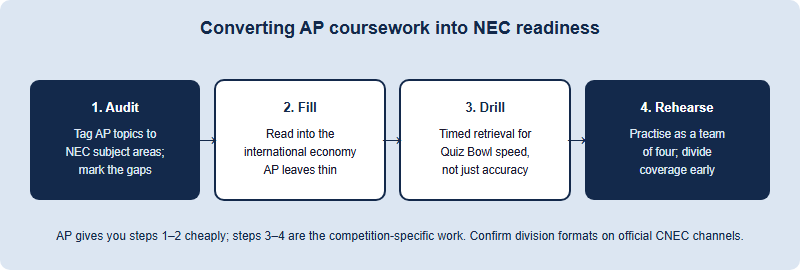
A coursework-to-prep plan that reuses what you already revise
The advantage of being an AP student is that your AP revision and your NEC prep can be the same study sessions, re-pointed. You do not need two separate workloads. Practically:
- Re-point your AP review. When you revise market structures or AD–AS for the AP exam, do a second pass under a timer in NEC question style. Same content, competition format.
- Add one weekly international block. Devote one session a week purely to the world economy — trade, FX, and current macro events. This is the content AP will not cover for you.
- Choose your division by readiness, honestly. The Pre division (individual or 2–4) is the natural on-ramp for a student newer to competition; David Ricardo and Adam Smith (teams of four) suit students with stronger command and a settled team. The official division rules sit on the CNEC site; confirm them before you commit.
- Practise the seven-round shape. The NEC spans Qualifying Test, Super Econ, Quiz Bowl, Critical Thinking, Econ Lab, Econ Immersion, and the U20 Youth Voice round. AP prepares the knowledge for the written rounds; the applied and team rounds need their own rehearsal.
Note where the line sits: the CEE sets the official academic standard and the NEC rules; the CNEC, run by Hanlin as the authorized China test center, runs the national round and the only official route from China to the global rounds. Any named question-setters or judges associated with the contest are organiser claims — treat them as such and confirm officially rather than as settled fact.
What an AP grade does and does not tell you about NEC readiness
A 5 on AP Micro or Macro is a genuine signal of conceptual command, and it shortens your path. It does not, on its own, predict a deep NEC run, because the Challenge measures two things AP does not: retrieval speed and team coordination. The honest read is that a strong AP grade puts you ahead on knowledge and even with everyone else on the competition-specific skills — which is precisely why the conversion steps above matter. Use AP as the floor it is, then build the speed and the team play on top. We make no guarantee about results or admissions outcomes; this is a study plan, not a promise.
Frequently asked questions
Do I need both AP Micro and AP Macro to do the NEC?
No. Either AP course gives you a strong base in its half; you fill the other half and the international economy from study. Confirm current subject scope on official CNEC channels.
Which NEC division should an AP student enter?
Pre (individual or 2–4) suits newcomers; David Ricardo and Adam Smith are teams of four for stronger students. Check division rules on the official CNEC site.
Is AP enough for the world-economy questions?
Partly. AP Macro touches trade and exchange rates, but the NEC’s international scope is broader, so treat it as a dedicated study block of its own.
How do I enter the NEC from China?
Through the CNEC, the officially authorized China National Round run by Hanlin since 2016 — the only official path to the NEC global rounds. See the CNEC home page for current details.
Published by the NEC / CNEC editorial desk, operated by Hanlin Education as the officially authorized China National Economics Challenge (CNEC) test center. The NEC is run by the Council for Economic Education, which sets the official rules — always confirm current dates, divisions, fees and awards on the official CNEC channels. Corrections are made within 7 working days.