
If you are aiming for engineering, medicine, computer science, history or English — not economics — is the National Economics Challenge (NEC) still worth your time? Sometimes yes. The NEC builds quantitative reasoning, data literacy and timed teamwork that transfer to almost any field, but it is a real commitment that only pays off if it fits your interests and schedule. This guide gives you the honest case for and against, from a non-major's point of view.
Why a non-major would even consider it
The NEC, run by the Council for Economic Education (CEE, founded 1949), is a timed, test-and-team competition covering microeconomics, macroeconomics and the world/international economy, reaching roughly 10,000 students a year in the United States. None of that screams "useful for a future biologist." But strip away the subject label and look at what the format actually trains, and the picture changes. Economics is, at its core, a discipline of modelling decisions under constraints — and that is a habit of mind that travels.
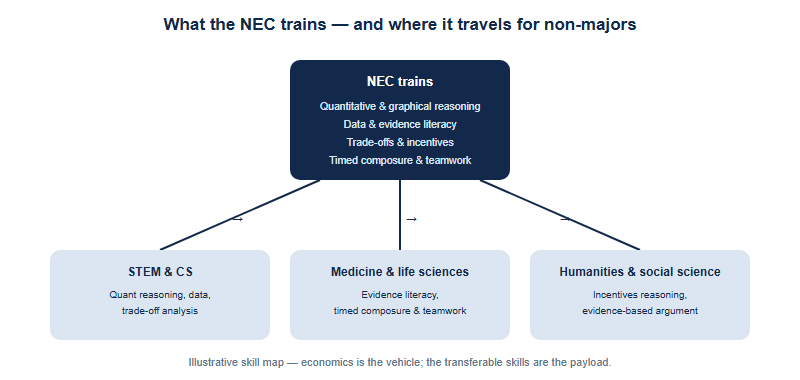
A STEM applicant gets disciplined practice turning words into graphs and equations, reading data, and reasoning about trade-offs — the same muscles used in physics, statistics and any research that handles real numbers. A humanities applicant gets a framework for arguing about incentives, policy and human behaviour with evidence rather than assertion, which sharpens essays in history, politics and philosophy. And every entrant gets the two things the NEC trains hardest regardless of major: composure under a timed clock and genuine small-team collaboration. Those are not economics skills. They are study-and-work skills that an economics competition happens to deliver well.
The transferable skills, named honestly
It is easy to claim "transferable skills" and leave it vague. Here is the concrete version, mapped to what a non-major actually does later. None of this requires you to love economics; it requires you to be willing to learn a structured way of thinking and perform it under pressure.
| What the NEC drills | Where a non-major uses it |
|---|---|
| Building and reading graphs/models (supply-demand, cost curves) | Physics, statistics, engineering and any lab science that fits models to data |
| Turning data into a conclusion under time pressure | Timed STEM exams, research write-ups, and any role that interprets numbers fast |
| Reasoning about trade-offs and incentives | Policy and ethics debates in history, politics, philosophy and medicine |
| Structured, evidence-based argument | Humanities essays and personal-statement writing that needs a defensible claim |
| Composure on a live buzzer / timed round | Interviews, vivas, oral exams and high-pressure presentations everywhere |
| Genuine small-team collaboration | Group projects, lab teams and any future workplace |
Notice what is not on that list: nothing about needing a prior economics background, and nothing that only an economist will ever use. A first-time entrant from a science or humanities track starts the same place as everyone else — the content is learnable in a season, and the harder part is the format, which is exactly the part that transfers. If you want to see how that content is organised before deciding, the structure sits on the CNEC home page.
The honest cost — this is not a free add-on
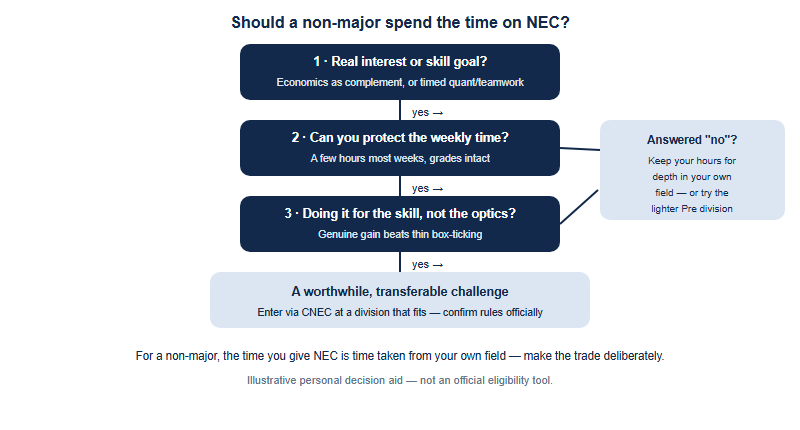
Here is where a non-major guide has to be straight with you, because the case against matters as much as the case for. The NEC is not a low-effort badge you collect in an afternoon. A realistic season is weeks of preparation across three subject areas — micro, macro and the world economy — ideally with regular team practice, building toward the competition rounds. For a non-major, that economics study sits on top of the subjects you actually care about and the courses you are graded on.
That is the real trade-off. Every weekly hour you give the NEC is an hour not spent on your physics olympiad, your research project, your portfolio, or your humanities reading. If economics genuinely interests you as a complement — or if you simply want disciplined practice at quantitative reasoning and timed teamwork — that trade can be worth it. If you are stretched thin and adding the NEC purely because it "looks good," it is usually the wrong call: a thin, reluctant participation in an unrelated field is a weaker signal than depth in your own. Choosing the entry-level Pre division (which can be entered individually or as a team of 2–4) is one way to keep the cost proportional, rather than committing to a four-person advanced team. The figure below frames the decision as the honest opportunity-cost question it really is.
How a non-major should read the admissions angle
Be careful here, because this is where wishful thinking creeps in. For a student applying outside economics, the NEC is not evidence of fit for your intended major, and no competition is a guaranteed route to a prize or a university place. What it can credibly show — if you do it seriously — is intellectual range, comfort with quantitative material, and the kind of curiosity that reaches beyond a single subject. A future medic who can also reason about health-policy trade-offs, or an engineer who understands the economics around technology, is showing breadth, not confusion.
But breadth only reads as a strength when your core is already strong. The NEC works for a non-major as a complement to a deep, coherent profile in your real field — never as a substitute for it, and never as filler. Universities and readers see through a scatter of unrelated activities; they respond to a clear central interest with one or two genuine adjacent explorations. If the NEC is that adjacent exploration and you can speak honestly about what you learned, it adds something. If it is just another line, it does not. Treat it as a credible interest signal among many, valued for the learning, and you will frame it correctly.
If you decide it fits: entry in China and what to verify
For families in China there is one official route. The CNEC is the official China National Round, operated by Hanlin (SKT) since 2016 across 20+ provinces and 300+ schools, and it is the only official path from China onward to the NEC global rounds. The NEC is organised by division so you can enter at a level that matches your experience: the Pre division (entry level) can be entered individually or as a team of 2–4, while David Ricardo (intermediate) and Adam Smith (advanced) are each a team of four. For a non-major testing the waters, Pre is usually the sensible starting point — it keeps the time cost proportional to the experiment.
Everything specific you need to budget around — current dates and deadlines, the exact registration fee, the round format for the cycle, and the award structure — is set by the organiser and updated each year, so confirm it on the official CNEC site rather than relying on figures from a forum. The CEE sets the underlying academic standard for the NEC; the CNEC desk runs the China round. Any named question-setters or judges cited elsewhere are organiser claims you should confirm officially rather than take as fact.
A first-party note from the CNEC desk
As the officially authorized China test center for the NEC, the pattern we see is that non-economics students who enjoy the NEC are the ones who came for the skills — the timed reasoning, the data work, the team rounds — and treated the economics as an interesting new language to pick up. The ones who regret it are usually students who added it late, under pressure, purely for the line on an application, and then found it competing with the work that actually defines them. Our honest advice to a non-major is therefore the same advice we would give about any cross-field activity: do it if it genuinely adds to a strong core, start in a division that keeps the cost sensible, value the learning over the medal, and verify every specific figure on the official channels. If after the opportunity-cost check above the answer is "not this year," that is a perfectly good answer — depth in your own field is rarely the wrong bet.
Frequently asked questions
Is the NEC worth it if I'm not majoring in economics?
It can be, as a complement to a strong core. It builds quantitative reasoning, data literacy and timed teamwork that transfer, but only if it fits your time.
Will the NEC help a STEM or humanities application?
It can show breadth and quantitative comfort, but it is not proof of fit for your major and never guarantees a prize or a place. Keep your core field deep.
Do I need economics background to enter?
No. The content is learnable in a season, and the entry-level Pre division can be entered individually. Confirm divisions and rules on the official CNEC channels.
How much time does the NEC really take?
A realistic season is weeks of study across micro, macro and world economy, ideally with team practice. For a non-major that sits on top of your graded subjects.
Published by the NEC / CNEC editorial desk, operated by Hanlin Education as the officially authorized China National Economics Challenge (CNEC) test center. The NEC is run by the Council for Economic Education, which sets the official rules — always confirm current dates, divisions, fees and awards on the official CNEC channels. Any errors will be corrected within 7 working days.