
If you take IB Economics, you already hold most of what the NEC (National Economics Challenge) tests — your micro, macro and global-economy units cover the same theory. The gap is format, not knowledge: IB rewards extended written evaluation and real-world commentary, while the NEC’s Qualifying Test and Quiz Bowl reward fast, precise recall of definitions, diagrams and mechanisms under the clock. This guide maps your HL/SL syllabus onto the NEC and shows exactly where to re-train.
Why IB Economics is unusually well-suited to the NEC
The NEC is run by the Council for Economic Education (CEE, founded 1949) and examines three subject areas: microeconomics, macroeconomics, and the world/international economy. That third area is the decisive overlap. Among the major international curricula, IB Economics is the one that builds a dedicated global economy unit into its core — covering international trade, exchange rates, the balance of payments, economic integration, and economic development. So an IB student walks in with structured coverage of the exact area many candidates treat as an afterthought.
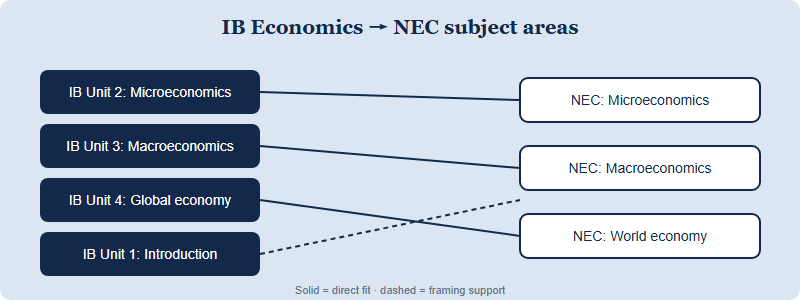
In broad terms, IB’s four units line up against the NEC’s three subject areas like this. The fit is strong on coverage; the work is in converting IB-style understanding into NEC-style speed.
| IB Economics unit | Maps to NEC area | IB strength for NEC |
|---|---|---|
| Unit 2 — Microeconomics | Microeconomics | Strong: demand/supply, elasticity, market failure, costs |
| Unit 3 — Macroeconomics | Macroeconomics | Strong: AD/AS, the business cycle, fiscal & monetary policy |
| Unit 4 — The global economy | World/international economy | Standout: trade, exchange rates, BoP, integration, development |
| Unit 1 — Introduction (HL: behavioural insights) | Cross-cutting concepts | Useful framing; lighter direct yield in a quiz format |
Where the IB syllabus already carries you
Several IB habits transfer almost directly to NEC items, and you should lean on them rather than relearn the material from scratch:
- Diagram fluency. IB drills you to draw and label demand/supply, AD/AS, externality, and trade diagrams. The NEC frequently asks you to read a shift or identify an outcome from such a diagram — your IB diagram bank is exactly the right mental library.
- The global-economy unit. Tariffs, quotas, comparative advantage, floating vs fixed exchange rates, the current account, and the development indicators you cover for IB Unit 4 are squarely inside the NEC’s world-economy area.
- Policy mechanisms. IB’s treatment of fiscal and monetary policy — how a central bank’s rate change works through to AD, or how automatic stabilisers behave — is the same causal chain the NEC tests, just asked in seconds rather than paragraphs.
- Real-world examples. The “real-world example” discipline you build for IB internal assessment and Paper 1 gives you the contextual anchor that helps in the NEC’s Critical Thinking case work, where you reason about an applied scenario.
A useful first-party observation from running the China National Round: IB students who fall short rarely fail on theory. They lose marks on speed and on a handful of definitional edges (see below), not on whether they understand the economics.
What IB over-emphasises — and under-emphasises — for this format
IB Economics is built around extended evaluation: “to what extent” essays, 15-mark Paper 1 parts, and a heavily weighted internal assessment of commentaries. That is excellent training for thinking, but the NEC’s early rounds — the Qualifying Test and Quiz Bowl — are multiple-choice and rapid-recall. Three IB tendencies need active rebalancing.
| IB tendency | Why it helps in IB | NEC adjustment to make |
|---|---|---|
| Long evaluative writing (“to what extent”) | Earns the top IB markbands | Practise reaching the correct answer in <60s; save evaluation for Critical Thinking |
| Selective real-world commentary | Rewarded in IA and Paper 1 | Pair it with broad factual coverage; the quiz rewards breadth, not depth on one case |
| Lighter quantitative load (esp. SL) | IB keeps maths accessible | Drill calculations: elasticity, multiplier, price floors/ceilings, simple index numbers |
| Curriculum-paced sequencing | Macro often comes in Year 2 | Front-load macro early if you compete before finishing the IB macro unit |
Two areas deserve special attention. First, quantitative work: SL Economics in particular keeps the maths light, but NEC items will ask you to compute — a price-elasticity value, the size of a spending multiplier, the effect of a binding price ceiling, or a percentage change from an index. Build a short calculation drill into your routine. Second, pacing: an IB student trained to spend ten minutes structuring an argument can freeze when the right move is to commit to an answer in under a minute. Timed practice is the single highest-yield habit you can add.
There is also a vocabulary edge. IB and US-style economics agree on the substance but occasionally differ in labelling and emphasis (for example, how monetary tools or certain market structures are framed). When you practise on US-origin NEC-style questions, treat any unfamiliar term as a definition to log, not a knowledge gap to panic over.
A curriculum-specific prep plan for IB students
Because your theory base is already strong, an efficient plan spends most of its time on format conversion, not content. The four-phase sequence below assumes you are competing through the official China National Round (CNEC) toward the NEC global rounds.
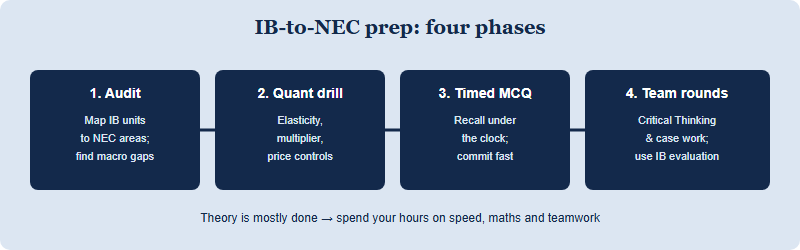
- Phase 1 — Audit. Lay your IB unit list beside the NEC’s three subject areas. The likely gap is macro timing: if your school teaches macro in Year 2 and you compete earlier, front-load AD/AS, inflation, unemployment and policy now.
- Phase 2 — Quantitative drill. Convert qualitative IB understanding into numbers — practise elasticity, the multiplier, price-floor/ceiling effects, and reading index or growth figures. Short, daily sets beat occasional long sessions.
- Phase 3 — Timed multiple-choice. Rehearse the Qualifying-Test rhythm: answer correctly in under a minute, flag-and-move when unsure, and review every miss as a definition or mechanism to log.
- Phase 4 — Team rounds. For David Ricardo and Adam Smith divisions, the team rounds and Critical Thinking are where IB’s evaluative training finally pays its full premium — channel “to what extent” reasoning into structured case responses.
Choose your division honestly against your year and experience. The NEC’s three divisions are Pre (entry level; individual or a team of two to four), David Ricardo (intermediate; a team of four), and Adam Smith (advanced; a team of four). An IB student new to competition often starts in Pre or David Ricardo and steps up the following cycle. Exact division rules, eligibility and the round line-up are set by the organiser — confirm them on the official CNEC pages before you register.
How the China route works for IB students
The NEC is a US competition with roughly 10,000 American students taking part each year, and it is overseen academically by the CEE, which sets the official rules and standards. For students in China, the official route runs through the CNEC (China National Economics Challenge), the official China National Round operated by Hanlin (SKT) since 2016, now spanning 20+ provinces and 300+ schools. The CNEC is the only official path from China into the NEC global rounds, so your division placement, registration and schedule are handled through it rather than by signing up to the US event directly.
Practically, this means an IB student’s pathway is: register through the CNEC, compete in the China National Round in your chosen division, and — depending on results and the current cycle’s rules — progress toward the NEC global rounds. Some materials reference well-known economists (for example, named question-setters or endorsers) as part of the event’s profile; treat those as organiser claims and confirm any such detail officially rather than assuming it. For the authoritative timeline, fees and division structure, always work from the live CNEC schedule and rules.
Frequently asked questions
Does IB Economics cover everything the NEC tests?
It covers the same three areas — micro, macro and the global economy — very well. The gap is usually format and quantitative drill, not theory; confirm the current syllabus on the official CNEC channels.
Is HL required, or can SL students compete?
Both can compete. SL students should add extra calculation practice, since SL keeps the maths lighter than the NEC’s quiz items tend to demand.
Which NEC division should an IB student pick?
Often Pre or David Ricardo first, then a step up next cycle. Division rules are set by the organiser — verify eligibility on the official CNEC pages.
How do students in China actually enter the NEC?
Through the CNEC, the official China National Round operated by Hanlin since 2016 — the only official route from China to the NEC global rounds.
Published by the NEC / CNEC editorial desk, operated by Hanlin Education as the officially authorized China National Economics Challenge (CNEC) test center. The NEC is run by the Council for Economic Education, which sets the official rules — always confirm current dates, divisions, fees and awards on the official CNEC channels. Any error will be corrected within 7 working days.