
The NEC works best as one deliberate piece of a multi-year activity plan, not a standalone trophy. Slot it where its workload, timing and skill profile complement what you already do: enter the right division for your stage, place its team-heavy season in a gap between your other deadlines, and let its applied micro-and-macro reasoning reinforce — rather than collide with — your other competitions and ECs.
Start from the portfolio, not the competition
Admissions officers and any thoughtful mentor read your activity list as a narrative, not a checklist. The question is never “is the NEC good?” — it is “what does the NEC add that your other activities don't, and can you carry it well in the term you plan to run it?” The National Economics Challenge is run by the Council for Economic Education (CEE, founded 1949) and tests microeconomics, macroeconomics and the world/international economy across three divisions and seven rounds. That profile — applied economic reasoning under time pressure, much of it in a team of four — is what you are adding to the mix.
Before you sign up, sketch your full slate on one page: every competition, club leadership, research project and exam season you are already committed to. Then ask three sequencing questions of the NEC against that page:
- Timing — does the CNEC national round and its run-up fall in a relatively open window, or does it pile onto another deadline?
- Load — the David Ricardo and Adam Smith divisions are teams of four; the Pre division can be entered individually or as a 2–4 student team. Can you and your teammates sustain that during your busiest term?
- Complementary skills — does the NEC stretch a muscle your portfolio is missing (applied micro/macro, team quiz reasoning), or just duplicate something you already demonstrate?
If the answer to that last question is “duplicate”, the NEC may still belong — but as depth, not breadth. If it adds a genuinely new dimension, it earns its place as a distinct line on your list. For the official rules and current division and round structure that anchor this planning, see the CNEC home page.
Match the division to your stage in the plan
The single biggest sequencing decision is which division you enter, and when. The three divisions are designed as a ladder, so they map naturally onto where you are in a multi-year arc rather than onto a single year. Treat the table below as a planning aid, not a rule — always confirm current eligibility and division definitions on the official CNEC channels.
| Division | Level | Entry format | Where it tends to fit in a multi-year plan |
|---|---|---|---|
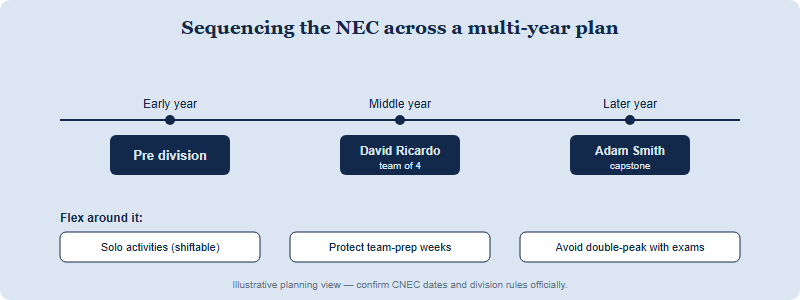
| Pre | Entry | Individual or 2–4 students | An early-stage on-ramp while you are still building your core economics and your other activities are light. |
| David Ricardo | Intermediate | Team of 4 | A middle-of-plan step once you have a settled team and a term with room for shared prep. |
| Adam Smith | Advanced | Team of 4 | A capstone for a later year, when your economics depth and your portfolio narrative are both mature. |
The portfolio logic here is continuity: a student who progresses Pre → David Ricardo → Adam Smith across several years shows a clean upward trajectory in one discipline, which reads far more credibly than a scatter of one-off entries. That progression is also a teammate story — the same four students improving together is a stronger signal than four strangers assembled for a single season.
Sequence the NEC season around your other deadlines
Because the higher divisions are team events with seven rounds — Qualifying Test, Super Econ, Quiz Bowl, Critical Thinking, Econ Lab, Econ Immersion and U20 Youth Voice — the NEC has a heavier collaboration load than a solo exam-style olympiad. That changes how you place it in the year. A solo maths or essay competition can often be squeezed into a busy term because you control your own hours; a four-person quiz team cannot, because four calendars have to align.
Practical sequencing moves that keep the NEC from colliding with the rest of your slate:
- Anchor on the CNEC round first. The CNEC national round is the only official path from China to the NEC global rounds, so its dates are the fixed point. Build everything else around it — and confirm those dates on the official CNEC channels before you lock anything in.
- Protect the team-prep weeks. Identify the run-up window when your team needs shared sessions, and avoid stacking another team-heavy commitment (a debate tournament, a hackathon, a model UN conference) into the same fortnight.
- Use solo activities as the flex. Individually-controlled work — independent research, an essay competition, problem sets — is easier to shift by a week. Let those absorb the pressure so the fixed team dates stay protected.
- Don't double-peak with exams. If your IB, A-Level or AP sittings fall close to the NEC season, drop down a division or skip a year rather than degrade both.
Let the skills compound across your activities
The strongest portfolios are not collections of unrelated wins — they are activities whose skills compound. The NEC's seven rounds each train something transferable, and the planning trick is to point those gains at the rest of your slate rather than treating the competition as a sealed box.
| NEC round | Skill it trains | What it feeds elsewhere in your portfolio |
|---|---|---|
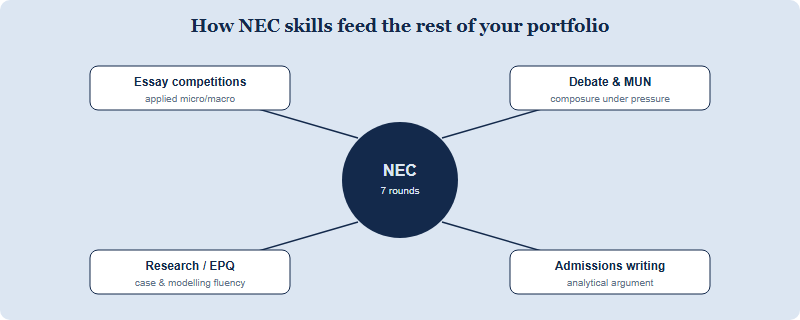
| Qualifying Test & Super Econ | Rapid applied micro/macro recall | Stronger economics foundations for an essay competition or EPQ/research. |
| Quiz Bowl | Team buzzer reasoning under pressure | Composure and quick recall useful in debate and oral defences. |
| Critical Thinking | Open-ended economic argument | Analytical writing for personal statements and admissions essays. |
| Econ Lab & Econ Immersion | Applied, scenario-based economics | Modelling and case-study skills for business or research activities. |
| U20 Youth Voice | Communicating economics to an audience | Presentation skills that carry into MUN, clubs and interviews. |
Read that way, the NEC can be the connective tissue of an economics-leaning portfolio: it sharpens the applied reasoning that an essay competition rewards, the composure that debate demands, and the case fluency that a research project needs. That is the difference between “I did five things” and “my five things tell one coherent story.” For how the NEC's skills map onto a longer academic trajectory, our CNEC editorial section covers it in more depth.
A simple decision framework
When you are unsure whether to add the NEC this year, run it through four checks in order. If you stall at any step, that is your answer — defer, drop a division, or commit fully.
- Fit: Does it add a new dimension (applied economics, team reasoning) my list lacks? If yes, continue.
- Stage: Which division matches where I am — Pre, David Ricardo or Adam Smith? Pick honestly.
- Calendar: Do the CNEC dates leave my team genuine prep weeks without crashing another deadline? Confirm officially first.
- Carry: Can all four of us sustain this without degrading our existing commitments? If no, drop a division or wait a year.
The goal is never to collect the most activities. It is to build a slate where each piece earns its place and the pieces reinforce one another — and, placed thoughtfully, the NEC can be one of the load-bearing pieces of an economics-focused plan.
FAQ
Should I do the NEC if I already do an economics essay competition?
Often yes — they complement. The NEC trains rapid applied reasoning; an essay trains depth. Just avoid running both peaks in the same fortnight.
Which NEC division fits a beginner's portfolio?
The Pre division is the entry level and can be entered individually or as a 2–4 team — a sensible early on-ramp. Confirm current rules on the official CNEC channels.
How heavy is the NEC compared with a solo competition?
Heavier on coordination: the higher divisions are teams of four across seven rounds, so four calendars must align. Plan its season earlier than a solo event.
Is the NEC worth a place over breadth elsewhere?
It earns its place when it adds depth and connects to your other activities. If it only duplicates a skill you already show, treat it as depth, not a new line.
Published by the NEC / CNEC editorial desk, operated by Hanlin Education as the officially authorized China National Economics Challenge (CNEC) test center. The NEC is run by the Council for Economic Education, which sets the official rules — always confirm current dates, divisions, fees and awards on the official CNEC channels. Any factual error will be corrected within 7 working days.