
The National Economics Challenge (NEC) tests national income accounting as a measurement problem, not a growth story. You must know that GDP can be built two ways — the expenditure approach (C + I + G + NX) and the income approach — that they sum to the same total, and that nominal GDP must be deflated by the GDP deflator to get real GDP. The marks live in the traps: what counts, what double-counts, and which prices apply.
Two ways to add up the same economy: expenditure and income
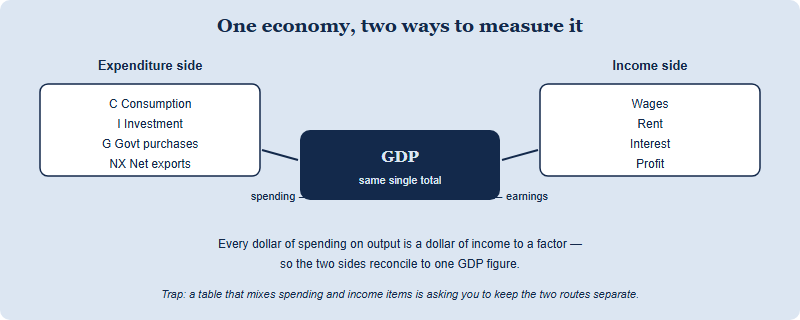
The first thing NEC items reward is knowing that gross domestic product is the market value of all final goods and services produced within a country in a period — and that you can measure that single total from either the spending side or the earning side. Every dollar spent on output is a dollar of income to someone (wages, rent, interest, profit), so the expenditure total and the income total are two views of one number. Questions that hand you a table of components are testing whether you can assemble the identity without leaving anything out or counting anything twice.
The expenditure approach is the one most NEC questions lead with: GDP = C + I + G + NX, where C is household consumption, I is gross private investment (including business fixed investment, residential investment, and the change in inventories), G is government purchases of goods and services, and NX is net exports (exports minus imports). The income approach instead sums the payments to the factors of production — compensation of employees, rents, interest, and profits — plus the two adjustments students forget: indirect business taxes and depreciation (the consumption of fixed capital). Both routes must reconcile to the same GDP, and an item that gives you one set of figures and asks for the other is checking that you know they are equivalent.
- C — consumption: household spending on goods and services. Note that buying a newly built home is counted in investment, not consumption.
- I — investment: business capital, new residential construction, and the change in inventories — not the purchase of stocks or bonds, which are financial transfers.
- G — government purchases: spending on goods and services. Transfer payments such as pensions or unemployment benefits are excluded because nothing is produced in exchange.
- NX — net exports: exports minus imports. Imports are subtracted because they were produced abroad, not within the domestic economy.
You can see where these macroeconomics items sit alongside the micro and world-economy questions on the CNEC site; the accounting framework here is the spine that the later inflation, unemployment, and policy topics all hang from.
| Expenditure approach | Income approach | Both must equal |
|---|---|---|
| C — consumption | Compensation of employees | GDP (one total, two views) |
| I — gross investment | Rents | |
| G — government purchases | Interest | |
| NX — net exports | Profits | |
| = GDP | + indirect taxes + depreciation |
The “final goods only” rule and the double-counting trap
A whole family of NEC questions exists to catch students who add up everything that gets sold rather than only what counts. GDP measures the value of final goods and services — those bought by the end user. The value of intermediate goods, which are used up in producing something else, is excluded, because it is already embedded in the price of the final good. Count the steel and the car and you have counted the steel twice. The exam-safe fix is the value-added method: at each stage, add only the increase in value the firm created, and the stages sum to the final price.
The second exclusion NEC tests is the line between production and mere transfer. GDP records output produced this period, so several common transactions are deliberately left out: the resale of used goods (the production was counted in an earlier year), purely financial transactions such as buying shares or bonds (no good or service is produced), and transfer payments from government (a redistribution, not output). A favourite trap hands you a list and asks for “this year’s GDP”; the discipline is to strike out the second-hand car, the stock purchase, and the pension cheque before you total anything.
- Count once, at the final stage. Use value added to avoid summing intermediate inputs into the total.
- Exclude used goods. A second-hand sale transfers an asset; it was counted as output in the year it was made.
- Exclude financial trades. Stocks and bonds change ownership of claims; nothing new is produced.
- Exclude transfer payments. Benefits and subsidies redistribute income without a matching good or service.
Nominal vs real GDP: the deflator does the work
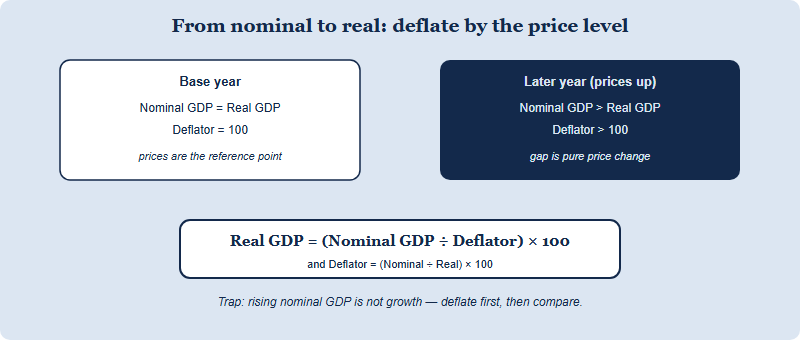
This is the heart of the assigned topic and the place NEC questions most reliably separate strong students. Nominal GDP values output at the prices of the current year, so it can rise simply because prices rose, even if no extra goods were made. Real GDP values output at the prices of a fixed base year, stripping out price changes so that any movement reflects a genuine change in the quantity of goods and services. When an item asks whether the economy actually produced more, the answer always runs through real, not nominal, GDP.
The bridge between the two is the GDP deflator, defined as nominal GDP divided by real GDP, multiplied by 100. Rearranged, real GDP equals nominal GDP divided by the deflator, times 100. NEC computational items typically give you nominal GDP and a deflator (or the underlying base-year and current-year prices and quantities) and ask you to recover real GDP, or to compute the deflator itself. The marks are lost when students confuse the deflator with the Consumer Price Index: the deflator covers all domestically produced output and uses current-year quantities, while the CPI tracks a fixed basket of consumer goods and includes imported items. They are both price indices, but they are not interchangeable, and NEC questions exploit the difference.
| Measure | Prices used | What a rise means | Use it to… |
|---|---|---|---|
| Nominal GDP | Current-year prices | Output or prices rose — can't tell which | State value at today's prices |
| Real GDP | Fixed base-year prices | Genuinely more goods produced | Compare output across years |
| GDP deflator | Nominal ÷ Real × 100 | Average price of all output rose | Convert nominal to real |
| CPI (contrast) | Fixed basket, includes imports | Cost of a consumer basket rose | Track consumer cost of living |
GDP vs GNP, and the welfare caveats NEC wants named
Two further distinctions show up in the Critical Thinking and short-answer rounds. The first is geography: GDP counts output produced within a country's borders regardless of who owns the factors, while GNP (or gross national income) counts output produced by a country's residents wherever they are. A foreign-owned factory operating domestically adds to GDP but not to GNP; income a citizen earns abroad adds to GNP but not to GDP. Questions test this by describing a cross-border operation and asking which aggregate it enters.
The second is the limits of GDP as a measure of well-being, which NEC essays and CT prompts ask students to argue carefully rather than dismiss. GDP omits non-market production such as unpaid household and volunteer work; it ignores the distribution of income, so a rising total can mask widening inequality; it does not net out environmental degradation or resource depletion; and it says nothing about leisure, health, or the composition of output. The disciplined answer the exam rewards is that GDP is an excellent measure of market output and a useful but incomplete proxy for living standards — powerful for comparison, limited as a verdict on welfare.
- GDP vs GNP: borders versus residents — pin down which one a cross-border income flow belongs to.
- Real GDP per capita: the usual living-standards proxy, because it adjusts for both prices and population.
- What GDP misses: non-market work, inequality, environmental cost, leisure — name these to earn the evaluation marks.
How to drill national income accounting for the NEC rounds
National income accounting rewards a fixed checklist applied at speed, which fits the NEC format — the Qualifying Test and Quiz Bowl punish hesitation on definitions, while Critical Thinking and the Econ Lab reward the conceptual reads on GDP's limits. A first-party drilling routine we use with CNEC teams:
- Memorise the expenditure identity cold. C + I + G + NX should be automatic, with the inclusions and exclusions of each term (new homes in I, transfers out of G, imports subtracted in NX) rehearsed as a list.
- Run an exclusion sweep first. Before totalling any GDP table, strike out used goods, financial trades, transfer payments, and intermediate inputs. Doing this before arithmetic kills the double-counting error.
- Always ask “nominal or real?” When a question mentions growth or comparison across years, convert to real GDP with the deflator before drawing any conclusion. Treat a bare nominal rise as ambiguous.
- Separate the two price indices. Drill the deflator (all output, current quantities) apart from the CPI (fixed consumer basket, includes imports) so a question on one is not answered with the other.
National income accounting is one slice of the macroeconomics the NEC tests, but it is the measurement language every later macro topic — inflation, unemployment, fiscal and monetary policy — is written in, so the precision you build here pays off across the whole syllabus and the world-economy section too. To see where these macroeconomics items sit in the wider format and timeline, confirm the current structure on the official CNEC channels before relying on any specific detail.
FAQ
What is the expenditure formula for GDP that NEC tests?
GDP = C + I + G + NX: consumption, gross investment, government purchases, and net exports (exports minus imports).
How do you convert nominal GDP to real GDP?
Divide nominal GDP by the GDP deflator and multiply by 100; real GDP values output at fixed base-year prices.
What is excluded from GDP in NEC questions?
Intermediate goods, used-good resales, purely financial trades, and government transfer payments are all left out.
How does the GDP deflator differ from the CPI?
The deflator covers all domestic output at current quantities; the CPI tracks a fixed consumer basket and includes imports.
Published by the NEC / CNEC editorial desk, operated by Hanlin Education as the officially authorized China National Economics Challenge (CNEC) test center. The NEC is run by the Council for Economic Education, which sets the official rules — always confirm current dates, divisions, fees and awards on the official CNEC channels. Errors are corrected within 7 working days.