
Advancement to the NEC (National Economics Challenge) global rounds runs through one official channel for students in China: the CNEC, the China National Round operated by Hanlin (SKT) as the authorized China test center since 2016. You register and compete as a team within CNEC; top-performing teams in the qualifying division earn the invitation upward. This guide explains the mechanics of that hand-off — not a global-finals rulebook.
The pathway in one picture: there is exactly one official door
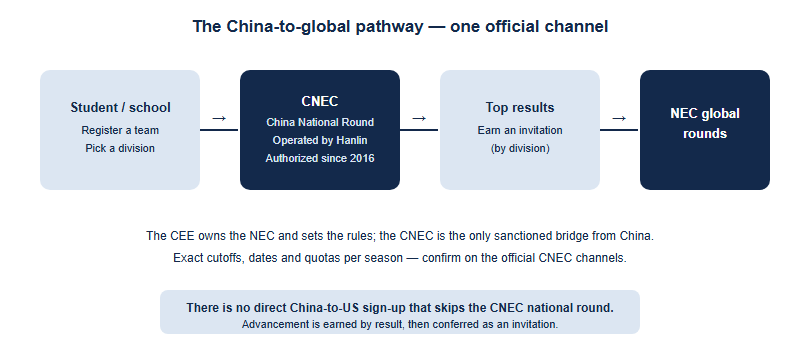
The most important thing to understand before you spend a season preparing is structural, not tactical: for a student sitting in a Chinese international school, the route to the NEC global rounds is not a direct sign-up on a US portal. It is a relay. You enter the CNEC China National Round, you perform inside a division there, and advancement is earned by result, then conferred as an invitation to the next stage. The Council for Economic Education (CEE, founded 1949) owns the NEC and sets the academic standard; the CNEC is the officially authorized China test center that runs the national round and is the only sanctioned bridge from China to the global stage.
That single-door design has three practical consequences. First, your division choice at the CNEC stage is also a choice about which advancement track you sit in. Second, advancement is a team event in the competitive divisions, so the unit that moves up is the roster, not an individual. Third, because the CEE defines the rules and the CNEC executes them in China, any specific cutoff, date or quota is something to confirm on the official CNEC channels rather than assume — the structure below is stable, but the numbers attached to a given season are not ours to invent.
Where you start: divisions are advancement tracks, not just difficulty tiers
Most newcomers read the three NEC divisions as a simple difficulty ladder. They are that — but for advancement purposes they are better understood as separate tracks, because the division you compete in at the CNEC stage frames the bracket you would advance within. The NEC's academic content is the same family across the board — microeconomics, macroeconomics, and the world/international economy — but the entry format and team structure differ by division.
| Division | Level | Team structure | What it signals for advancement |
|---|---|---|---|
| Pre | Entry | Individual or a team of 2–4 | On-ramp division; the place to learn the round formats before committing to a full competitive roster |
| David Ricardo | Intermediate | Team of 4 | The standard competitive track for most international-school teams new to NEC depth |
| Adam Smith | Advanced | Team of 4 | The top track; the deepest theory and the most demanding bracket to advance through |
The strategic read is to choose the division that matches your team's genuine depth, not the most prestigious-sounding one. Advancement is comparative: you are ranked against the other teams in your division. A well-drilled team that places highly in David Ricardo is on a real upward path; a half-prepared team that over-reaches into Adam Smith generally is not. Because the precise mapping of which division's results feed which level of the global rounds can vary by season, treat the table above as the shape of the decision and verify the current-season specifics on the official CNEC channels before you lock a roster. You can review division framing on the official CNEC homepage.
What actually moves you up: the result-to-invitation hand-off
Advancement in NEC is not a separate exam you sign up for after the national round — it is a consequence of how your team performs inside the CNEC stage. The CNEC round is scored across the NEC's competition formats, and standing at the top of your division's field is what produces an invitation forward. Mechanically, three things govern whether your team converts a strong season into an actual advancement:
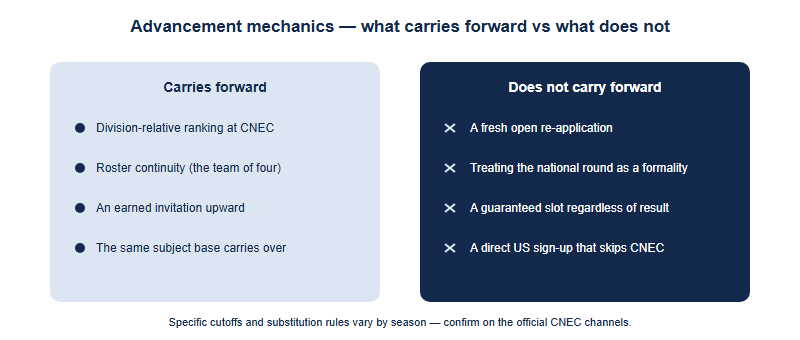
- Division-relative ranking. You advance on where you finish within your division's bracket, not on an absolute score in isolation. The competition is the other teams beside you, so depth of the field matters.
- Roster continuity. Because the competitive divisions are team events (teams of four in David Ricardo and Adam Smith), the unit that advances is the roster. Plan for the same four students to carry through, and confirm any substitution rules on the official channels.
- The invitation, not a re-application. Advancement is conferred — eligible teams receive the path to the next stage rather than re-entering a fresh open registration. Treat your national-round result as the qualifying act itself.
A common misconception worth dispelling: students sometimes assume that because the global rounds are the "real" NEC, the national round is a formality. The opposite is true. The CNEC national round is the selection event. Everything that determines whether you advance is decided there, which is exactly why your preparation budget should be weighted toward the national-round formats rather than toward speculation about the global stage. For how those formats are scored, the CNEC competition pages are the reference point.
A first-party note from the CNEC desk: planning backward from advancement
As the officially authorized China test center, the CNEC desk sees the same avoidable mistakes each cycle, and they are almost all planning errors rather than knowledge gaps. The single biggest one is teams that assemble late and treat the national round as a warm-up. Because advancement is decided at CNEC, a roster that forms in the final weeks has effectively conceded its upward path before the first round is scored. Teams that advance tend to lock their four members early, settle their division honestly, and rehearse the round formats together rather than studying solo.
The second recurring issue is division over-reach. Adam Smith is the prestige track, and ambitious students gravitate to it, but advancement is comparative within a division. A team is far better served winning a place near the top of David Ricardo than finishing mid-pack in Adam Smith. The third is logistical: students who do not confirm the current-season registration window, team-size rule and result-to-invitation specifics on the official CNEC channels, and instead rely on last year's memory or a forum post. Those operational facts can change between cycles, and the CEE — which sets the official rules — is the ultimate authority that the CNEC pages reflect.
None of this guarantees an outcome, and nothing here should be read as a promise of advancement or of any admissions result. What it does offer is a clearer model of the machine: enter through the one official door, compete honestly within the right track, keep your roster intact, and treat the national round as the decisive event it actually is. The specific dates, divisions, fees and awards for the live season belong on the official CNEC channels; the pathway shape above is what stays constant.
Frequently asked questions
How do students in China qualify for the NEC global rounds?
By competing in the CNEC China National Round, operated by Hanlin as the authorized test center; top division results earn an invitation upward.
Is there a direct way to enter the NEC global rounds from China without CNEC?
The CNEC is the only sanctioned bridge from China to the NEC global rounds; there is no direct sign-up that skips the national round.
Does my division choice affect advancement?
Yes — advancement is ranked within your division's bracket, so choose the track that matches your team's real depth. Confirm specifics on the official CNEC channels.
Does the whole team advance or just individuals?
In the competitive divisions (David Ricardo and Adam Smith) NEC is a team event of four, so the roster advances together. Verify substitution rules officially.
Published by the NEC / CNEC editorial desk, operated by Hanlin Education as the officially authorized China National Economics Challenge (CNEC) test center. The NEC is run by the Council for Economic Education, which sets the official rules — always confirm current dates, divisions, fees and awards on the official CNEC channels. Any errors will be corrected within 7 working days.