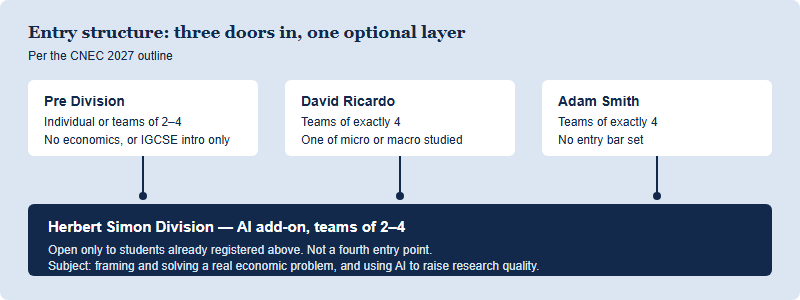
Herbert Simon is the fourth division on the CNEC 2027 programme, and it is an add-on rather than a fourth entry point. The organiser’s outline opens it only to students who are already registered in Pre, David Ricardo or Adam Smith. Teams are two to four students, and the subject is applied artificial intelligence in economics research. You choose it in addition to a division, never instead of one.
That single sentence is the one most students get wrong when they hear that CNEC now has an AI division. This article sets out exactly what the 2027 outline states, what it does not state, and how to decide whether adding it is sensible for your team — or whether it quietly costs you the round that actually determines your season.
What the 2027 outline actually says about Herbert Simon
The Herbert Simon Division belongs to CNEC, the China national programme. It is not a division of the global NEC structure run by the Council for Economic Education, and you should not expect to find it described in the same terms on the international side. When you read about NEC divisions written for a United States audience, you are usually reading about a two-division structure that predates all of this. Keep the two frames separate.
| Attribute | What the 2027 outline states | Why it matters to you |
|---|---|---|
| Eligibility | Open only to students already registered in the Pre, David Ricardo or Adam Smith divisions | There is no independent entry. Your main-division registration is the prerequisite, so the ordinary division rules still bind you first |
| Team size | Two to four students per team | Narrower than David Ricardo and Adam Smith, which require exactly four. A subset of your main team can enter without the whole roster |
| Subject | Applied AI in economics research: framing and solving a real economic problem, and using AI to raise research efficiency and the quality of the output | Two distinct skills are being assessed, not one. Tool fluency alone does not satisfy the first aim |
| Programme | CNEC China | Do not assume the same track exists at every global site or in materials written for other national programmes |
The naming is worth a sentence, because it tells you something about intent. CNEC divisions are named after economists: Adam Smith, David Ricardo. Herbert Simon received the 1978 Nobel Memorial Prize in Economic Sciences for his work on decision-making inside economic organisations, and he was also one of the founding figures of artificial intelligence research, sharing the 1975 Turing Award with Allen Newell. He is close to the only person you could name a division after and have it point at both fields at once. The outline itself does not gloss the name, so treat that reading as ours rather than the organiser’s.
Add-on, not a fourth way in: three readings that cost students a season
Every autumn we watch the same three misreadings appear once a new option is announced. Each of them is fixable in September and expensive in December.
- “I will enter the AI division instead, because I have not studied economics.” You cannot. Eligibility runs through an existing registration in Pre, David Ricardo or Adam Smith, and Pre and David Ricardo carry entry conditions assessed against your background before September, while Adam Smith sets no entry bar. If you have not studied economics, the honest route is the Pre division, not the AI track.
- “It is an AI competition, so the economics matters less.” The first stated aim is framing and solving a real economic problem. The tooling is the second aim, not the first. A polished report about a question that is not economically well posed fails the harder half of the brief.
- “We will add it later if the term goes well.” Possibly — but the outline we are working from does not publish a separate deadline, a stage, or an entry mechanism for the add-on. Do not plan around a window whose existence has not been confirmed. Ask the organiser directly during the registration period.
The structural point matters more than any of the detail. Your division decision still comes first, still gets assessed against your economics background as at before September, and still carries the consequence we have written about separately: if you have not chosen a division by 30 November, the registration defaults into Adam Smith, the hardest division. Adding an AI track on top of a division you drifted into by inaction is the worst version of this season.
Teams of two to four, inside a division that requires four
The team-size difference is the most practically useful fact in the whole announcement, and almost nobody notices it. David Ricardo and Adam Smith require exactly four students. The Herbert Simon add-on takes two to four. That means the AI entry does not have to be your whole roster.
In practice that opens a configuration that solves a real problem. Most four-person teams are not uniformly interested in data work. One or two members are comfortable with spreadsheets, a scripting language or a statistical package; the others are stronger on written argument or on the recall speed the live rounds demand. A two- or three-person subset can carry the AI entry while the full four keeps its focus on the qualifying test, and nobody is dragged into a project they cannot contribute to.
Two cautions before you split. First, the outline does not state whether members of a Herbert Simon team must all sit in the same main division, so do not assume a mixed-division subset is permitted — ask before you plan around it. Second, a subset entry still consumes the calendar of the people in it, and those people are usually your strongest problem-solvers. Splitting the work does not create free labour; it moves the load onto whoever you least want distracted in the fortnight before the preliminary.
What “applied AI in economics research” actually demands
The outline gives two aims, and they are different skills. The first is framing and solving a real economic problem. The second is using AI to raise research efficiency and the quality of the output. Teams that treat these as one aim usually produce a fluent report about a question that no economist would have asked.
On the first aim, the discipline is ordinary economics, applied earlier than students expect. A researchable question names a mechanism, a population and a period: not “how does AI affect employment” but “how did delivery-platform entry change hours worked in three second-tier Chinese cities between 2019 and 2024, and through which channel”. If you cannot say which variable moves first and what would falsify your answer, no amount of tooling rescues the project.
On the second aim, our editorial experience is that the binding constraint is verification, not generation. Language models produce plausible numbers, and in economics research the number is the argument. We run one rule internally and recommend it to every team: every figure that appears in the output must be traceable to a named source you personally opened — a national statistics office, a central bank release, the World Bank or IMF databases, a published paper. A statistic that a model produced and nobody located is not evidence; it is a fabrication with a confident tone.
Three habits follow from that, and they cost less time than fixing the problem later:
- Keep a source line for every number. Series name, publisher, release date, retrieval date. Do this while drafting, not at the end.
- Log what you asked and what you changed. CNEC’s Critical Thinking round ends in a defence in front of judges, and the habit of knowing your own work transfers directly. If a member cannot explain why a method was chosen, the work is not yet the team’s.
- Separate the model’s draft from your claim. Generated text is a starting point that you then argue with. The output that leaves your team should be the version you can defend line by line.
One honest caveat: the outline states the subject matter, not the assessment criteria. It does not publish a rubric, a permitted-tools list, a disclosure format for AI assistance, or a length limit. Do not infer any of those from how other competitions handle AI. Ask the organiser, and write to the answer you get.
Who should take it on, and who should leave it this season
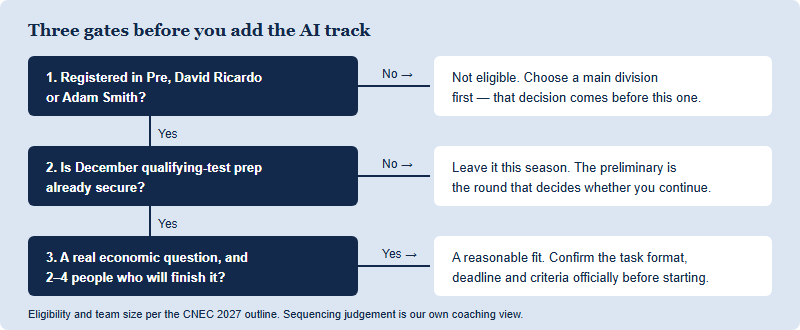
The clearest fit is a team that is already comfortable in its main division, has at least one member with real data or coding literacy, and has a question that came from something they noticed rather than from a topic list. Established school economics clubs tend to qualify because they already have a research habit and a term of shared work behind them.
The clearest non-fit is a first-time entrant whose December preliminary is the binding constraint on the season. From coaching across the divisions, the pattern we see is unglamorous: the teams that travel furthest are usually the ones that made the qualifying test boring and secure before they took on anything optional. Our own China cohort at the 2026 Asia global site finished with team golds, a team silver and team bronzes, and a first place globally on an individual component — that is our own de-identified tally rather than an official statistic, and results vary from year to year and team to team. What it does not show is any shortcut around the test that gets you there.
One boundary worth stating plainly: treat this as an economics-research opportunity, and evaluate it on whether the work is worth doing. We make no claim about what any competition does for a university application, and you should be sceptical of anyone who does.
What the outline does not tell you yet
Honest gaps, listed so you can ask precise questions instead of guessing. In the outline we are working from, the Herbert Simon Division does not come with a published stage mapping, submission deadline, assessment rubric, output format, permitted-tools list, or separate fee. The five rounds that are mapped to stages — the Qualifying Test, Critical Thinking, the Quiz Bowl, the new OX-BP Debate Sessions and U20 Youth Voice — are set out in our stage-by-stage guide to the 2027 rounds, and the AI add-on is described separately from that table.
Two framing reminders while you wait for detail. This remains a test-and-team competition, structurally different from the economics essay prizes that some students enter in the same year — we compare the two formats in our guide to NEC against the essay competitions. And the AI track does not change the arithmetic of the main season: registration runs through the autumn, the preliminary sits in mid-December, the China national round follows in March, and the global sites run from May onwards. Confirm every date and fee on the official channels before you commit, because they are set each season and they move.
Frequently asked questions
Can I enter the Herbert Simon Division on its own?
No. The 2027 outline opens it only to students already registered in the Pre, David Ricardo or Adam Smith divisions. It is an add-on.
How many students are on a Herbert Simon team?
Two to four, per the outline. That is narrower than David Ricardo and Adam Smith, which both require exactly four students.
Is this a division of the global NEC competition?
It appears in the CNEC China programme outline. Do not assume the same track exists in materials written for other national programmes.
What does the AI division assess?
Applied AI in economics research: framing and solving a real economic problem, and using AI to raise research efficiency and output quality.
Published by the NEC (CNEC) editorial desk, operated by Hanlin Education for China-based international-school students. Official rules are set by the competition and change yearly — confirm current details on councilforeconed.org and through the official CNEC channels. Errors are corrected within 7 working days.