
Eligibility for the National Economics Challenge (NEC) turns on three things: your grade level / experience, the division you enter, and that division's team-composition rule. The NEC is run by the Council for Economic Education (CEE), which sets the official academic standard; students in China enter through CNEC, the official China National Round operated by Hanlin (SKT) since 2016 — the only official path from China to the NEC global rounds. This guide covers the rules of who can enter, not how to click through a sign-up form.
The three divisions decide almost everything
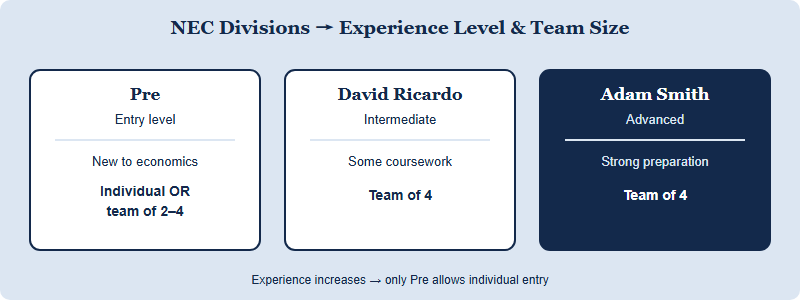
The single most important eligibility question is not your age — it is which division you belong in. The NEC offers three, ordered by economics experience rather than by a rigid grade boundary. Picking the right one is the difference between a fair fight and an unwinnable one, and the division also dictates whether you compete alone or as a fixed team.
- Pre (entry level) — designed for students new to formal economics. This is the only division that can be entered as an individual or as a small team of two to four, which makes it the natural on-ramp for younger or first-time competitors.
- David Ricardo (intermediate) — for students with some economics coursework or competition experience. Entered as a team of four.
- Adam Smith (advanced) — the top tier, for students with substantial economics preparation. Also a team of four.
The headline number to internalise: with the sole exception of Pre (which permits individual entry), NEC is a team competition built around squads of four. There is no "solo Adam Smith" route. If you only have two committed teammates, your options are shaped accordingly, and that constraint is worth confronting before you fall in love with a division above your roster size.
Grade levels: think "high school", then read the fine print
The NEC is fundamentally a high-school economics competition: in the United States it draws roughly 10,000 students a year, the great majority of them secondary-school students. For Chinese international-school families, that maps cleanly onto the senior years — broadly the Grade 9 to Grade 12 window where students are taking IB Economics, A-Level Economics, AP Microeconomics and Macroeconomics, or an equivalent.
But "high school" is a category, not a precise cut-off, and this is exactly the kind of fact you should never guess at. Whether a specific Grade 8 student or an early-graduating Grade 12 student qualifies, and whether any year-of-birth boundary applies, is set by the official rules and can vary by cycle. Do not assume a grade range from how the divisions sound — confirm the current grade and age eligibility on the official CNEC channels before you commit a younger or borderline student.
A more useful mental model than "what grade am I in?" is "how much economics have I actually done?" Because the NEC sorts by experience tier, a motivated Grade 10 student who has finished a full microeconomics course may be better placed than the grade label alone suggests — and a Grade 12 student with no prior economics is not automatically an Adam Smith candidate. Match the division to the preparation, not to the calendar.
| Eligibility factor | What it decides | Where to confirm |
|---|---|---|
| School level | NEC is a high-school competition (~10,000 US students/yr) | Official CNEC rules |
| Grade / age cut-off | Exact grade range & any year-of-birth limit | Official CNEC channels — do not assume |
| Division | Pre / David Ricardo / Adam Smith by experience | Official CNEC rules |
| Team size | Individual or 2–4 (Pre) vs team of 4 (Ricardo, Smith) | Official CNEC rules |
| China entry path | CNEC = the only official route to the global rounds | en.nec.org.cn / CNEC pages |
Team-composition rules: how to build a legal squad of four
Once you are in David Ricardo or Adam Smith, the team of four is the unit of competition, and the composition rules deserve real attention because they trip up well-prepared students every year. Below are the questions that determine whether your roster is valid — and the honest answer to several of them is "check the official rules for this cycle," because they are precisely the details organisers adjust.
- Must all four come from the same school? Many team competitions require it; whether the NEC / CNEC does, and whether cross-school or mixed teams are permitted, is a rule to verify officially rather than infer.
- Can divisions be mixed within one team? No — every member of a team competes in that team's single division. You cannot pair an Adam Smith student with a Pre student on the same roster; pick one division for the whole team.
- What if a teammate drops out? Substitution windows, minimum team size on competition day, and whether a three-person team may still compete are governed by the official rules — confirm before you assume a depleted team is disqualified.
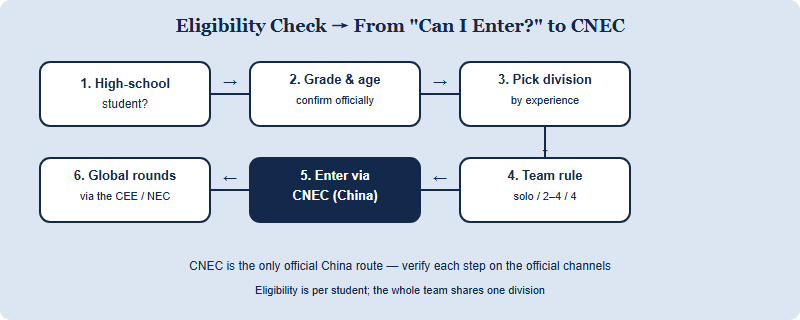
- Does everyone need to meet the grade/age rule individually? Treat eligibility as per student: each member must independently satisfy the grade and age requirements for the division. One ineligible member can put the whole entry at risk.
The practical takeaway: lock your four committed students and your target division early, then read the current composition rules together as a team. A first-party tip from running the China round — the most common avoidable mistake is forming the team around the strongest student's ambition (Adam Smith) when the other three are genuinely intermediate. A coherent David Ricardo squad that all sit at the same level routinely outperforms a top-heavy Adam Smith team carrying two passengers.
Who can enter from China: the CNEC route
For students based in China, eligibility has one extra dimension beyond grade and team: the path itself. You do not enter the US National Economics Challenge directly. Instead, students compete in the CNEC (China National Economics Challenge) — the official China National Round operated by Hanlin (SKT) since 2016, now spanning 20+ provinces and 300+ schools. CNEC is the only official channel through which a China-based team can progress toward the NEC global rounds.
What this means for eligibility, concretely:
- International-school and bilingual students in China are the core audience. The NEC's subjects — microeconomics, macroeconomics, and world/international economy — sit naturally alongside IB, A-Level and AP economics, so the academic profile maps onto China's international-school cohort.
- The division and team rules above still apply. CNEC runs the same three-division, team-of-four structure; entering via China does not change who is eligible within a division, only the round you enter through.
- The CEE sets the standard; CNEC runs the China round. Hanlin operates CNEC as the officially authorized China test center, but the academic rules originate with the Council for Economic Education. Where a CNEC-specific eligibility detail differs from the US framing, the official CNEC pages are authoritative.
If you are weighing the NEC against essay-style economics competitions, note that it is a test-and-team format rather than a single-author essay contest — a structural difference that also shapes who thrives in it. You can review the official China-round framing and current rules on the CNEC site, and use the NEC / CNEC home page as your starting point for verifying dates, divisions and entry details before forming a team.
Frequently asked questions
What grade do you need to be in for the NEC?
It is a high-school competition, broadly the senior-school years. Confirm the exact grade and age cut-off on the official CNEC channels.
Can I enter the NEC as an individual?
Only in the Pre division, which allows individual entry or a team of two to four. David Ricardo and Adam Smith require a full team of four.
How do students in China enter the NEC?
Through CNEC, the official China National Round run by Hanlin (SKT) since 2016 — the only official path to the NEC global rounds.
Can one team mix divisions or schools?
Every team competes in one division, and eligibility is per student. Cross-school and substitution rules should be confirmed on the official CNEC pages.
Published by the NEC / CNEC editorial desk, operated by Hanlin Education as the officially authorized China National Economics Challenge (CNEC) test center. The NEC is run by the Council for Economic Education, which sets the official rules — always confirm current dates, divisions, fees and awards on the official CNEC channels. Any errors will be corrected within 7 working days.