
The hardest part of moving from AP Economics to the National Economics Challenge is not the content — it is the change in how you are asked to think. AP trains a solo, untimed, one-topic-at-a-time, recall-driven learner; the NEC rewards a fast, integrated, judgement-first economist who performs on a team. Bridging that gap means retraining four habits over a term, not learning a new syllabus.
Same economics, different game
If you have studied AP Microeconomics or AP Macroeconomics, you already hold a large share of the economics the NEC tests. The Council for Economic Education (CEE, founded 1949) runs the National Economics Challenge across microeconomics, macroeconomics and the world / international economy, drawing roughly 10,000 students a year in the United States. The overlap with the AP canon is real — which is exactly why so many AP students underestimate the jump and then stall in their first practice rounds.
The reason is that a competition is a different kind of test from a course. AP is built to certify that you understand economics in a controlled, predictable, individual setting. The NEC is built to find out who can use economics quickly, under pressure, in conversation with teammates, when the question does not announce which chapter it belongs to. A student can know every diagram in the AP textbook and still freeze in a buzzer round, because the skill being tested has changed even though the subject has not. This article is about that mindset shift — not which AP chapters map onto which NEC topics, and not a week-by-week summer plan, both of which we cover separately. Here the single question is: how do you stop studying like a coursework student and start performing like a competitor?
For students in China, the route into the global rounds is the China National Round (CNEC), operated by Hanlin (SKT) as the officially authorized China test center since 2016, now spanning 20-plus provinces and 300-plus schools. The CEE sets the official academic standard and the NEC rules; the CNEC runs the national round and is the only official path from China to the NEC global stages. Exact divisions, rounds, dates and formats are set by the organiser and shift season to season, so confirm the current cycle on the official CNEC channels before you plan around any specific deadline.
The four shifts that separate a course from a competition
The gap between AP-style learning and NEC performance is not one big difference but four small, trainable ones. Name them explicitly and each becomes a thing you can practise, rather than a vague feeling that “the competition is just harder.” The table below is the map for the rest of this guide.
| Dimension | How AP trains you | What the NEC demands | The shift to make |
|---|---|---|---|
| Pace | Generous minutes per item; time to second-guess | Buzzer-speed recall in rounds like Quiz Bowl | From accuracy-at-leisure to accuracy-at-speed |
| Structure | One concept per question, cleanly separated | Questions thread micro into macro into trade | From isolated topics to connected reasoning |
| Mode | A purely individual exam | Teams of four sharing coverage and the buzzer | From solo study to coordinated play |
| Goal | Reproduce the correct definition or diagram | Make and defend a judgement from evidence | From recall to applied judgement |
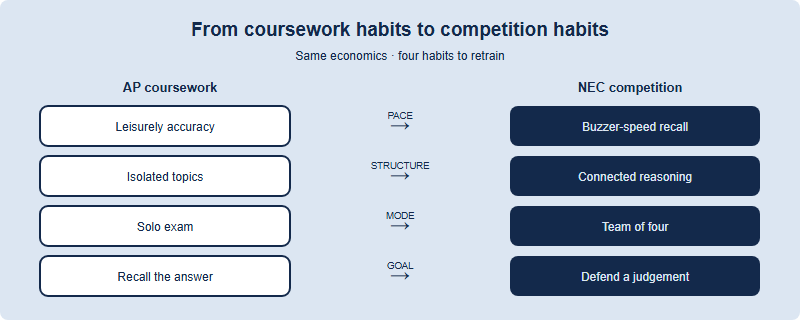
Shift 1 and 2: from leisurely accuracy to fast, connected thinking
The first wall AP students hit is pace. On an AP exam you have time to read a multiple-choice item twice, eliminate options and still pause to check. Several NEC rounds remove that cushion: in a buzzer-paced format such as Quiz Bowl, the economics you “know well enough for the exam” has to surface in seconds or it does not count. The fix is not more reading — it is retrieval practice under a clock. Drill in short timed sets where the goal is to commit fast and review afterwards, so that recall becomes a reflex rather than a deliberation. Knowing and retrieving are different muscles, and only the second one is tested when the buzzer is live.
The second wall is structure. AP questions are engineered to test one idea at a time: this item is about elasticity, that one is about the money market. Competition questions are deliberately less tidy — a single prompt can ask you to read a market-structure situation, infer the policy response and trace its macro consequence, threading three “chapters” into one answer. AP teaches each block cleanly but rarely makes you join them under pressure. Bridging this means practising the joins on purpose: take any concept you have revised and force the next sentence to be “…and the knock-on effect on the wider economy is…”. When you read the news, push every story one step further than the AP textbook would — from the micro event to the macro echo to the trade angle. That chaining habit is what the applied and critical-thinking rounds are really probing.
Shift 3: from a solo exam to a team of four
This is the shift AP students most often ignore, because the AP exam gives no reason to develop it. AP is, start to finish, an individual test of one person’s knowledge. The NEC is largely a team competition: the David Ricardo and Adam Smith divisions are teams of four, while the entry-level Pre division can be an individual or a small group of two to four. A roster of four strong solo economists who have never practised together routinely loses buzzer points to a coordinated team that has divided its coverage and agreed who answers what.
Retraining here is a social skill as much as an academic one. A team that bridges the gap well does three things a lone AP student never has to: it maps coverage so each member owns certain syllabus branches and no topic is left thin; it rehearses hand-offs so “you take the macro, I’ll take the trade question” is a trained reflex under time pressure; and it builds the trust to let the right person buzz without hesitation. The exact divisions and which rounds are team-based for the season are set by the organiser, so confirm them on the official CNEC channels — but the principle holds: collaboration is a rehearsed skill, and AP gave you no reps in it.
- Map coverage early. Assign syllabus branches across the four so the team’s knowledge has no holes — the opposite of studying alone.
- Rehearse the hand-off. Practise passing a question to the right teammate instantly; the smoothness is what wins timed rounds.
- Practise out loud, together. Run mock rounds as a unit so the team behaves like one in competition, not like four strangers.
Shift 4: from recall to applied judgement
The deepest shift is in what counts as a good answer. AP largely rewards reproduction: state the definition, draw the correct diagram, identify the textbook outcome. The NEC’s applied and critical-thinking style rewards judgement — reading a scenario, choosing the right model, and arguing the consequence in a way you can defend against a follow-up. A perfectly memorised definition is the starting line of a strong competition answer, not the finish.
The practical way to retrain this is to stop letting yourself stop at the definition. For any concept, practise a tight three-part answer — claim, mechanism, consequence: what is happening, why economically, and what follows. Then anticipate the challenge: a judge or teammate asks “but what about the other side?” and you have a second sentence ready. This is also why building a running bank of real-world cases pays off — not to memorise, but to have rehearsed the move from evidence to judgement so many times that it feels routine. AP gives you the raw concepts; this habit turns them into the kind of argument the harder rounds are designed to reward.
A term-length bridge: how to retrain across a semester
Because these are habits, not facts, you cannot cram them — you change them by how you study week to week across a term. The arc below sequences the four shifts so each builds on the last: settle the knowledge first, then layer on speed, then connection and judgement, then team play. Treat the phases as a scaffold to fit your own calendar, not a fixed timetable, and confirm the season’s real schedule on the official CNEC channels.
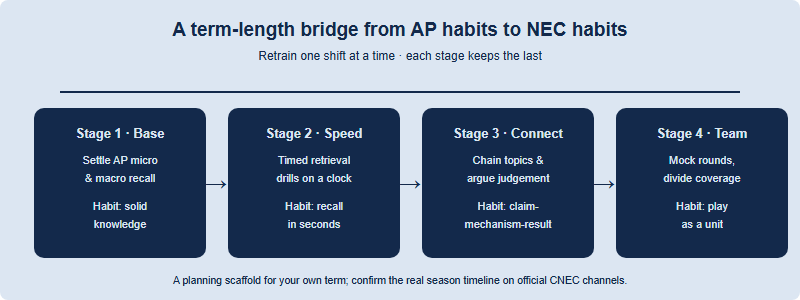
Read across the stages and the logic of the bridge is clear: you are not adding more economics on top of AP, you are progressively changing how you deploy the economics you already have. A student who tries to be fast, integrated, judgement-driven and team-ready all in week one usually achieves none of them; a student who layers the shifts in order arrives at competition season performing rather than panicking. You can see how the rounds those habits target are structured on the CNEC site, and should confirm the current specifics there since formats are set officially.
A first-party note from running the China round
As the officially authorized China test center (CNEC) for the NEC, the most consistent pattern we see is that the AP students who struggle are rarely short on knowledge — they are students who kept studying like the AP exam was still the target. They revise definitions instead of drilling speed, work alone instead of rehearsing the team, and stop their answer at the textbook outcome instead of carrying it to a defensible judgement. The ones who do well treat the move to the NEC as a change of habits, and they start that change early enough for it to settle. None of these shifts requires a paid course; they require deliberately practising the things AP never asked of you. We re-check every format and division detail against the CEE standard and the official CNEC materials each season rather than assuming last year’s structure holds, and any named question-setters or judges associated with the contest should be treated as organiser claims and confirmed officially. To build your bridge around the confirmed current cycle, start from the CNEC home page. We make no promise about results or admissions outcomes — this is a preparation approach, not a guarantee.
FAQ
I got a 5 in AP Micro — am I ready for the NEC?
You are ahead on knowledge but even with everyone on the competition-specific habits: speed, connected reasoning, judgement and team play. Build those on top.
What is the biggest difference between AP and the NEC?
Not the content, which overlaps heavily, but the demands: timed recall, questions that thread topics together, team rounds, and arguing a judgement rather than reciting a definition.
How long does the AP-to-NEC transition take?
Treat it as a term, not a cram. The four habit shifts settle best when layered in order over a semester, fitted to your own calendar.
Do I bridge this gap alone?
Mostly not. Speed and judgement you can train solo, but the NEC is largely a team event, so coordinated practice is part of the bridge. Confirm division rules on the official CNEC channels.
Published by the NEC / CNEC editorial desk, operated by Hanlin Education as the officially authorized China National Economics Challenge (CNEC) test center. The NEC is run by the Council for Economic Education, which sets the official rules — always confirm current dates, divisions, fees and awards on the official CNEC channels. Any error will be corrected within 7 working days.