
Most students need somewhere between three and ten months of real, weekly study for the NEC, and the figure depends almost entirely on your starting level, not the calendar. A confident AP Economics student can be ready in roughly three to four focused months; someone meeting demand and supply for the first time should plan on eight to ten. This guide sizes a three-phase plan — foundations, drilling, then mock rounds — by where you start, and tells you what “done” looks like before each phase ends.
Months of effort, not weeks on a calendar
There are two different questions a student preparing for the National Economics Challenge can ask, and they are easy to confuse. The first is “when are the rounds, and how do I plan back from them?” — a scheduling question answered by a season calendar. The second, which this guide answers, is “how many months of actual study do I need, and what should each month contain?” That second question is about your personal learning curve, and its answer barely moves when the official dates shift. A student who needs eight months of foundation work needs them whether the China round lands in spring or autumn.
Keeping the two separate matters because students routinely under-estimate the learning question while obsessing over the date one. The NEC is run by the Council for Economic Education (CEE, founded 1949), draws roughly 10,000 students a year in the United States, and tests microeconomics, macroeconomics and the world / international economy — a genuinely broad body of content. From China, the official route into it is CNEC, the China National Round operated by Hanlin (SKT) since 2016 across 20+ provinces and 300+ schools, and the only official path to the NEC global rounds. The CEE sets the academic standard; CNEC runs the China round. None of that tells you how long you need — so before you map anything onto real dates from the official CNEC pages, work out your honest study budget first.
Step one: a diagnostic that sets your timeline
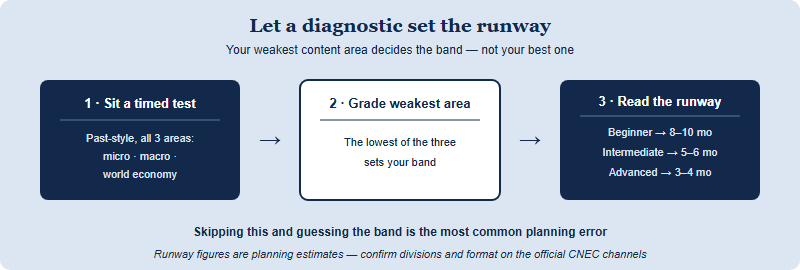
You cannot size a timeline you have not measured. Before booking a single month, sit a short past-style diagnostic across all three content areas — micro, macro and the world economy — under rough time pressure, and grade yourself honestly. The point is not the score; it is to locate which of three bands you are in, because each band implies a very different total runway. Your weakest area sets the band, not your strongest: a student fluent in micro but blank on macro is a beginner for planning purposes, because the syllabus is tested whole.
| Starting band | What it looks like | Realistic total runway | Where most of the time goes |
|---|---|---|---|
| Beginner | Little or no formal economics; meeting core models for the first time | ~8–10 months of weekly study | Foundations (the bulk of the plan) |
| Intermediate | One AP/A-Level econ course done; solid on one area, shaky on another | ~5–6 months | Split between foundations gaps and drilling |
| Advanced | Confident across AP Micro + Macro or equivalent; strong recall | ~3–4 months | Drilling and mock rounds; light foundations |
Two honesty checks keep this realistic. First, “weekly study” means consistent hours every week, not a heroic final fortnight — a beginner who can only commit two hours a week should stretch the runway, not compress the syllabus. Second, your division ambition adjusts the figure. The NEC has three divisions: Pre (the entry tier, which can be an individual or a team of 2–4), David Ricardo (intermediate, a team of 4) and Adam Smith (advanced, also a team of 4). Aiming at Adam Smith from a beginner base means budgeting toward the upper end of every band below; entering Pre as an individual lets you trim the team-rounds work in phase three.
The three phases, and how to size each one
Whatever your total runway, the work moves through the same three phases in the same order: foundations (learn the economics), drilling (make recall fast and accurate), then mock rounds (rehearse the competition itself). What changes by starting level is not the order but the proportion each phase takes. A beginner spends most of their runway on foundations; an advanced student spends almost none, pouring the time into drilling and mocks instead. The diagram below shows how the same three phases stretch and shrink across the three bands.
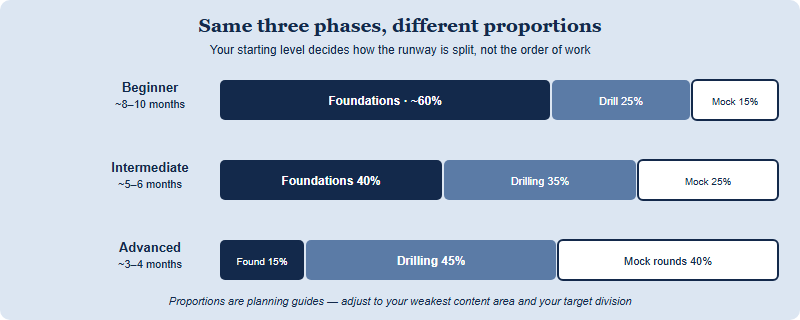
The single most common planning mistake is inverting this: a beginner who skips ahead to mock rounds “to feel ready” simply rehearses confusion at speed, while an advanced student who re-reads textbook chapters they already know wastes a runway they could have spent winning marks. Match the proportion to the band, then let each phase end on evidence — described next — rather than on a date.
Phase 1 — Foundations: learn the economics properly
Foundations is where you build genuine understanding across all three content areas, in roughly this order: microeconomics first (it underpins the rest), then macroeconomics, then the world / international economy. Work topic by topic, and resist the urge to drill speed before the concept is secure — fluency built on a shaky model just produces fast wrong answers. For a beginner this is the long phase; for an advanced student it shrinks to patching the one or two areas the diagnostic flagged.
Exit criterion: you can explain each core model in plain language and apply it to an unfamiliar scenario without notes — not merely recognise it. A practical test: pick any topic at random and teach it aloud for two minutes. If you stall, that topic is not done. Do not leave foundations until your weakest area clears this bar, because the Qualifying Test that every team member sits will find it. If you are weighing which division to build toward while you study, our CNEC overview is the place to confirm what each tier expects.
Phase 2 — Drilling: turn knowledge into fast, accurate recall
Drilling converts understanding into speed. Here you stop learning new theory and start doing volume: timed multiple-choice sets, short-answer practice, diagram sprints, and quick-calculation work on percentages, index numbers and real values. The shift in mindset is the whole point — competition rounds reward correct answers produced under a clock, which is a different skill from understanding a model in an untimed setting. Advanced students spend the largest slice of their runway here; beginners reach it later but must not skip it.
Exit criterion: your accuracy stays high as the timer tightens, and your error log stops surfacing the same mistakes. Keep a running list of every question you get wrong and why; when new errors are rare and repeats have disappeared, drilling has done its job. A useful internal benchmark is consistency, not perfection — hitting a steady practice score three sessions running matters more than one lucky high. Until that steadiness appears, stay in this phase rather than advancing on optimism.
Phase 3 — Mock rounds: rehearse the real thing
The final phase rehearses the competition format itself rather than the economics. The NEC is built around seven rounds — the Qualifying Test, Super Econ, Quiz Bowl, Critical Thinking, Econ Lab, Econ Immersion and U20 Youth Voice — and several reward live, collaborative, buzzer-style performance that no amount of solo study prepares you for. If you are in a team of four (David Ricardo or Adam Smith), this is when roles, communication and Quiz-Bowl coordination get built through repetition. Pre-division individuals can run a lighter version focused on solo timed performance.
Exit criterion: a full mock under realistic conditions feels familiar, not novel — the format no longer costs you marks, only the content does. For teams, the test is whether you coordinate smoothly under pressure rather than talking over each other. Confirm the current round line-up and any format details on the official CNEC channels before your final mocks, since rounds can vary by division and season. The table below summarises the three phases and their exit gates.
| Phase | Goal | Main activities | Exit criterion (move on only when…) |
|---|---|---|---|
| 1 · Foundations | Genuine understanding across all three areas | Topic-by-topic study: micro → macro → world economy | You can teach any topic aloud, weakest area included |
| 2 · Drilling | Fast, accurate recall under time | Timed sets, diagram sprints, quick calculations, error log | Accuracy holds as the clock tightens; repeat errors gone |
| 3 · Mock rounds | Competition fluency and team coordination | Full mocks, Quiz-Bowl reps, role assignment for teams | The format feels routine; only content, not nerves, costs marks |
Adapting the plan — and a first-party warning
The plan flexes in two directions. If your weekly hours are limited, stretch the total runway rather than cutting a phase — a beginner on light hours might need the full ten months, and that is fine. If you are returning for a second NEC season, you can often start partway into drilling, treating foundations as a quick refresh and spending the recovered time on mocks. And if your diagnostic is lopsided — strong macro, weak micro — spend foundation time only where you are weak, then rejoin the shared drilling phase.
From running the China National Round since 2016, the timeline error we see most is not starting late — it is skipping the diagnostic and guessing the band. Students who assume they are intermediate when they are really beginners run out of foundation time and arrive at mocks rehearsing gaps; students who assume they are beginners when they are advanced burn a runway on re-reading and never build competition speed. Twenty minutes of honest self-testing at the start protects months of effort afterward. Pair this learning timeline with the round-by-round mechanics on our competition pages so each phase is preparing you for something concrete — and remember that the timeline is yours to own, while the official dates, divisions and rules stay with the CEE and CNEC.
Frequently asked questions
How many months do I need to prepare for the NEC?
Roughly 8–10 months from scratch, 5–6 with one econ course done, and 3–4 if you are strong across AP Micro and Macro. Size it by a diagnostic.
Can I prepare for the NEC in one or two months?
Only if you are already an advanced student tightening speed and mocks. From a beginner base, two months is not enough to learn the full syllabus well — stretch the runway instead.
How do I know when to move from foundations to drilling?
When you can explain any core model aloud and apply it to a new scenario without notes — including your weakest content area, not just your strongest.
Does the timeline differ by division?
Yes. Adam Smith and David Ricardo teams need fuller mock-round practice; Pre individuals can run a lighter phase three. Confirm division rules on the official CNEC channels.
Published by the NEC / CNEC editorial desk, operated by Hanlin Education as the officially authorized China National Economics Challenge (CNEC) test center. The NEC is run by the Council for Economic Education, which sets the official rules — always confirm current dates, divisions, fees and awards on the official CNEC channels. Any factual error will be corrected within 7 working days.