
The Super Econ round of the National Economics Challenge (NEC) tests one thing the written exam does not: how fast you can recognise the right concept and the right model and answer correctly under time pressure. It rewards instant retrieval across microeconomics, macroeconomics and international economics — not slow derivation. This guide explains what the round asks of you and gives a focused routine to train the reflex it rewards.
Where Super Econ sits among the seven NEC rounds
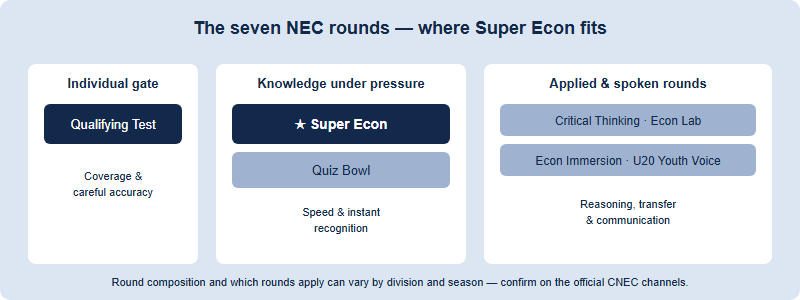
The NEC is built from seven distinct rounds — the Qualifying Test, Super Econ, Quiz Bowl, Critical Thinking, Econ Lab, Econ Immersion and U20 Youth Voice. Each rewards a different skill, and Super Econ occupies a specific niche: it sits in the “knowledge-under-pressure” family alongside Quiz Bowl, distinct from the applied-reasoning and presentation rounds. The economic content stays constant across all seven — micro, macro and world economics, the same syllabus the Council for Economic Education (CEE, founded 1949) sets for the competition. What changes is the delivery format, and Super Econ's format is built around speed.
It helps to picture the difference. The Qualifying Test is the individual gate that filters most of the field, and it is the most “studyable” round because it rewards systematic coverage — work through the syllabus, close your gaps, sit timed papers. Super Econ takes that same body of knowledge and asks a sharper question: not “do you understand this?” but “can you produce the answer in seconds?” A student who can derive elasticity from first principles but needs ninety seconds to do it will lose ground to one who simply knows the formula on sight. That gap — understanding versus instant recall — is the whole game in Super Econ.
What Super Econ actually tests
Strip the round to its core and Super Econ is a test of recognition speed across the full economics syllabus. Three abilities decide your score:
- Instant concept identification. Reading a prompt and knowing immediately which idea is in play — that a question about a price ceiling is really about shortages and deadweight loss, or that “crowding out” lives in the loanable-funds market — without re-reasoning from scratch.
- Formula and diagram recall on sight. Elasticity, the spending and money multipliers, the GDP expenditure identity, the quantity theory of money, the standard supply-and-demand and AD–AS shifts — these should surface the instant they are needed, not after a derivation.
- Accuracy that survives the clock. Speed without accuracy is worthless; the round rewards students who are both fast and right, which means trained retrieval rather than rushed guessing.
Notice what Super Econ does not primarily test: it is not the round where you build a long argument or interpret a fresh dataset — those skills belong to Critical Thinking and Econ Lab. Treating Super Econ like an essay round (over-explaining, second-guessing) is a common way strong students lose time. The mental mode is closer to a trained athlete's reflex than a philosopher's deliberation.
A practical word on the round's exact mechanics: the precise number of questions, the time limit, whether it is scored individually or as a team contribution, and how it is weighted are set by the organiser and can change from season to season. We deliberately do not publish fixed numbers here, because an out-of-date figure would mislead your prep. Confirm the current Super Econ format, timing and scoring on the official CNEC competition pages before you lock a study plan around any specific structure. What is stable — and what this guide is built on — is the skill the round rewards: fast, accurate retrieval.
The question style: train the retrieval, not the topic
Because Super Econ rewards recognition, the most useful way to think about question style is by the mental move each question demands, not by the topic label. Most Super Econ-style prompts fall into a few recurring families, and each family has a recognisable trigger phrase and a default response you can train to automaticity.
| Question family | Typical trigger | The retrieval you want to be instant |
|---|---|---|
| Definition / term match | “Which best describes…” | The precise textbook definition, distinguished from its near-neighbours (e.g. nominal vs real, movement vs shift) |
| Formula / calculation | Numbers given, a value wanted | The formula on sight: elasticity, multiplier, GDP identity, unemployment/inflation rates |
| Diagram / direction-of-change | “An increase in X causes…” | The correct curve, the direction it shifts, and the new equilibrium — pictured, not derived |
| Cause-and-effect chain | “What happens to… if…” | The first link in the chain (e.g. rates ↓ → investment ↑), answered fast and not over-extended |
| Policy / mechanism ID | “A central bank that wants to…” | The matching tool (open-market operations, reserve ratio, taxes/spending) and its directional effect |
The payoff of this view is that your practice stops being “revise macro” and becomes “drill the direction-of-change family until I never hesitate.” That is a far more trainable target, and it is exactly the kind of deliberate, family-by-family drilling that separates teams who clear the speed rounds comfortably from those who freeze.
A four-block training routine for Super Econ
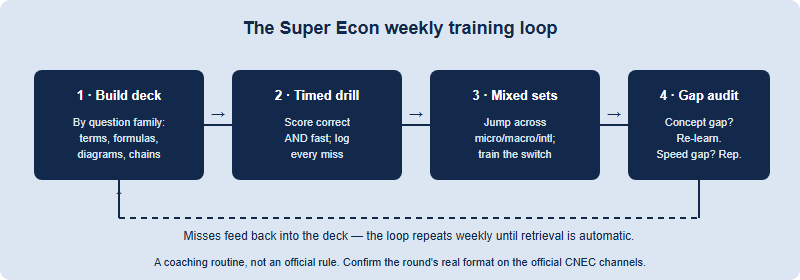
Here is a concrete routine our CNEC coaches use to build the recognition reflex. It runs in four blocks and is designed to be repeated weekly in the lead-up to the competition. The logic is simple: build the cards, drill them against a clock, then close the specific gaps the clock exposes.
Block 1 · Build a retrieval deck (foundation). Convert the syllabus into a flashcard deck organised by the question families above, not by chapter. One card per definition, per formula, per standard diagram, per canonical cause-effect chain. Writing the cards is itself half the learning, because it forces you to state each idea in its cleanest, fastest form. Aim for ruthless brevity: if a card takes more than a few seconds to read, split it.
Block 2 · Timed retrieval drilling (the core). Drill the deck against a stopwatch, scoring yourself on both correct and fast. Set a per-card target (for example, answer-before-you-flip in a fixed few seconds) and track which cards you miss the target on. This is the block that actually builds the reflex — slow, untimed review will never produce competition speed. Any card you hesitate on goes into a “retrain” pile for the next session.
Block 3 · Mixed rapid-fire sets (transfer). Once individual cards are fast, practise mixed sets that jump unpredictably between micro, macro and international — because the real round will not feed you one topic at a time. The skill here is the fast topic-switch: recognising, in a fraction of a second, which mental drawer to open. Rotate the order every session so you never memorise a sequence.
Block 4 · Gap audit and targeted repair (review). End each week by reviewing your miss log. The cards you keep getting wrong-under-time reveal either a shaky concept (fix by re-learning the underlying idea) or a slow retrieval path (fix by more reps). Treat these two failure modes differently: a concept gap needs teaching; a speed gap needs drilling. This audit step is what keeps the routine improving instead of plateauing.
First-party notes from running the China round
From operating the China National Round, a few patterns repeat with Chinese international-school students, and they shape how we coach Super Econ. First, students from AP, IB and A-Level backgrounds usually arrive with strong conceptual economics — they understand the material — so their bottleneck in Super Econ is almost never knowledge; it is retrieval speed and exam nerves under a fast clock. The fix is reps, not more theory, which is why Blocks 2 and 3 carry the most weight in our plans.
Second, the most common avoidable error is treating a speed round like a careful exam: re-reading prompts, over-explaining to yourself, second-guessing a correct first instinct. Training mixed, timed sets specifically inoculates against this, because it teaches you to trust a trained recognition and move on. Third, Super Econ ability transfers — the same instant command of definitions and models that wins this round also steadies a student in the live Quiz Bowl and in university interviews, where you rarely get ninety seconds to think.
A note on standards and scope: the economic syllabus behind Super Econ is the one the CEE sets for the NEC; Hanlin operates the CNEC as the officially authorised China test centre and the official path from China into the NEC global rounds, but we do not set the academic rules and we do not invent the round's mechanics. Any named question-setters or judges you see referenced are the organiser's claims to confirm officially, not facts we assert. For the authoritative line-up of rounds, divisions, dates, fees and scoring, always check the official CNEC channels — this guide is about how to train, which is where we can genuinely add value beyond what the rulebook prints.
Frequently asked questions
What is the Super Econ round in the NEC?
It is one of the seven NEC rounds and tests speed-plus-accuracy: recognising the right economic concept, formula or diagram and answering fast across micro, macro and international economics.
How many questions and how long is Super Econ?
The exact question count, timing and scoring are set by the organiser and can change each season. Confirm the current format on the official CNEC channels before planning your prep.
How is Super Econ different from the Qualifying Test?
The Qualifying Test rewards careful, complete coverage of the syllabus. Super Econ takes the same content but rewards instant retrieval — being right and fast, not just right.
What is the best way to train for Super Econ?
Build a flashcard deck by question family, drill it against a stopwatch, practise mixed rapid-fire sets across topics, then audit your misses weekly to repair concept and speed gaps.
Published by the NEC / CNEC editorial desk, operated by Hanlin Education as the officially authorized China National Economics Challenge (CNEC) test center. The NEC is run by the Council for Economic Education, which sets the official rules — always confirm current dates, divisions, fees and awards on the official CNEC channels. We correct any error within 7 working days.