
The Econ Lab round is the National Economics Challenge’s applied, research-style task: a timed, real-world challenge where a team analyses an economics problem with real data and proposes a solution, rather than recalling textbook answers. Introduced as a China-round (CNEC) component built around an annual theme, it rewards teams that turn messy figures into a clear, defensible argument under the clock. This walkthrough covers what the task involves, how to divide it across four students, and how to spend your time.
What the Econ Lab round actually is
The National Economics Challenge (NEC) is run by the Council for Economic Education (CEE), founded in 1949, and tests microeconomics, macroeconomics, and the world/international economy across roughly 10,000 US students each year. CNEC — the China National Economics Challenge, operated by Hanlin (SKT) since 2016 across 20+ provinces and 300+ schools — is the official China National Round and the only official path from China to the NEC global rounds. Econ Lab sits inside the CNEC round structure as the most “hands-on” of its components.
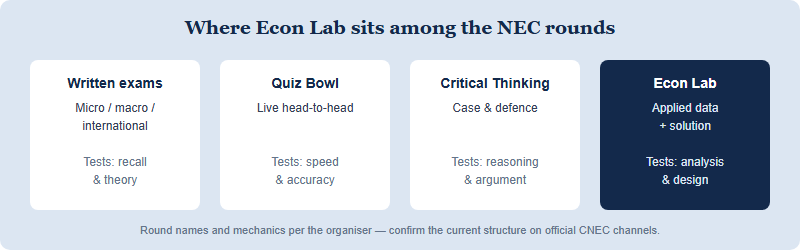
Per the organiser, Econ Lab (经济实践创新) is framed as a limited-time, real, interdisciplinary research experience: built around an annual consumer-economics theme, teams apply economic principles — often alongside ideas from psychology and sociology — to analyse a real-world economic problem and put forward a solution, with mentor guidance during the process. It is distinct from the written exams (micro, macro, international), from the live Quiz Bowl, and from the Critical Thinking case-and-defence round. In other words, Econ Lab is where economics stops being a quiz and starts being a project.
Because the exact mechanics of any single round can change year to year, treat the specifics that follow as a working model of how a data-analysis challenge of this kind tends to run. Always confirm the current format, time limit, deliverable and scoring on the official CNEC channels before you prepare — see the round overview on the CNEC home page.
Inside the data-analysis task: from theme to deliverable
A data-analysis challenge of this style usually moves through four stages, regardless of the exact year’s prompt. Knowing the shape lets your team start fast instead of staring at a blank page.
- Frame the question. The theme (for example, a consumer-economics topic) is broad. Your first job is to narrow it into one answerable question — “does X drive Y, and by how much?” — that your data can actually speak to.
- Interrogate the data. You are typically given, or asked to gather, real figures: prices, spending, survey responses, indices. The skill is identifying which series matter and what each one is really measuring (nominal vs real, levels vs growth, sample vs population).
- Build the argument. Connect the numbers to economic mechanisms — elasticity, incentives, externalities, behavioural nudges — so the analysis explains why, not just what.
- Propose and defend a solution. The round rewards a recommendation that follows from the evidence, with its trade-offs named honestly. Judges notice teams that anticipate the obvious objection.
The interdisciplinary angle matters here. Because the prompt invites psychology and sociology, a strong Econ Lab response often pairs a demand-side economic point with a behavioural one — for instance, explaining a spending pattern through both price signals and habit formation. That is genuinely different from the written exams, where a clean textbook answer is enough.
| Stage | What the team produces | Common trap |
|---|---|---|
| Frame the question | One sharp, testable question | Staying too broad; trying to “cover the theme” |
| Interrogate the data | 2–4 key figures, correctly read | Mixing nominal and real; ignoring the base year |
| Build the argument | Mechanism linking data to economics | Describing numbers without explaining causation |
| Propose & defend | One recommendation + trade-offs | A “solution” the data does not support |
A worked illustration: what “interrogating the data” looks like
To make the second stage concrete, imagine an Econ Lab prompt around the annual consumer-economics theme that hands your team a short dataset on a category of household spending. The figures below are illustrative only — invented to show the thinking, not real CNEC data — but the moves are the ones the round rewards.
| Year | Avg. spend (nominal) | Price index (2023 = 100) | What a strong team notices |
|---|---|---|---|
| 2023 | 1,000 | 100 | Base year — anchor for real comparisons |
| 2024 | 1,120 | 108 | Nominal up 12%, but prices up 8% |
| 2025 | 1,210 | 115 | Real spend ≈ 1,052; growth is slowing |
A weak response says “spending rose 21% over two years.” A strong one deflates the nominal figures by the index, reports that real spending rose closer to 5%, and flags that the real increase is decelerating — then asks why. That “why” is where economics enters: is demand income-inelastic, are households substituting toward cheaper alternatives, or is a behavioural shift (say, post-pandemic habit change) at work? The Econ Lab marks live in that move from arithmetic to mechanism, and in pairing the economic read with the behavioural one the interdisciplinary brief invites. You do not need the heavy data toolkit for this; you need the discipline to convert one or two figures into one defensible claim.
How to approach it as a team of four
CNEC’s David Ricardo (intermediate) and Adam Smith (advanced) divisions compete in teams of four; the Pre division can enter individually or in small groups. For any team round, the difference between a scramble and a clean submission is role clarity decided before the clock starts, not during it.
A practical split for four students:
- Lead analyst — owns the central question and the headline finding, and keeps the team from drifting off the prompt.
- Data handler — pulls the relevant series, checks units and base years, and runs the percentage-change and real-value calculations the argument needs.
- Economics builder — maps each figure to a mechanism and stress-tests whether the recommendation actually follows.
- Synthesiser / presenter — turns the work into the deliverable (slides, write-up, or oral defence as required) and rehearses the answer to the likely judge question.
Roles should overlap, not silo. The data handler and economics builder must talk constantly, because a calculation only earns marks once it is attached to an economic point. The first-party habit our CNEC coaches emphasise is a five-minute mid-round “stand-up”: the team pauses, the lead analyst restates the single claim in one sentence, and everyone confirms their piece supports it. Teams that skip this step tend to produce four good fragments that do not add up to one argument.
Time management: the part teams underestimate
The most common Econ Lab failure is not weak economics — it is running out of time with a half-finished deliverable. Three rules help:
- Set a “data cutoff.” Decide in advance the moment you stop hunting for more figures and start writing. More data after the cutoff almost never changes the headline; it just eats the clock.
- Draft the conclusion early. Write your one-sentence recommendation roughly a third of the way in, then work backwards to support it. A provisional answer you refine beats a perfect answer you never finish.
- Protect rehearsal time. If the round ends in a presentation or defence, reserve the final block to rehearse the answer to the single most likely judge question — usually “what is the weakness in your own recommendation?”
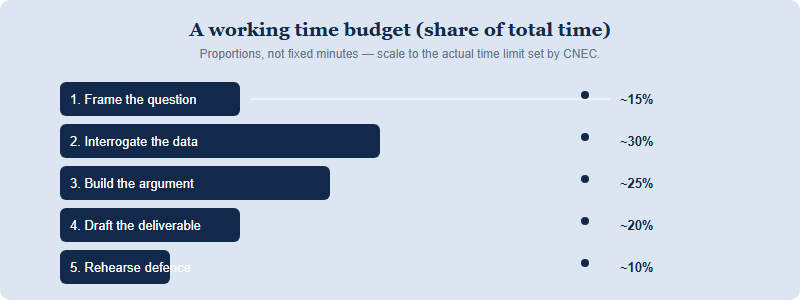
Whether the time limit is a single sitting or spread across a longer window, the proportions above hold: roughly a third on the data, a quarter on the argument, and a deliberate buffer to package and defend.
What separates a winning Econ Lab response
Per the organiser, Econ Lab outcomes are recognised through an Econ Lab Excellence Award that ranks participating teams. Exact scoring criteria are set by CNEC and should be confirmed officially, but the qualities that distinguish strong applied-economics work are consistent across this kind of round:
- One claim, clearly stated. The judges should be able to repeat your headline finding after one slide or one paragraph. Teams that hedge between three findings read as undecided.
- Evidence that is actually used. Every figure you present should do work in the argument. A table no one refers to is decoration; a single deflated number that anchors the conclusion is persuasion.
- Honest trade-offs. A recommendation that admits its cost or its losers is more credible than one that claims to fix everything. Naming the strongest objection to your own proposal — before a judge does — signals economic maturity.
- Interdisciplinary, not scattered. Bringing in psychology or sociology helps only when it sharpens the economic point, not when it replaces it.
For students preparing from China, the practical advantage of the CNEC route is that Econ Lab is mentored: coaches can rehearse the framing-to-defence sequence with a team before competition day, which is exactly the part that cannot be crammed the night before. To see how Econ Lab fits with the written exams, Quiz Bowl and Critical Thinking rounds across the David Ricardo and Adam Smith divisions, start from the CNEC overview and check the current-season schedule before you build your prep plan.
Frequently asked questions
Is the Econ Lab round a written exam?
No. Per the organiser it is an applied, timed research challenge where a team analyses a real economic problem and proposes a solution — separate from the micro, macro and international written exams.
How many students are on an Econ Lab team?
CNEC’s David Ricardo and Adam Smith divisions compete as teams of four; the Pre division can enter individually or in small groups. Confirm current rules on official CNEC channels.
How long do teams get for the Econ Lab task?
The format and time limit can change by season, so the exact duration is set by CNEC. Plan your effort by proportion and confirm the current limit officially.
Does Econ Lab use knowledge beyond economics?
Yes — the round is framed as interdisciplinary, inviting psychology and sociology alongside economic analysis, per the organiser.
Published by the NEC / CNEC editorial desk, operated by Hanlin Education as the officially authorized China National Economics Challenge (CNEC) test center. The NEC is run by the Council for Economic Education, which sets the official rules — always confirm current dates, divisions, fees and awards on the official CNEC channels. Any errors are corrected within 7 working days.