
The David Ricardo division is the National Economics Challenge (NEC) intermediate track: a required team of four tested on microeconomics and macroeconomics, pitched at students who have begun a formal economics course rather than absolute beginners. The biggest change from the Pre division is structural — Pre lets you enter solo or in a small group, while David Ricardo forces a coordinated four-person team. This guide unpacks that format, the team demands it creates, and the realistic step-up from Pre.
What “David Ricardo” is — and is not
The NEC is run by the Council for Economic Education (CEE), a non-profit founded in 1949, and reaches close to 10,000 students a year in the United States. The CEE sets the official academic standard. In China, the National Round is operated as CNEC by Hanlin (SKT) — the officially authorized China test center since 2016, now spanning 20+ provinces and 300+ schools, and the only official path from China onto the NEC global rounds.
Within that structure, David Ricardo sits in the middle of three divisions. It is the intermediate track: per the organiser, it is positioned for first-time competitors with limited prior coursework, and it tests micro and macro principles. What it is not: it is not the entry-level on-ramp (that is Pre), and it does not carry the heavier world-economy weighting of the advanced Adam Smith track. If you are still deciding which of the three divisions fits your team, that is a separate question we cover elsewhere — this article assumes you are looking squarely at David Ricardo and want to know what it demands. Confirm the current division definitions on the official CNEC site, as the CEE reviews them each cycle.
The format: a fixed team of four feeding seven rounds
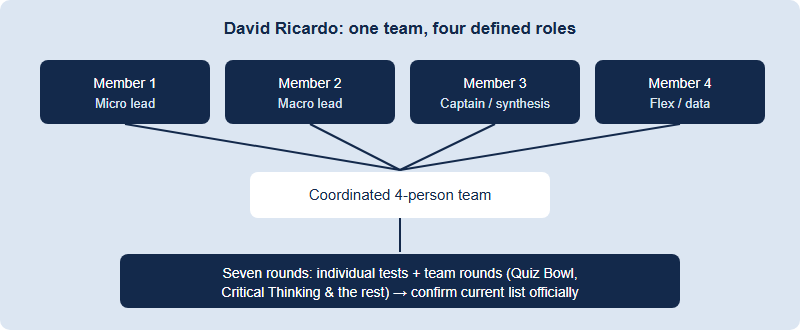
The defining fact of David Ricardo is the team of four — not a suggestion, but the entry requirement. That single rule reshapes everything that follows, because the CNEC National Round is built around seven components: the Qualifying Test, Super Econ, Quiz Bowl, Critical Thinking, Econ Lab, Econ Immersion and U20 Youth Voice. Some reward individual recall; others are collaborative. (Always confirm the current round list, sequence and weighting on the official CNEC schedule — event formats are reviewed each cycle, so treat any specific timing or point split as “verify officially.”)
Two structural truths follow from a fixed four:
- You cannot hide a weak strand. With four people, you have exactly enough bodies to cover micro, macro, a captain/synthesis role and a flex slot. There is no fifth substitute to paper over a gap, so a strand nobody owns becomes the team’s ceiling.
- Team rounds reward rehearsal, not just knowledge. Collaborative components — the rapid-recall and critical-thinking style rounds — turn on communication, division of labour and trusting a teammate’s call under time pressure. A team of four who have practised together routinely out-performs four stronger individuals meeting cold.
In other words, the format is the strategy. A David Ricardo result is decided as much by how four students coordinate as by how much each one knows. That is the first real departure from Pre.
The step-up from Pre: what actually changes
Students moving up from Pre often expect “harder questions” and little else. The bigger shifts are operational. Pre can be entered as an individual or a small team of two to four and is built for students new to formal economics; David Ricardo requires a full four and assumes you are mid-way through a formal course. Here is the honest before-and-after.
| Dimension | Pre (entry) | David Ricardo (intermediate) |
|---|---|---|
| Entry format | Individual or team of 2–4 | Required team of 4 |
| Intended profile | New to formal economics | First-time competitors, mid-course in econ |
| Core subjects | Micro & macro foundations | Micro & macro, applied more deeply |
| Coordination load | Low — can compete solo | High — four roles must mesh |
| Single point of failure | Yourself only | Any uncovered strand or unrehearsed round |
| Preparation rhythm | Self-paced study | Self-study plus regular team practice |
Read the bottom three rows together. The jump from Pre to David Ricardo is mostly a jump in coordination: you go from being accountable to yourself to being one quarter of a system. A Pre competitor who simply scales up their solo study and shows up with three other strong-but-uncoordinated students will usually under-perform a David Ricardo team that drilled together for a season. The content step-up is real but incremental; the teamwork step-up is the one people under-budget.
There is also a content nuance worth naming. David Ricardo deepens the same micro and macro you met in Pre rather than bolting on a new subject — that bigger leap, into world-economy material, belongs to the advanced Adam Smith track. So a Pre-to-Ricardo move is best framed as “go deeper on what you know, and learn to do it as four,” not “learn a brand-new field.”
Team demands: staffing four roles that mesh
Because the four is fixed, the highest-leverage decision you make all season is who owns what. A workable default for an intermediate team:
- Micro lead. Owns supply and demand, elasticities, market structures, costs and firm behaviour — the bread-and-butter of the individual rounds.
- Macro lead. Owns national income, inflation, unemployment, fiscal and monetary policy, and the basic models. The natural partner to the micro lead in cross-topic questions.
- Captain / synthesis. The strongest all-rounder, responsible for collaborative rounds: hearing two teammates’ answers and committing the team to one under the clock. This role is about judgement and nerve, not just knowledge.
- Flex / data. Covers diagrams, calculations and the seams between micro and macro, and provides cover when one strand gets unexpectedly heavy in a given round.
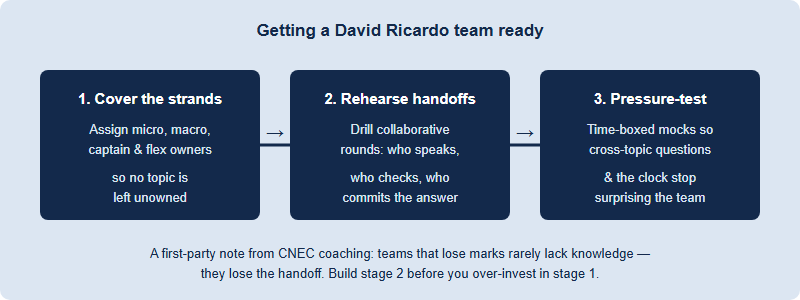
Three demands flow from this structure. First, cross-training matters: roles are starting points, not silos, because any teammate may face a question outside their lane in a mixed round. Second, practising the handoff is non-negotiable — the moment a collaborative round opens, the team needs a rehearsed habit for who speaks, who checks and who commits. Third, realism about staffing: four genuinely engaged students who can divide labour will beat a brilliant pair carrying two passengers. If you cannot field four committed members, the Pre division (which allows individuals or smaller groups) may be the more honest fit for this cycle. For students entering through the official China route, the CNEC programme is where team registration and the path to the global rounds come together.
Realistic scope: depth without the world economy
A frequent worry among Pre graduates is that David Ricardo will suddenly demand international trade, exchange rates and current global affairs. It does not weight those the way the advanced track does. The CEE describes the assessment as covering micro and macro principles; for David Ricardo, your scope is the deeper, applied version of that foundation rather than a new third subject. In practical terms, prepare to:
- Apply core micro (markets, elasticity, market structures, externalities) to less obvious scenarios, not just textbook cases.
- Reason through macro models (aggregate demand and supply, fiscal and monetary policy, inflation and unemployment trade-offs) and explain the mechanism, not only the conclusion.
- Handle cross-topic questions that bridge micro and macro — exactly where a team’s flex role and captain earn their place.
- Work cleanly with diagrams and short calculations under time pressure, since accuracy at speed separates teams of similar knowledge.
Keep the boundary honest: the world-economy strand — trade theory, balance of payments, exchange-rate regimes and live international developments — is the marker of the Adam Smith division, not David Ricardo. Reading widely about the global economy will never hurt, but for an intermediate team it is a bonus, not the core syllabus. Always verify the exact topic coverage and any published topic list on the official CNEC channels before you lock a study plan, because the organiser can adjust emphasis year to year.
Frequently asked questions
Can I enter the David Ricardo division on my own?
No. David Ricardo requires a team of four. If you want to compete solo or in a smaller group, the Pre division allows individuals and teams of 2–4. Confirm team rules officially.
How is David Ricardo different from Pre, in one line?
Pre is an entry on-ramp you can do alone; David Ricardo is an intermediate, fixed four-person team that deepens the same micro and macro. The jump is mostly coordination.
Does David Ricardo test the world economy?
It centres on micro and macro; the heavier world-economy weighting belongs to the advanced Adam Smith track. Verify current topic coverage on the official CNEC site.
What should a David Ricardo team practise first?
Assign micro, macro, captain and flex roles, then rehearse the team rounds. Intermediate teams more often lose points on the handoff than on knowledge.
Published by the NEC / CNEC editorial desk, operated by Hanlin Education as the officially authorized China National Economics Challenge (CNEC) test center. The NEC is run by the Council for Economic Education, which sets the official rules — always confirm current dates, divisions, fees and awards on the official CNEC channels. Any errors will be corrected within 7 working days.