The Adam Smith division is the National Economics Challenge (NEC) advanced track: a team of four, no eligibility barrier, that is tested on microeconomics, macroeconomics and the world economy. It suits AP/IB-Economics students, returning competitors and strong self-studiers who can absorb a third subject — international economics — that the David Ricardo (intermediate) division does not weight the same way. Below we decode who should attempt it and what that extra content really demands.
What “Adam Smith” actually means inside the NEC
The NEC is run by the Council for Economic Education (CEE), a non-profit founded in 1949, and reaches close to 10,000 students a year in the United States. The CEE sets the official academic standard; in China, the National Round is operated as CNEC by Hanlin (SKT) — the officially authorized China test center since 2016, now spanning 20+ provinces and 300+ schools, and the only official path from China onto the NEC global rounds.
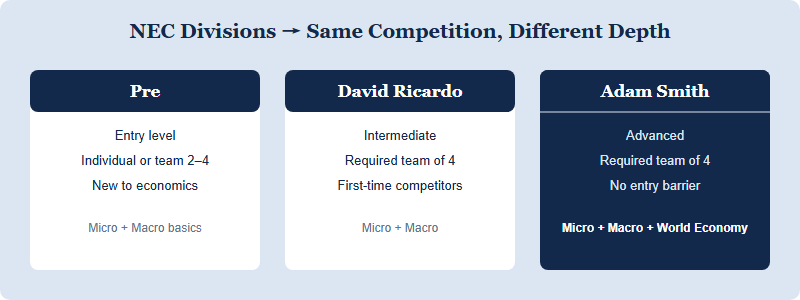
For 2027 the competition runs four divisions, scaled by experience rather than by age or grade alone. Three are entry routes; the fourth, Herbert Simon, is an add-on:
- Pre (entry): the on-ramp — can be entered as an individual or a small team of 2–4. Built for students new to formal economics.
- David Ricardo (intermediate): a required team of four, positioned for first-time competitors with limited prior coursework.
- Adam Smith (advanced): a required team of four, with no entry barrier — anyone may enter, including students who could “qualify down” into Ricardo. Per the CEE, this is the track for “advanced placement, baccalaureate, honors students, and returning competitors.”
The phrase that matters most is “no entry barrier.” Adam Smith does not gate you out, and it does not gate stronger students in to easier divisions. That is precisely why choosing it is a judgement call rather than a formality — and why a guide focused on this division (most of our earlier coverage centered on Ricardo) is overdue.
Adam Smith vs David Ricardo: where the real gap is
On paper the two advanced-and-intermediate tracks look similar — both are four-person teams, both move through the same competition structure. The differences that decide your result are about scope, depth and the opponents you face, not about the format.
| Dimension | David Ricardo (intermediate) | Adam Smith (advanced) |
|---|---|---|
| Intended profile | First-time competitors; limited prior coursework | AP/IB/honors students; returning competitors |
| Team size | Required team of 4 | Required team of 4 |
| Entry rule | Positioned for newcomers (per organiser) | No entry barrier — anyone may enter |
| Core subjects | Microeconomics + macroeconomics | Microeconomics + macroeconomics + world economy |
| Typical depth | Foundational principles applied cleanly | Foundations plus applied, current, cross-border reasoning |
| Field strength | Mixed-experience teams | The strongest teams self-select here |
Read that “field strength” row carefully. Because Adam Smith has no barrier, the most prepared teams gravitate to it voluntarily. A capable team can post a respectable score in Ricardo and a middling placement in Adam Smith against the same questions, simply because the surrounding field is denser. The decision is therefore part self-assessment and part strategy — covered in the decision section below.
What the world economy actually adds
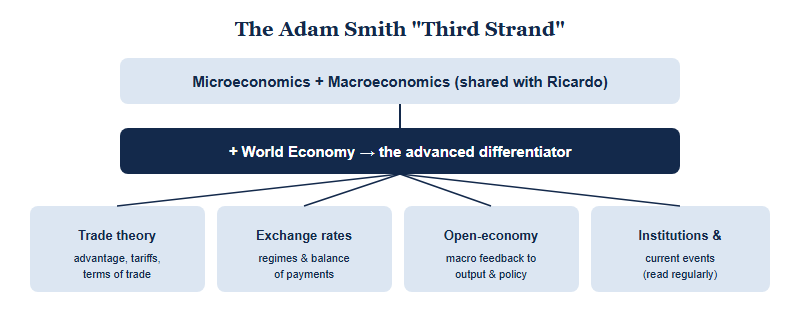
The CEE describes the assessment as covering “key micro and macroeconomic principles, as well as their knowledge of the world economy.” For Adam Smith, that third strand is the differentiator, and it is the part students most often under-prepare. It is not a separate, exotic subject so much as the open-economy extension of the macro you already study — but it carries its own vocabulary, models and current-events demands. Expect material in the following territory (confirm the exact emphasis and any topic list on the official CNEC channels):
- Trade theory: comparative advantage (the David Ricardo idea, fittingly), gains from trade, terms of trade, tariffs, quotas and other barriers.
- Exchange rates & balance of payments: how currencies move, fixed vs floating regimes, the current and capital accounts.
- Open-economy macro: how trade flows, capital flows and exchange rates feed back into output, inflation and policy choices.
- International institutions & current events: the bodies and live developments that shape the global economy — the area where a well-read team gains the most marginal points.
Two demands follow from this. First, the world economy rewards breadth plus currency: a team that reads about the global economy regularly will out-answer a team that only memorised a textbook. Second, it is naturally a specialisation slot — on a four-person team, designating one member to own international/macro current events is one of the highest-leverage roles you can assign.
How the rounds reward an Adam Smith team
The organiser’s 2027 programme outline lists the national round as the Qualifying Test, Critical Thinking and Quiz Bowl, with the OX-BP Debate Sessions and U20 Youth Voice added at the global round. Two changes are worth noting if you have read older guidance, ours included: Super Econ now sits in the club programme as a September-to-November online leaderboard activity rather than a competition round, and Econ Lab and Econ Immersion, which featured in earlier seasons, do not appear in the 2027 outline — confirm the current line-up with the organiser rather than assuming either way. For an advanced team, two structural truths shape preparation:
- Breadth-heavy components reward the world-economy reader. Rapid-recall and critical-thinking style rounds are where current, cross-border knowledge converts directly into points — exactly the strand Ricardo teams touch less.
- Team components reward role specialisation. Because Adam Smith is a fixed four, you can deliberately assign owners: micro, macro, world economy, and a “captain/synthesis” role for collaborative rounds. A team of four generalists is usually beaten by a team of four specialists who trust each other’s calls.
If you are still mapping the overall competition before zooming into Adam Smith, start with the CNEC home page for the official structure, then return here for the advanced-track view.
Should you attempt Adam Smith? A practical decision guide
Because nothing stops you from entering, the honest question is not “am I allowed?” but “is this the division where this team does its best work — and signals the most?” Use these checks:
- Coursework signal. If most of your team is taking or has taken AP/IB Economics (or equivalent rigour), Adam Smith is the natural home; the CEE explicitly frames it for AP/baccalaureate/honors students.
- Returning competitors. If you placed before — even in Ricardo — the organiser positions you to move up. Repeating an easier division can read as playing it safe.
- Appetite for the third strand. Be honest about whether your team will actually read the global economy weekly for a season. If yes, the world economy becomes a points advantage; if no, it becomes the soft spot opponents exploit.
- Admissions framing. For students targeting economics, business or PPE-style programmes, attempting the advanced track — and engaging with international economics — is a more distinctive story than a comfortable placement one level down. (No competition guarantees an admissions outcome; treat it as evidence of rigour, not a ticket.)
- Team realism. Four committed students who can divide labour beat a stronger pair carrying two passengers. If you cannot field four genuinely engaged members, consider whether Pre or Ricardo is the more honest fit this year.
A reasonable rule of thumb: if your team has the coursework and the reading discipline, choose Adam Smith and specialise; if you have the coursework but not yet the international-current-events habit, you can still choose it — but assign that gap to a named owner immediately. For Chinese international-school students entering through the official China route, the CNEC programme is where division choice, registration and the path to the global rounds come together.
Frequently asked questions
Is the Adam Smith division harder to get into than David Ricardo?
No — Adam Smith has no entry barrier; anyone may enter. It is “harder” only because the strongest teams self-select into it and it adds the world economy.
Do I need AP or IB Economics to enter Adam Smith?
It is not a hard requirement, but the CEE frames the track for AP/IB/honors and returning competitors. Strong self-studiers can attempt it; confirm rules officially.
What exactly does “world economy” cover?
Broadly the open-economy extension of macro: trade, exchange rates, balance of payments and international institutions/current events. Confirm topic weighting on the official CNEC site.
Can a team of fewer than four enter Adam Smith?
Adam Smith is positioned as a required team of four. If you cannot field four, the Pre division allows individuals or smaller teams. Verify current team rules officially.
Published by the NEC / CNEC editorial desk, operated by Hanlin Education as the officially authorized China National Economics Challenge (CNEC) test center. The NEC is run by the Council for Economic Education, which sets the official rules — always confirm current dates, divisions, fees and awards on the official CNEC channels. Any errors will be corrected within 7 working days.