
The short answer: the National Economics Challenge (NEC) is a timed economics exam-and-team competition run by the Council for Economic Education, testing microeconomics, macroeconomics and world economy. FBLA (Future Business Leaders of America) is a US Career and Technical Student Organization — a membership body with school chapters and a wide catalog of business events. They reward different things, and they can sit side by side on a strong applicant's record.
Two different kinds of competition, easily confused
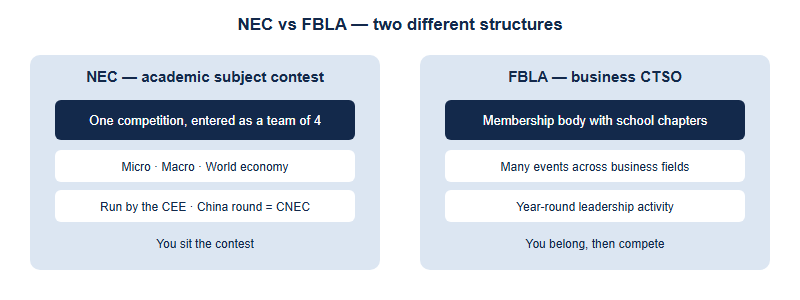
Students and parents browsing "economics and business competitions" often drop NEC and FBLA into the same shortlist and treat them as alternatives. They are not interchangeable. NEC is an academic subject competition: it measures how well you reason across the whole of economics under exam conditions, as part of a four-person team. FBLA is a student organization: you join a chapter, build leadership and business skills through the year, and then enter one or more of its many competitive events, which span business disciplines from accounting and finance to marketing, technology and public speaking.
Put differently, NEC is a contest you sit; FBLA is a community you belong to that also runs contests. That single structural difference drives almost everything else — the skills tested, the time commitment, the way you enter, and the signal each sends to a university admissions reader.
What NEC actually tests
NEC's academic backbone is the same three subject areas wherever you compete: microeconomics, macroeconomics and world/international economy. It is run by the Council for Economic Education (CEE), founded in 1949, and reaches roughly 10,000 students a year in the United States. Rather than a single submission, NEC runs through a sequence of rounds. Per the organiser, these include the Qualifying Test, Super Econ, Quiz Bowl, Critical Thinking, Econ Lab, Econ Immersion and the U20 Youth Voice — a mix of timed individual-style assessment and live team play.
NEC is organised by division, so students enter at a level matching their experience. Per the organiser:
| Division | Level | Team structure (per the organiser) |
|---|---|---|
| Pre | Entry | Individual, or a team of 2–4 |
| David Ricardo | Intermediate | Team of 4 |
| Adam Smith | Advanced | Team of 4 |
For students in China, the official China National Round is CNEC, operated by Hanlin (SKT) since 2016 across 20+ provinces and 300+ schools. It is the only official route from China onward to the NEC global rounds. The exact number of rounds, their timing, scoring weights, fees, and the path from CNEC to the global rounds are set by the organiser and can change each year, so treat the official CNEC schedule and rules as the authority. Any named question-setters or judges you see cited elsewhere are organiser claims to confirm officially, not facts we assert.
What FBLA is — a CTSO, not a single exam
FBLA stands for Future Business Leaders of America, a long-running US Career and Technical Student Organization (CTSO) for students interested in business and entrepreneurship. The defining feature is the chapter model: students join through a school chapter, pay membership, and take part in activities across the year — meetings, projects, community work, officer roles and leadership conferences — not just a one-off test.
Its competitive side is a broad catalog of events rather than a single subject. Across that catalog you find very different formats: objective tests on business topics, prepared and impromptu presentations, role-play and case scenarios, and project-based or production-style events. Subjects range across accounting, economics, finance, marketing, management, public speaking and information technology. Some events are individual; others are done in pairs or small groups. Membership tiers, eligibility, event lists, formats, fees and the conference structure are defined by FBLA and can change by year and by region, so confirm the current specifics on FBLA's official channels before planning around them.
For an international-school student, the practical contrast is this: with NEC you prepare a defined economics syllabus and compete; with FBLA you commit to an organization, develop business and leadership skills over time, and then pick events that fit your interests from a wide menu.
Side-by-side: how they really differ
| Dimension | NEC (economics contest) | FBLA (business CTSO) |
|---|---|---|
| What it is | A single academic economics competition | A membership organization with chapters that runs events |
| Subject scope | Economics only: micro + macro + world economy | Business broadly: accounting, finance, marketing, IT, management, more |
| How you take part | Register and compete in a defined contest | Join a chapter, stay active all year, then enter chosen events |
| Typical format | Timed rounds + live team events (e.g. Quiz Bowl) | Many formats: objective tests, presentations, role-plays, projects |
| Solo or team | Team of 4 (Pre may be individual or 2–4) | Varies by event: individual, pair or group |
| Organiser | Council for Economic Education (CEE) | FBLA (US CTSO) |
| China entry route | CNEC, the official China National Round | Per FBLA's own official process |
| Confirm officially | Divisions, rounds, fees, dates via CNEC/CEE | Membership, events, formats, fees, conferences |
The headline takeaway: NEC asks "how good is your economics, under the clock, as a team?" FBLA asks "how committed are you to business and leadership across a year, and where do you want to compete within that?" Neither is harder or more prestigious in the abstract — they simply test different things.
How to choose — and why both can strengthen a portfolio
Rather than asking which is "better," ask which lets you show your best work. A few honest self-checks:
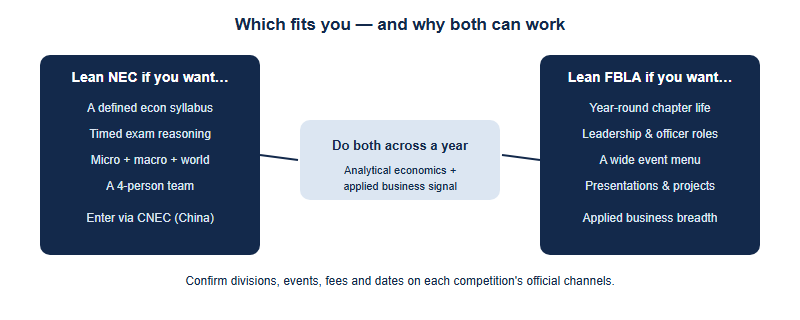
- Subject focus. If economics specifically is your thing — you enjoy supply-and-demand graphs, macro policy and global trade — NEC is the sharper fit. If you want to range across business functions, FBLA's breadth suits you.
- Working style. If you perform under timed exam pressure and like a fixed syllabus, lean NEC. If you prefer ongoing projects, presentations and team leadership, lean FBLA.
- Time commitment. NEC is a contest you prepare for and sit. FBLA is a year-round commitment to a chapter and its activities, with events layered on top.
- Application signal. NEC evidences analytical economics range and teamwork; FBLA evidences sustained business engagement, leadership and communication. Universities read these as different, genuine commitments.
Here is the part most students miss: NEC and FBLA are not rivals for one slot on your record — they develop different muscles, and admissions readers can tell. A student who does well in NEC and contributes to an FBLA chapter shows both rigorous economic reasoning and applied, real-world business engagement. The analytical discipline you build for NEC — clean command of micro, macro and trade — gives you sharper foundations for FBLA's finance, economics or business-plan events. Conversely, FBLA's presentation and project work builds the communication that NEC's Critical Thinking elements reward.
If you are mapping a multi-year plan, you can sequence them: use one to build a foundation and the other to broaden the profile, fitting both to the calendar. Whether dates clash and what each costs depends on the current cycle, so check the official CNEC schedule alongside FBLA's own timeline before committing to both.
A first-party note from the CNEC desk
As the officially authorized China test center for the NEC, the CNEC desk sees this choice every cycle. The common mistake is treating an academic economics contest and a business membership organization as the same category, then being surprised they demand different things. Our practical guidance: be honest about whether your strength is deep economics reasoning or broad business engagement and leadership. Many students benefit from both over time — NEC to evidence analytical depth, FBLA to evidence applied breadth — but start where your strengths already are, then add the second. For the China-side calendar, divisions and registration, see the CNEC homepage; the CEE sets the underlying academic standard for the NEC, while FBLA's own channels remain the authority for anything FBLA-specific. This article focuses only on the economics-contest-vs-business-CTSO distinction.
Frequently asked questions
Is FBLA an economics competition like NEC?
No. NEC is an economics exam-and-team contest under the CEE. FBLA is a business CTSO with chapters running many business events. Confirm formats officially.
Should I choose NEC or FBLA?
Pick by focus: choose NEC for deep economics and timed team play, FBLA for year-round business activity and leadership. Many strong applicants do both over time.
How do students in China enter NEC?
Through CNEC, the official China National Round operated by Hanlin since 2016 — the only official path from China to the NEC global rounds. Check current dates on the official CNEC site.
Do NEC and FBLA count as the same thing for applications?
No. NEC signals analytical economics range and teamwork; FBLA signals sustained business engagement and leadership. They complement rather than replace each other.
Published by the NEC / CNEC editorial desk, operated by Hanlin Education as the officially authorized China National Economics Challenge (CNEC) test center. The NEC is run by the Council for Economic Education, which sets the official rules — always confirm current dates, divisions, fees and awards on the official CNEC channels. Any errors will be corrected within 7 working days.