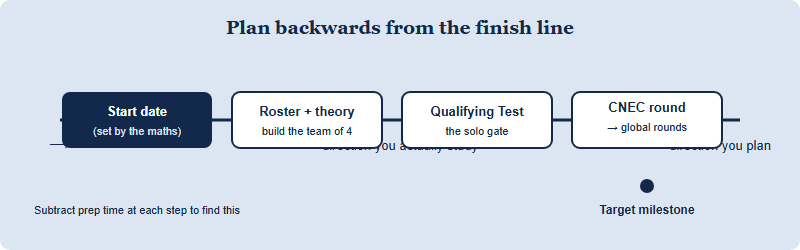
To run a strong NEC season, plan it backwards: fix your target milestone — the NEC global rounds, reached from China only through the official CNEC national round — then work back through the China round, the Qualifying Test and team build-out, scheduling each economics topic so it peaks at the right time. Below is a month-by-month framework; confirm every exact date on the official CNEC channels, because the calendar shifts season to season.
Why a season needs backwards planning, not a date list
Most NEC pages — including a few that used to live on this site — hand you a list of dates and divisions and leave the actual planning to you. That is the wrong unit of help. The National Economics Challenge is run by the Council for Economic Education (CEE, founded 1949) and draws roughly 10,000 students a year in the United States; the China National Economics Challenge (CNEC) has been operated by Hanlin (SKT) since 2016, across 20+ provinces and 300+ schools, and is the only official route from China into the NEC global rounds. The CEE sets the academic standard; CNEC runs the China round. What that structure means in practice is simple: there are two finish lines — the China round first, the global rounds after — and your study has to crest twice.
A date list cannot tell you when to start macroeconomics, when to stop learning new theory and start drilling speed, or when to lock your four-person roster. A backwards-planned calendar can. The principle is to anchor on the latest immovable milestone you are aiming for, subtract realistic preparation time for each layer, and let that arithmetic — not optimism — set your start date for each topic. Treat the months below as relative phases you slot against the real, official dates once CNEC publishes them.
The four phases of an NEC season
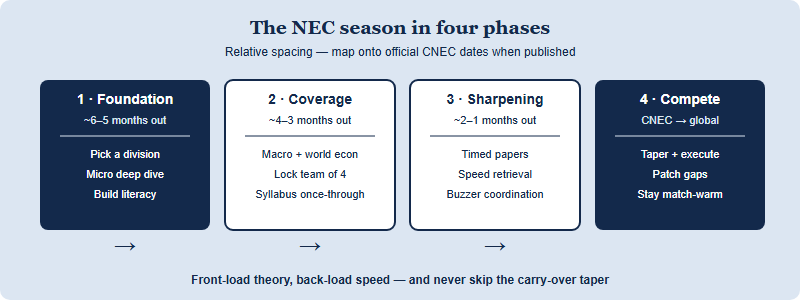
Whatever the calendar year, every NEC season moves through the same four phases. Naming them lets you place your own dates against a stable spine instead of guessing. The months attached below are illustrative spacing, not official dates — they show typical gaps between phases so you can judge how early to begin.
- Phase 1 — Foundation (roughly 5–6 months out): build economic literacy across all three subjects and decide which division fits. Pre is the entry tier and can be an individual or a team of 2–4; David Ricardo is the intermediate tier and must be a team of 4; Adam Smith is the advanced tier, also a team of 4. Your division choice changes how much runway you need.
- Phase 2 — Coverage & team build (roughly 3–4 months out): finish the syllabus, lock your roster, and start working as a unit. The Qualifying Test is sat by every team member, so weak links are exposed here — this is the window to raise your lowest scorer, not your highest.
- Phase 3 — Sharpening (roughly 1–2 months out): shift from learning to retrieving. Speed drills, timed papers and live team rounds (Quiz Bowl coordination) replace new theory. By now you should be consolidating, not discovering.
- Phase 4 — Compete & carry over (CNEC round, then the gap to global): peak for the China round; if you advance, treat the interval before the global rounds as a focused second taper, not a holiday.
The most common planning error is collapsing Phases 1 and 2 into a single panicked sprint a few weeks before the China round. The CEE syllabus — micro, macro and world/international economics — is too broad to absorb at speed and also master under a buzzer. Spacing protects you from that trap. A second, subtler error is forgetting Phase 4’s “carry over”: teams that advance from CNEC sometimes go quiet for weeks, then arrive at the global rounds cold. Plan the gap as deliberately as you plan the run-up.
A month-by-month framework you adapt to the official dates
Here is the spine as a working table. Read the left column as “months before your CNEC round,” not as calendar months — once CNEC confirms the national-round date, you count backwards and drop these tasks onto real weeks. If your team is in the Adam Smith division, weight the later phases harder; if you are entering Pre as an individual, you can compress the team-build column.
| Time before CNEC round | Phase | Primary focus | Milestone to hit |
|---|---|---|---|
| ~6 months out | Foundation | Read broadly; pick a division; map the three subjects | Division chosen; baseline diagnostic done |
| ~5 months out | Foundation | Microeconomics deep dive (elasticity, market structures, welfare) | Micro topic checklist green |
| ~4 months out | Coverage | Macroeconomics deep dive (GDP, inflation, policy, multipliers) | Macro topic checklist green; roster shortlisted |
| ~3 months out | Coverage | World/international economics; lock the team of 4 | Full syllabus once-through; roster final |
| ~2 months out | Sharpening | Timed Qualifying-Test-style papers; raise weakest scorer | Whole team clears a consistent practice bar |
| ~1 month out | Sharpening | Speed retrieval; live team rounds; buzzer coordination | Roles assigned; reflexes built, not theory |
| CNEC round | Compete | Taper, rest, execute the China round | Perform; log what to fix |
| Gap → global | Carry over | Second taper: patch gaps from CNEC, keep the team warm | Arrive at global rounds match-ready |
Two sequencing rules make this calendar work. First, front-load theory, back-load speed. New economic concepts belong in the early months; the final stretch is for converting understanding into fast, accurate recall and clean team coordination. Reverse that order and you will be learning macro the week you should be drilling it. Second, let the Qualifying Test set your roster deadline. Because every member sits that solo gate, your team must be fixed early enough that your weakest scorer has real time to climb — not chosen the week before. If you are still unsure which division to commit to, our CNEC overview is the place to start before you build the rest of the plan around it.
Calibrating the calendar to your division and starting point
The framework flexes. A first-time individual entering the Pre division can run a lighter version: less team-build, more solo coverage, and a shorter sharpening phase because there is no Quiz Bowl coordination to rehearse. A David Ricardo or Adam Smith team of four needs the full spine and should add explicit team-rounds practice — the live, buzzer-style events reward coordination that only forms with reps, so they belong in the calendar from the start of Phase 3, not the final week.
Your honest baseline also moves the start date. A student already through AP Microeconomics, AP Macroeconomics or equivalent A-Level economics can compress the Foundation phase and begin nearer the Coverage stage. A student meeting demand-and-supply for the first time needs the full six-month runway. Run a quick diagnostic in month one — a short past-style paper across all three subjects — and let your weakest area, not your strongest, decide how much foundation time you book. Pair this seasonal calendar with the round-by-round mechanics on our competition pages so you know what each phase is preparing you for.
One first-party note from running CNEC since 2016: the teams that travel furthest are rarely the ones that crammed hardest in the final fortnight. They are the ones who started early, fixed their roster before the Qualifying Test rather than after, and protected the carry-over window between the China round and the global rounds. The calendar is the strategy. Lock the official dates, count backwards, and start on time — that single habit separates a scramble from a season.
Frequently asked questions
How many months before CNEC should we start preparing?
Treat ~6 months as a comfortable runway for a team building from scratch; experienced students can start later. Confirm the official CNEC date first, then count backwards.
When should we lock our team of four?
Before the Qualifying Test, which every member sits. Fixing the roster early gives your weakest scorer time to improve rather than exposing a last-minute gap.
Does the same calendar work for all three divisions?
The four-phase spine does. Pre individuals can compress team-build and sharpening; David Ricardo and Adam Smith teams of four need full team-rounds practice. Confirm division rules on the official CNEC channels.
What do we do between CNEC and the global rounds?
Run a focused second taper: patch the gaps CNEC exposed and keep the team warm. Don’t go quiet — advancing teams that pause arrive at the global rounds cold.
Published by the NEC / CNEC editorial desk, operated by Hanlin Education as the officially authorized China National Economics Challenge (CNEC) test center. The NEC is run by the Council for Economic Education, which sets the official rules — always confirm current dates, divisions, fees and awards on the official CNEC channels. Any factual error will be corrected within 7 working days.