
If you are applying to a US university as an intended economics major, the National Economics Challenge (NEC) is most useful as concrete evidence that you already think like an economist. Its three subject areas — microeconomics, macroeconomics and world economy — line up almost exactly with a first-year college econ sequence, and its team rounds rehearse the collaborative, argument-under-pressure work that econ programs value. The point is not the award line on your activities list; it is the trajectory NEC lets you show.
Why NEC content maps onto a college econ sequence
The NEC is run by the Council for Economic Education (CEE), founded 1949, and reaches roughly 10,000 students a year in the United States. Its tested content spans microeconomics, macroeconomics and world/international economy — the same three pillars that open almost every US economics degree. A typical intended-econ applicant has taken AP Micro and AP Macro, or IB/A-Level economics; NEC sits one layer above that coursework, asking you to apply the same models under time and in combination rather than recall them topic by topic.
That overlap is what makes NEC legible to a US admissions reader and to your future department. When a college lists “intro micro,” “intro macro” and “the global economy” as the gateway to the major, an applicant who has competed across exactly those domains is demonstrating readiness in the program’s own vocabulary. The table below lines up NEC’s subject areas with the typical first-year US econ curriculum so you can see the mapping directly.
| NEC subject area | Typical first-year US econ course | What you can show you practised |
|---|---|---|
| Microeconomics | Principles of Microeconomics | Supply/demand, elasticity, market structure, marginal reasoning applied to novel cases |
| Macroeconomics | Principles of Macroeconomics | GDP, inflation, monetary & fiscal policy, reading aggregate trade-offs |
| World / international economy | The Global Economy / international electives | Trade, exchange rates, comparative advantage, cross-border policy effects |
A note on honesty: NEC is a strong supercurricular signal, not an admissions guarantee. US economics admissions are holistic, and no single competition admits anyone. What NEC does is give you specific, defensible material — models you wrestled with, a question that changed your mind — that a generic “I love economics” essay can never produce.
It also helps to be precise about what US readers actually do with a competition like this. A holistic admissions office is not scoring NEC against a rubric; it is asking whether your file coheres — whether your stated major, your coursework, your reading and your activities point the same direction. NEC’s value is that it sits squarely inside an economics story. It is not a tie-breaker you bolt on; it is a beam that helps the whole econ-major narrative carry weight, which is a different and more durable kind of usefulness than “looks impressive.”
The three divisions as a visible growth arc
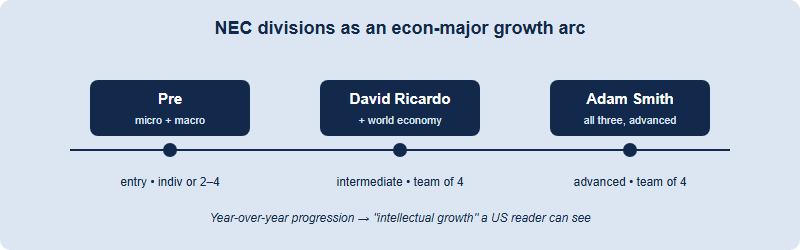
NEC’s structure is itself a narrative. It runs three divisions. The Pre division is the entry tier (individual, or a team of 2–4) and covers micro and macro. The David Ricardo division is intermediate (a team of 4) and adds international economics. The Adam Smith division is the advanced tier (a team of 4) across all three subject areas. Moving up that ladder over two or three years is a clean way to evidence intellectual growth — the trait US holistic review prizes most.
For an intended major, a Pre-then-Ricardo, or Ricardo-then-Adam-Smith progression reads as a student deepening on purpose, not collecting trophies. That arc is far more persuasive in an application than a single high placement, because it shows direction. The diagram below maps the divisions onto a multi-year applicant timeline.
What the seven rounds rehearse for an econ major
NEC is more than a multiple-choice test. Its seven rounds — Qualifying Test, Super Econ, Quiz Bowl, Critical Thinking, Econ Lab, Econ Immersion and U20 Youth Voice — each build a different muscle that a college economics program will later demand. Knowing which round trained which skill lets you write about NEC with specificity instead of clichés.
- Qualifying Test & Super Econ — fluency with the core models under time, the way problem sets and timed midterms work in college.
- Quiz Bowl — rapid recall and teamwork, useful framing for collaborative problem sessions.
- Critical Thinking — building and defending an economic argument from an open prompt; the closest thing to a seminar or a short response paper.
- Econ Lab & Econ Immersion — applying theory to richer, more realistic scenarios, which mirrors applied and data-oriented coursework.
- U20 Youth Voice — communicating economics to an audience, a skill economics departments increasingly reward.
For an intended major, the Critical Thinking and applied rounds are usually the richest essay material, because they generate a moment — a trade-off you had to defend, a model that broke when the scenario got messy. That moment is what turns a list entry into a story. (For a single-round deep dive, see our standalone guide to the NEC Critical Thinking round.)
Turning NEC into a US supplemental essay (without overclaiming)
US supplements — especially the “Why this major?” and “Why us?” prompts — reward reflection over résumé. The weakest NEC essay states a placement and stops. The strongest uses one concrete NEC moment to show how you reason and where your curiosity points next. Reframe the experience around thinking, not the medal.
| Weak framing (avoid) | Stronger framing (econ-major narrative) |
|---|---|
| “I placed in NEC, which proves I’m good at economics.” | “Defending a minimum-wage prompt in the Critical Thinking round forced me to weigh employment effects against welfare gains — and sent me reading labor economics.” |
| “NEC is a prestigious, recognized competition.” | “NEC’s world-economy round made trade models concrete for me, which is why I want to take international economics early.” |
| “My team won several rounds.” | “Splitting micro, macro and trade across four people taught me to defend a model I hadn’t personally prepared — the collaborative reasoning I expect in a problem set.” |
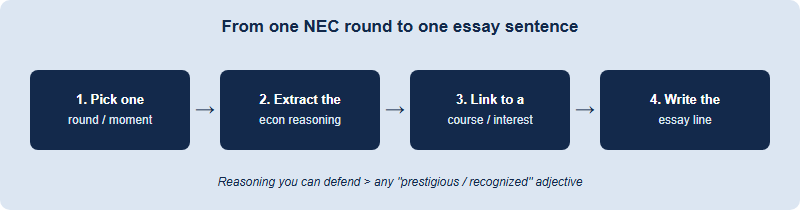
The pipeline below is the move: take a single round, extract the economic reasoning, connect it to a specific course or interest, and let that become a sentence in your supplement. This is also exactly what survives a reader’s skepticism — a real mechanism you can explain beats any adjective.
Fitting NEC into a coherent US econ-major profile
NEC works best as one load-bearing element of an econ-focused profile, not a standalone trophy. Pair it with AP/IB/A-Level economics for the academic baseline, and let NEC supply the applied, competitive layer. If you want to extend the trajectory, NEC’s reasoning pairs naturally with independent reading, a data project, or an economics essay competition for written depth — different muscles, same intellectual direction.
For students applying from China, the route into NEC matters. The China National Round (CNEC) has been operated by Hanlin (SKT) since 2016, across 20+ provinces and 300+ schools, and is the official path from China into the NEC global rounds. The CEE sets the academic standard; CNEC runs the China round. You can see the current China-round structure and season on the official CNEC site, and you should confirm dates, divisions, fees and awards there before building any application timeline around them.
Keep the claims proportionate. NEC is supporting evidence in a holistic file — it strengthens an econ-major narrative, it does not manufacture one. Used honestly, it gives a US admissions reader something rare: proof, in the program’s own terms, that you have already started doing economics.
Frequently asked questions
Does NEC content really match a US economics major?
Closely. NEC tests micro, macro and world economy — the same three pillars that open most US economics degrees. Confirm current emphasis on the official CNEC channels.
Will NEC get me admitted as an econ major?
No. US admissions are holistic and no competition guarantees a place. NEC supplies specific, defensible material for your essays — not an admission.
How do I write about NEC in a supplemental essay?
Pick one round, extract the economic reasoning, link it to a course or interest, and write that as a sentence. Reflection beats listing a placement.
Which division should an intended econ major target?
Whichever matches your level — progressing Pre → Ricardo → Adam Smith reads as growth. Division rules are set by the organiser; confirm on the official CNEC channels.
Published by the NEC / CNEC editorial desk, operated by Hanlin Education as the officially authorized China National Economics Challenge (CNEC) test center. The NEC is run by the Council for Economic Education, which sets the official rules — always confirm current dates, divisions, fees and awards on the official CNEC channels. Errors are corrected within 7 working days.