Winning the NEC Quiz Bowl is less about knowing more economics than your rivals and more about converting what you know into points faster and with fewer self-inflicted errors. The live, buzzer-style round rewards three trained skills: timing the buzz so you commit at the right moment, deciding when an early risk is worth it, and signaling cleanly inside a team of four. This guide drills only those tactics.
Most articles — including a few already on our own site — treat Quiz Bowl as one line in a “seven rounds, three divisions, here's the schedule” overview. That framing is fine once. But once your team has registered through CNEC, the overview no longer moves your score; the buzzer does. The National Economics Challenge is run by the Council for Economic Education (CEE, founded 1949), it draws roughly 10,000 students a year in the United States, and its economic content is fixed across rounds — microeconomics, macroeconomics, and world / international economics. The China National Round (CNEC) has been operated by Hanlin (SKT) since 2016, across 20+ provinces and 300+ schools, and is the official path from China into the NEC global rounds. The buzzer mechanics, scoring, and any penalty rules below describe how a live quiz round typically behaves; the exact format and rules for your season and division should always be confirmed on the official CNEC channels, because they can change year to year.
Why Quiz Bowl is a coordination test, not a knowledge test
By the time a team reaches a live buzzer round, every team in the room knows the core syllabus. The marginal point is rarely won by the team that knows one more definition; it is won by the team that loses fewer questions to the two classic failure modes: buzzing too early and being wrong, and buzzing too late and being beaten to a question you actually knew. Both are timing errors, and both are trainable.
This is why strong NEC teams treat Quiz Bowl as a four-person system rather than four individuals racing the same clock. Across the three divisions, the team structure differs — Pre is the entry tier and can be an individual or a team of 2–4, while David Ricardo (intermediate) and Adam Smith (advanced) are both teams of four. Whether your live round is contested as a full team, in smaller groups, or head-to-head should be confirmed on the official CNEC pages; the coordination principles here scale to whatever configuration your division uses.
A useful first-party observation from coaching China teams: the gap between a mid-table team and a finalist is almost never raw economics. It is that the finalist has rehearsed the moment of the buzz — who commits, who holds, and what happens in the two seconds after the buzzer goes down. Content gets you into the room; choreography wins inside it.
Buzzer timing: read the question, not the clock
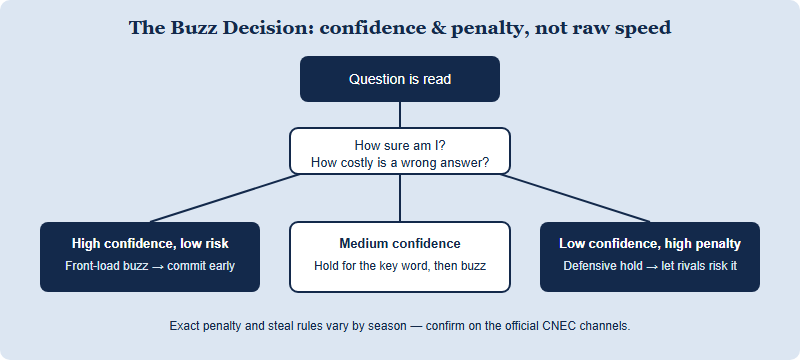
The single biggest mistake new teams make is treating every question as a pure speed race. It is not. In most quiz formats, a wrong answer costs you something — at minimum the question, and under some rule sets a penalty or the opponent's chance to steal. That asymmetry should change how you buzz. The right mental model is a confidence gate: buzz the instant your confidence crosses a threshold, and let the threshold rise with the cost of being wrong.
Three timing patterns are worth drilling explicitly:
- Front-load buzz (high confidence, low risk). When the question is a clean recall item — a definition, a standard formula, a named economist or policy — and the round has no harsh penalty, buzz early. Hesitating on a question you own is how you donate points.
- Hold-and-confirm (medium confidence). When you are 70–80% sure but the answer hinges on one word (“nominal” vs “real,” “shift” vs “movement along”), let the reader finish the qualifying clause, then buzz. The half-second you wait removes the most common careless miss.
- Defensive hold (low confidence, high penalty). When you are guessing and a wrong answer is punished, do not buzz first. Let an opponent take the risk; you can often learn from a wrong answer in the room and convert on the rebound, if the format allows it.
Notice that “buzz as fast as possible” appears in none of these. Speed is the right setting only in the front-load case. The skill you are building is recognising which case you are in before your thumb moves — and that recognition only becomes reflex through buzzer-simulator practice, not through reading more economics.
Category lanes: divide the syllabus before the match starts
The most reliable team upgrade is also the simplest: assign lanes so that, the moment a question reveals its topic, exactly one person is primed to take it. Because NEC content is fixed — micro, macro, and world / international economics — you can pre-split it cleanly. A typical four-person lane map keeps overlap deliberate, so a missed buzz still has a backup.
| Lane | Primary territory | Buzz triggers (example cues) | Backup lane |
|---|---|---|---|
| Seat A · Micro | Supply/demand, elasticity, market structure, costs | “price ceiling,” “marginal,” “monopoly,” “deadweight” | Seat B |
| Seat B · Macro | GDP, inflation, unemployment, fiscal/monetary policy | “CPI,” “multiplier,” “central bank,” “aggregate demand” | Seat A |
| Seat C · International | Trade, exchange rates, comparative advantage, balance of payments | “tariff,” “appreciation,” “current account,” “WTO” | Seat D |
| Seat D · History/people + utility | Named economists, key dates, definitions, fast recall | “who proposed,” “in what year,” “term for” | Seat C |
Lanes do three things at once. They cut the “everyone freezes / everyone lunges” chaos, because responsibility is pre-assigned. They speed up the buzz, because the lane owner has already decided this is their question by the time the cue word lands. And they protect against tunnel vision: the backup column means a question that slips past one seat is still covered. Critically, lanes are defaults, not handcuffs — if Seat C clearly knows a micro question cold and Seat A is hesitating, C should take it. The map exists to remove hesitation, not to enforce silence.
One caution rooted in the iron rule of preparation: do not over-engineer lanes around a round structure you have only assumed. If you are not certain whether your division's live round is full-team, paired, or head-to-head, build the lane logic to be configuration-agnostic and confirm the specifics on the official CNEC pages first. Train the habit; let the official format set the exact seating.
Intra-team signals: communicating without breaking the rules
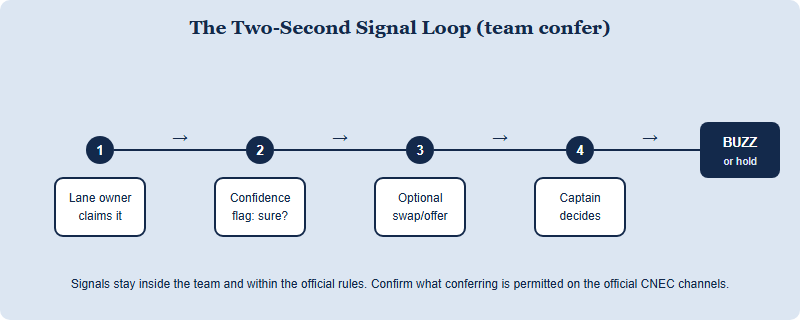
In rounds where a team confers before answering, the difference between a clean answer and a fumbled one is a tiny, pre-agreed signaling system. The goal is to resolve “who has this, and are we sure?” in under two seconds without talking over each other. Effective teams agree on a minimal vocabulary in advance and rehearse it until it is silent and instinctive.
- The claim. The lane owner makes one small, agreed gesture (a hand flat on the table, a finger lift) that means “this is mine, I've got it.” It pre-empts two people answering at once.
- The confidence flag. A second agreed signal separates “I'm certain” from “I think so.” This is what lets a captain decide whether to buzz now or hold for the key word.
- The veto / offer. If a non-owner is more sure, a quiet pre-agreed cue lets them offer to take it — and the owner can release the question. No debate, just a swap.
- The captain's call. One person holds the final say on borderline buzzes. Democratic buzzing is slow buzzing; a single decider keeps the team decisive under the clock.
Two rules govern all of this. First, signals must stay inside your team and within whatever the official rules permit — never attempt to communicate with anyone outside the team or to obtain information you are not allowed to have. Quiz Bowl integrity is non-negotiable, and the CEE sets the academic and conduct standard. Second, the system is only as good as the reps behind it: a signal invented the night before will collapse on stage. Build it early, practise it on a buzzer simulator, and let it become muscle memory.
A four-week buzzer drill block
Tactics only stick if you rehearse them. Below is a simple progression you can adapt; it assumes your team already has the economics and now needs the choreography. Adjust the cadence to your own calendar and the official CNEC timeline.
| Week | Focus | What you actually do | Success check |
|---|---|---|---|
| 1 | Lane assignment | Fix seats A–D; build the cue-word list per lane | Each member can name their triggers from memory |
| 2 | Solo buzz timing | Drill front-load vs hold-and-confirm on a buzzer sim | Fewer than 1 in 10 buzzes are “fast but wrong” |
| 3 | Signals & swaps | Add the claim / confidence / veto cues; rehearse silent | No double-buzzes; swaps resolve in under 2 seconds |
| 4 | Full-pressure scrimmage | Run timed mock matches; track every lost question's cause | Losses are content gaps, not timing or coordination errors |
The success check in Week 4 is the whole point: by the end, when you lose a question, the post-mortem should read “we didn't know it,” not “we beat ourselves.” That is the line between a team that has trained Quiz Bowl and a team that has only studied economics. For the broader picture of how this round sits among all seven NEC events, and how China teams qualify into them, see the round-by-round overview on the CNEC site; for division-specific team rules, always start from the official CNEC pages.
Frequently asked questions
Is it always better to buzz first in the NEC Quiz Bowl?
No. Buzz first only when confidence is high and the penalty for a wrong answer is low; otherwise hold. Confirm the exact scoring and penalty rules on the official CNEC channels.
How should a team of four split topics for Quiz Bowl?
Assign lanes — micro, macro, international, and a recall/people seat — with deliberate backups, so one person is primed per topic while a missed buzz is still covered.
Are team signals allowed during the round?
Communicating within your team may be permitted in conferring formats, but never outside it. Integrity is non-negotiable; verify what is allowed on the official CNEC pages.
Does Quiz Bowl test different economics from the written rounds?
No — the content is the same micro, macro and international economics. What changes is the live, buzzer delivery, which is what you train separately.
Published by the NEC / CNEC editorial desk, operated by Hanlin Education as the officially authorized China National Economics Challenge (CNEC) test center. The NEC is run by the Council for Economic Education, which sets the official rules — always confirm current dates, divisions, fees and awards on the official CNEC channels. Any factual error will be corrected within 7 working days.