
Macroeconomics is one of the three subject pillars the National Economics Challenge (NEC) tests, alongside microeconomics and the world economy. For NEC it means understanding how a whole economy behaves — output, prices, jobs, and the policies that steer them. This guide decodes the core macro topics Chinese international-school students should master and shows how to study them efficiently. The exact emphasis is set by the Council for Economic Education, so confirm current details officially.
How macro fits into NEC
The Council for Economic Education describes NEC as testing key micro and macroeconomic principles together with knowledge of the world economy. In plain terms, that is three pillars, and macroeconomics is the one that zooms out from individual buyers and firms to the economy as a whole. Where microeconomics asks why a single market clears, macroeconomics asks why national output rises, why prices climb, and what a government or central bank can do about it.
Beginners often find macro harder than micro, and the reason is instructive: micro problems tend to be self-contained, while macro concepts are chained together, so a shaky grasp of one link weakens the rest. Inflation makes little sense without output; policy makes little sense without aggregate demand. That interdependence is actually a gift once you see it, because it means you are learning one connected model rather than dozens of isolated facts.
Macro content surfaces throughout the season — in the written Qualifying Test and again in the live rounds. Our explainer of the seven NEC rounds shows where fast, applied macro reasoning pays off, from the rapid recall of Quiz Bowl to the applied analysis of the Critical Thinking round. As the team operating the officially authorised China National Economics Challenge (CNEC) test centre, we find that macro is where under-prepared students lose the most avoidable points, usually because they memorised definitions without understanding how the pieces move together.
The core macro topics, from GDP to policy
You do not need graduate theory for NEC macro; you need a firm command of the standard introductory-to-intermediate topics and the ability to connect them. Map your study around six clusters.
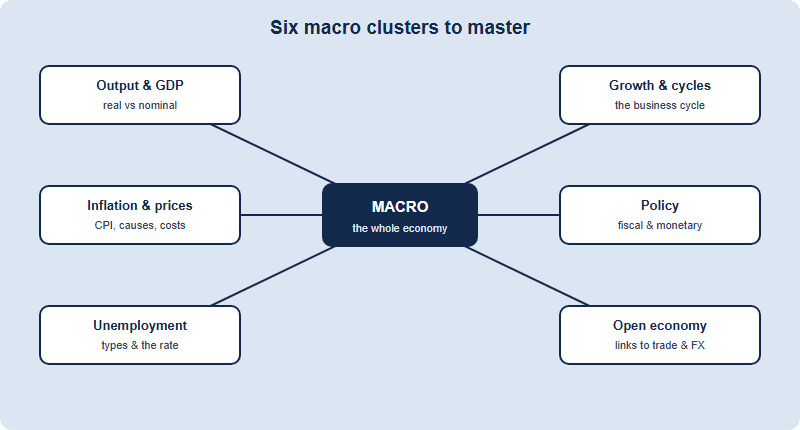
| Topic | Key terms | What NEC-style questions test |
|---|---|---|
| National output | GDP, GNP, nominal vs real, GDP deflator | Calculate and interpret output measures |
| Inflation & prices | CPI, inflation rate, demand-pull, cost-push | Read index data; distinguish causes and costs |
| Employment | Unemployment rate, frictional, structural, cyclical | Classify unemployment; read the labour market |
| Growth & cycles | Business cycle, recession, potential output | Identify the phase and its implications |
| Policy | Fiscal (spending, tax), monetary (rates, money supply) | Match the tool to the goal; trace the effect |
| Open economy | Exchange rates, net exports | Connect domestic policy to trade balances |
Walk through the clusters as a connected story rather than six silos. National output tells you how much the economy produces, and the real-versus-nominal distinction matters because only real figures strip out the effect of rising prices. Inflation measures those rising prices, and knowing whether it is driven by strong demand or by higher costs changes which policy response makes sense. Unemployment reads the labour side of the same economy, with different types pointing to different cures. Growth and the business cycle set all of this in motion over time. Policy is the set of levers used to smooth that cycle, and the open-economy cluster reminds you that no country moves in isolation. Study them together and the questions that combine two or three ideas — the ones that separate strong teams — stop feeling like tricks.
The models you must be able to draw
Macro rewards students who can see the machine, not just name its parts. Two models tie the topics above together, and being able to sketch and read them quickly is worth more than any list of memorised definitions.
The first is aggregate demand and aggregate supply (AD-AS). It shows how total spending and total production interact to set the overall price level and national output — and, crucially, how a policy change or a shock shifts the whole picture. If you can explain what moves aggregate demand and what happens to prices and output when it moves, you can reason through a large share of macro questions on sight. The second is the business cycle: the recurring swing between expansion and contraction. Knowing the phases lets you place a scenario instantly and predict which problems (rising unemployment, rising inflation) tend to dominate at each stage.
To use aggregate demand well, know what moves it: consumer spending, investment by firms, government spending, and net exports. A change in any of these shifts the whole curve, and almost every macro scenario can be read as a story about one of them moving. A collapse in confidence cuts consumption and investment; a stimulus package lifts government spending; a weaker exchange rate can raise net exports. Train yourself to ask, for any scenario, which component moved, in which direction, and what that does to output and prices. That single habit turns a wall of macro topics into a small number of repeatable moves.
Advanced competitors in the Adam Smith division are expected to push these models further, layering in nuance about time lags, expectations and trade-offs. But the same two diagrams remain the backbone. Practise drawing them from memory until the axes and shifts are automatic.
Fiscal versus monetary policy: the comparison that shows up everywhere
If one macro theme deserves extra attention, it is policy — because questions across the season keep asking you to distinguish the two main levers, match each to a situation, and trace its effect. Fiscal policy is the government’s tool of spending and taxation; monetary policy is the central bank’s tool of interest rates and the money supply. Both ultimately work by shifting aggregate demand, which is why students confuse them, and why examiners like testing whether you can keep them straight.
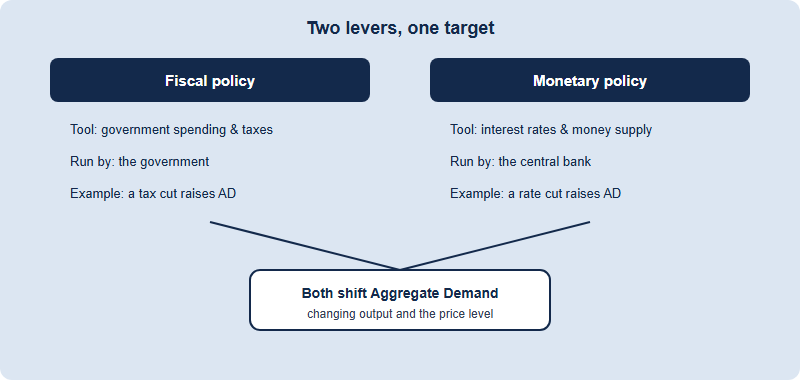
A quick self-test: given a scenario of high unemployment in a recession, can you name one fiscal and one monetary response, and say what each does to aggregate demand, output and prices? If you can do that fluently in both directions — expansion and contraction — your policy foundation is solid.
Work a quick example to see the pattern. Suppose inflation is climbing in an overheating economy. A contractionary fiscal response would raise taxes or cut government spending; a contractionary monetary response would raise interest rates. Both pull aggregate demand back, easing price pressure at the cost of some output and jobs — the trade-off examiners love to probe. If you can narrate that chain in a sentence, and then flip it for a recession, you are reasoning like a competitor rather than reciting like a student.
A macro study routine that sticks
Knowing what to study is half the job; the other half is a routine that actually retains it. The macro pillar is heavy on interconnected concepts, so favour active methods over passive re-reading.
- Build definition maps, not lists. Link GDP to growth, inflation to policy, unemployment to the cycle. Macro is a system; study it as one.
- Redraw the models weekly. Sketch AD-AS and the business cycle from a blank page until the shifts are reflexive.
- Practise with data. Read short economic reports and turn them into a one-line diagnosis: which phase, which problem, which policy.
- Drill both directions. For every policy, rehearse the expansionary and the contractionary case so you are never caught by the mirror-image question.
- Mix macro into timed sets. Since macro appears in fast rounds too, practise answering it quickly, not only in essays to yourself.
Master these six clusters and two models, and macro stops being the pillar that costs you points and becomes the one you rely on. Remember that the official syllabus emphasis and any weighting are set by the Council for Economic Education and can change each season — confirm the current details on the official pages before you finalise your study plan.
Frequently asked questions
Is macroeconomics a big part of NEC?
NEC tests micro, macro and the world economy. Macro is one of the three pillars, so strong macro is essential — confirm the exact emphasis officially.
Which macro topics should I start with?
Start with GDP, inflation and unemployment, then move to fiscal and monetary policy and the AD-AS model, which ties them together.
Do I need to draw graphs for NEC?
Being able to sketch and read the AD-AS model and the business cycle helps you answer quickly and explain your reasoning clearly.
How is macro different from the world-economy pillar?
Macro focuses on a single economy; the world-economy pillar adds trade, exchange rates and cross-border links. They overlap but are studied separately.
Published by the NEC (CNEC) editorial desk, operated by Hanlin Education for China-based international-school students; official rules are set by the competition and change yearly — confirm current details on councilforeconed.org; corrected within 7 working days.