
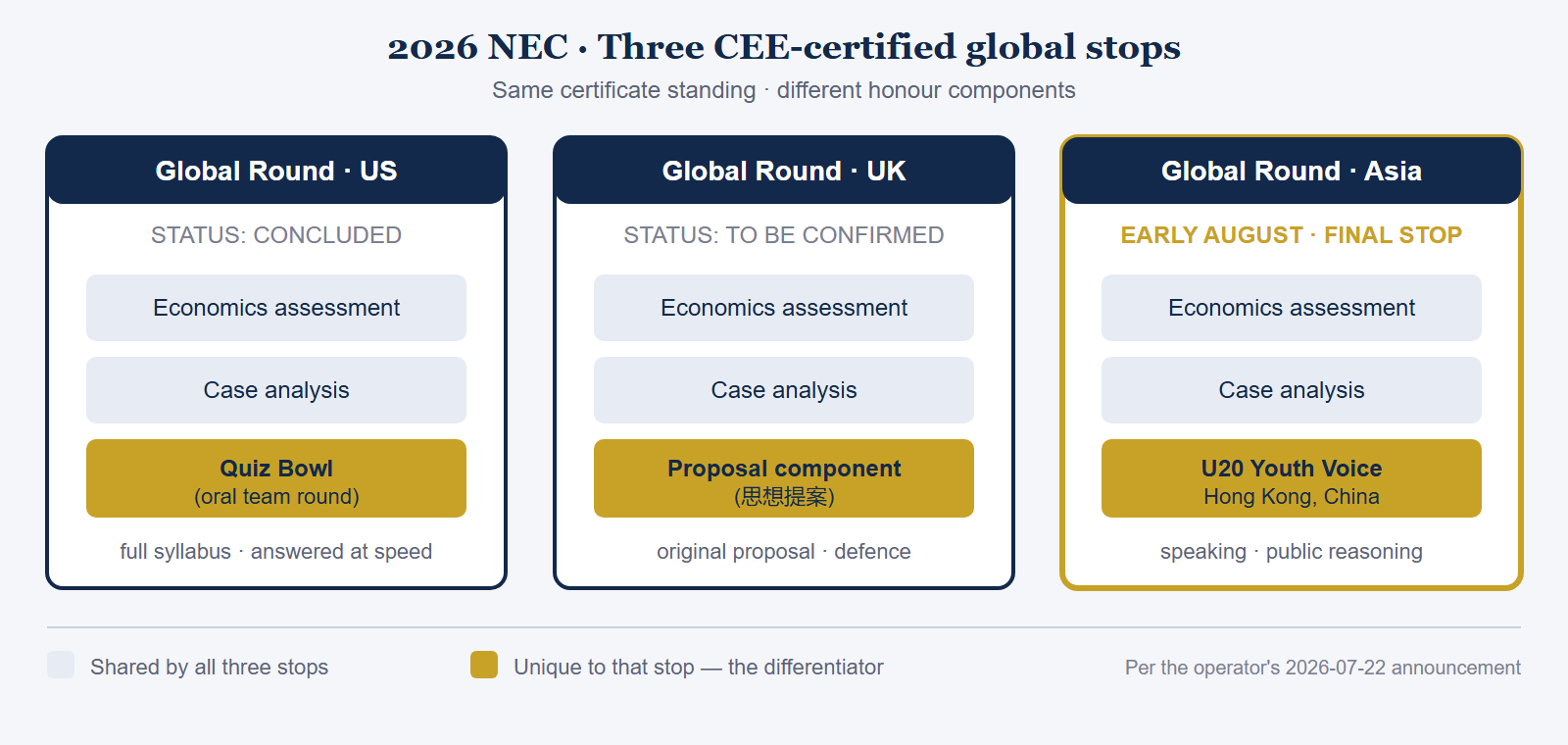
Short answer: The 2026 NEC season set up three CEE-certified global stops — the United States, the United Kingdom, and Asia. Per the operator, the US stop has concluded and the Asia stop takes place in Hong Kong, China in early August as the season’s final stop; the current status of the UK stop is one to confirm on the official channels. All three carry international honour certificates of equal standing, but the honour components differ by stop: Quiz Bowl in the US, a proposal component in the UK, and U20 Youth Voice in Asia.
Three stops, one standing — but not one format
Most families reading about the NEC global round assume there is a single event that happens once a year in one country. For the 2026 season, that is not how it worked. The organiser set up three global stops, each certified by the Council for Economic Education (CEE), each issuing international honour certificates of the same standing. Per the operator, the Global Round in the United States has concluded, and the Global Round (Asia) runs in early August in Hong Kong, China as the season’s final stop. The current status of the Global Round in the United Kingdom is one to confirm on the official channels.
That much is scheduling, as reported by the operator. The part that actually matters for how a team prepares is subtler, and it is the reason this article exists: the three stops do not award the same honour components. Two of the three components are shared across all stops. The third is different at each one. A team that is quick on its feet answering across the syllabus at speed is playing a different game from a team whose strength is building an original proposal, which is different again from a team built around public speaking.
For students in Greater China deciding which stop to aim at in a future season — or trying to read this season’s results correctly — that structural difference is the single most useful thing to understand.
What is the Hong Kong stop, exactly?
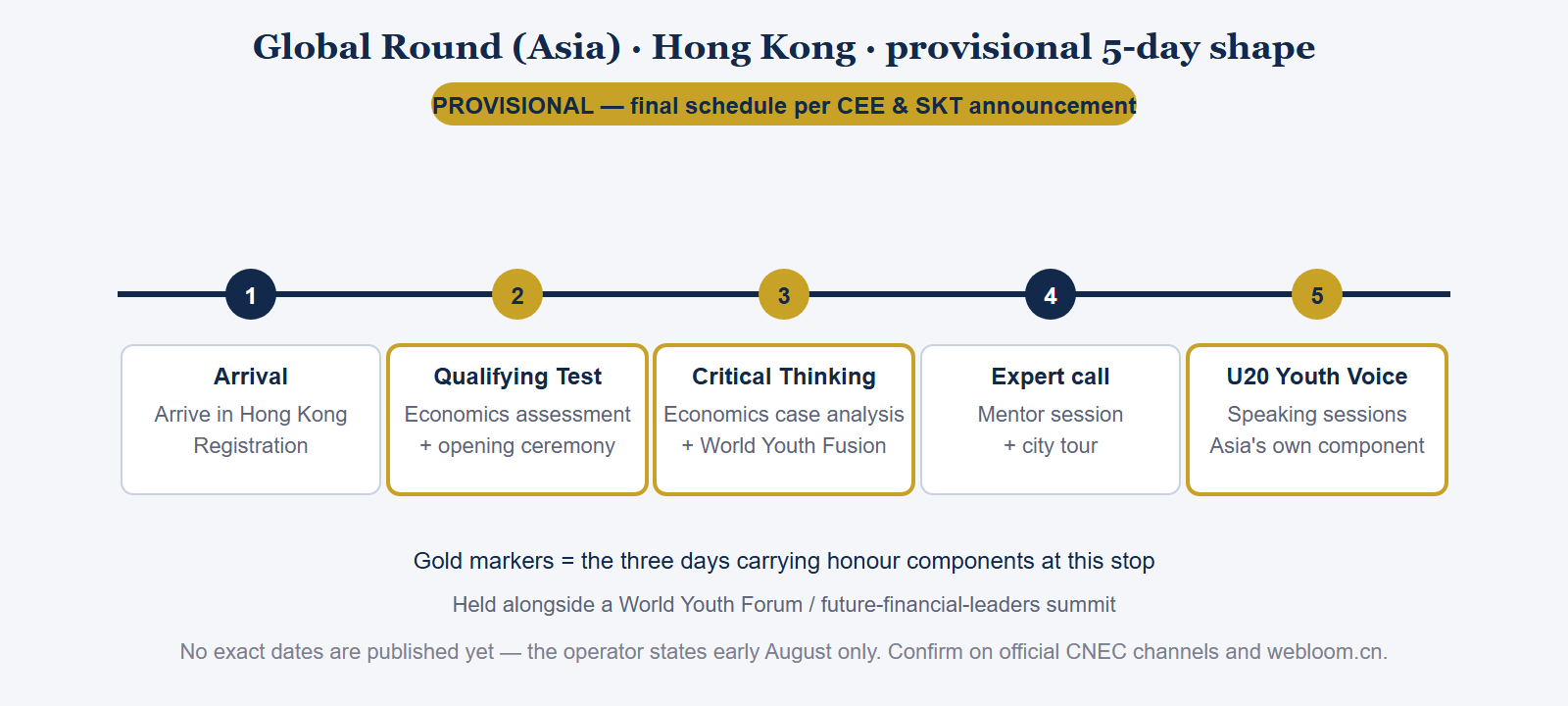
The Global Round (Asia) is held in Hong Kong, China and runs alongside a World Youth Forum / future-financial-leaders summit. That pairing is not cosmetic. It is why the Asia stop’s distinctive honour component is U20 Youth Voice rather than a fast-recall round or a proposal component: the forum context gives students a platform to reason out loud in front of an audience, and the honour recognises that.
Two practical points before anything else.
First: we are not going to give you exact August dates. The operator’s announcement says early August and explicitly defers the final schedule to CEE and SKT announcement. Any site quoting you a precise day-by-day calendar right now is guessing. Confirm on the official CNEC channels and webloom.cn.
Second: the five-day shape below is provisional. The operator has published it as a working structure, with the final schedule subject to CEE and SKT announcement. Treat it as the intended rhythm, not a booking document.
How do the three stops compare, component by component?
Here is the comparison in one table. Two rows are constant across all three stops; one row changes. The judging row is the part most teams underestimate.
| Component | Global Round · US | Global Round · UK | Global Round · Asia (HK) |
|---|---|---|---|
| Economics assessment (Qualifying Test) |
Honoured | Honoured | Honoured |
| Case analysis (Critical Thinking) |
Honoured | Honoured | Honoured |
| Third component (the differentiator) |
Quiz Bowl | Proposal component (思想提案) | U20 Youth Voice |
| Judging split | Economics assessment and case analysis are judged separately for DR (David Ricardo) and AS (Adam Smith). U20 Youth Voice and the proposal component are judged with both divisions merged, on multi-dimensional criteria. | ||
| Certificate standing | All three stops are CEE-certified and award international honour certificates of the same standing. | ||
| 2026 status (per the operator) |
Concluded | To be confirmed on the official channels | Early August — final stop of the season |
Why the DR/AS split matters more than families expect
Read that judging row again. The economics assessment and the case analysis are judged separately by division — DR (David Ricardo) teams are compared against DR teams, AS (Adam Smith) teams against AS teams. That is the arrangement most students already assume, and it is fair: the two divisions sit at different levels of economics preparation.
But U20 Youth Voice and the proposal component are judged with both divisions merged, on multi-dimensional criteria. A DR student standing up at U20 Youth Voice in Hong Kong is being assessed in the same pool as AS students.
That has two consequences worth thinking through honestly:
- For a strong DR team, the merged components are an opportunity. Public reasoning quality is not a pure function of how many chapters of macro you have covered. A well-prepared younger speaker can hold their own against an older field in a way that would be much harder on a technical assessment.
- For an AS team, the merged components are not a free win. Depth of economics does not automatically convert into a persuasive spoken argument. Teams that treat U20 Youth Voice as an afterthought after the Qualifying Test tend to find that out on the day.
In other words: two of the three honour components at every stop reward what you have studied; the third rewards a distinct skill, and at two of the three stops that third skill is judged across the whole field at once.
Which stop suits which student?
Since all three carry certificates of the same standing, the honest way to choose between them — in a future season, once the organiser confirms the stops on offer — is by strength fit, not prestige.
- The fast-recall team → the US stop. The Quiz Bowl is an oral round covering the full economics syllabus, answered at speed as a team. If your team practises by drilling and works well under time pressure, this is where that edge is worth points.
- The proposal team → the UK stop. The proposal component rewards constructing an original proposal and defending it; the exact submission and defence format is set by the organiser, so confirm it on the official channels. This is the stop for students who are better on the second read of a problem than on the first pass.
- The speaking team → the Asia stop. U20 Youth Voice sits inside a youth forum context and rewards students who can reason out loud, hold a position, and address a room. If your student is strong in MUN-style settings or debate, this is the stop where that transfers directly.
Note that in all three cases, the two shared components still stand. There is no stop where you can skip the economics assessment or the case analysis. The third component is a differentiator, not a substitute.
What do this season’s China results actually show?
Scale first, so the results have context: the NEC reaches roughly 10,000 students a year, per the organiser — confirm current figures on the official channels. Reaching a global stop at all is a narrow filter.
Within that, two 2026 results from our own records are worth reporting precisely because they demonstrate the point of this article. Per Hanlin and de-identified: in the AS (Adam Smith) division, a team placed first globally in Critical Thinking — the case-analysis component that every stop contests. In the DR (David Ricardo) division, a team placed second in the Quiz Bowl, the US stop’s distinctive component.
Read the shape of that: one placing came on a component shared by all three stops, the other on a stop-specific differentiator. It is a reminder that the third component is not a side event — it is a separate honour with its own field, and teams place in it independently of the assessment and the case analysis.
On the coaching side, per Hanlin and de-identified: in 2026, 14 teams advanced to the global round. These are past results from specific cohorts; they vary year to year and are not a forecast for any individual student. They also carry no bearing on Chinese school admission or points of any kind.
What to do while the Asia stop runs
If your team is heading to Hong Kong: the provisional shape above tells you the rhythm — a test day, a case-analysis day, and a speaking day, with a mentor session and a city day in between. Prepare for the Qualifying Test and Critical Thinking the way you would at any stop, and give U20 Youth Voice genuine rehearsal time rather than treating it as the closing ceremony. Remember the merged judging.
If you are planning for a future season: do not assume the same three stops, the same components, or the same calendar will repeat. The stop line-up, the honour components attached to each, and the dates are all set by the organiser and the China programme, and they can change. What is stable enough to plan around is the two shared components — the economics assessment and the case analysis — because those appeared at every stop in 2026. Build there first; treat the third component as the strategic choice you make once the season’s stops are announced.
And on dates specifically: the operator has said early August and nothing more precise, with the final schedule subject to CEE and SKT announcement. Confirm on the official CNEC channels and webloom.cn before booking anything.
Frequently asked questions
Is the Asia stop worth less than the US or UK stop?
No. All three 2026 global stops are certified by CEE and award international honour certificates of the same standing. The difference between them is structural — which honour components are contested at each stop — not hierarchical. Choosing a stop is a question of which components suit your team’s strengths.
What are the exact dates of the 2026 Hong Kong stop?
The operator states only that the Global Round (Asia) runs in early August, and that the final schedule is subject to CEE and SKT announcement. No exact dates have been published. Confirm on the official CNEC channels and webloom.cn rather than relying on any third-party calendar.
Are DR and AS students judged against each other in Hong Kong?
Partly. The economics assessment (Qualifying Test) and the case analysis (Critical Thinking) are judged separately for the DR (David Ricardo) and AS (Adam Smith) divisions. U20 Youth Voice, the Asia stop’s distinctive component, is judged with both divisions merged on multi-dimensional criteria — so a DR student competes in the same pool as AS students for that honour.
Which components appear at every stop?
Two: the economics assessment (Qualifying Test) and the case analysis (Critical Thinking). The third component differs — the Quiz Bowl in the US, a proposal component (思想提案) in the UK, and U20 Youth Voice in Asia. Whether the same three stops and the same components will be offered in a future season is set by the organiser and should be confirmed on official channels.
Published by the CNEC editorial desk, operated by Hanlin Education as an authorised China test centre for the NEC. The NEC is run by its organiser, the US Council for Economic Education; official rules, dates and arrangements are set by the organiser and the China programme and can change — always confirm on the official CNEC channels and webloom.cn. Student results quoted here are de-identified Hanlin data and vary from cohort to cohort; they are not a forecast for any individual student. Confirmed errors are corrected within 7 working days.