
The Pre division is a genuine entry point for younger students — per the organiser it is scoped to microeconomics and macroeconomics and can be entered individually or in a small team. It also has a structural ceiling: per the organiser's materials, Pre does not route through to the global round. Knowing that before you enter changes what a good first season looks like.
A structure the US competition does not have
Parents comparing notes across competitions get confused here, and the confusion is understandable, because the two programmes are not built the same way.
The US National Economics Challenge runs two divisions — David Ricardo for first-time competitors with no more than one general economics course, and Adam Smith for AP, IB, honours and returning competitors — and its published rules address themselves to high school students. There is no junior tier below David Ricardo.
CNEC, per the organiser's season materials, runs three: Pre, David Ricardo and Adam Smith, with an eligibility band spanning grades 7 to 12 and an upper age limit of under 20, the exact birth-date cut-off being set each season. That third tier is what makes a Grade 8 entry a real question rather than a hypothetical one. Confirm the current division structure, grade band and age cut-off on the official CNEC channels before planning around any of it, because these are exactly the parameters that move between seasons.
So the honest framing for a Grade 7 to 9 student is not “am I allowed in” — per the organiser you probably are. It is “what is this tier designed to do for someone my age, and what does it not do.”
What Pre is scoped to, and where the ceiling sits
Two features of the Pre division matter far more than anything else, and both are easy to miss because they are structural rather than difficulty-related.
Scope. Per the organiser's materials, Pre covers microeconomics and macroeconomics. David Ricardo and Adam Smith add international economics. For a younger student this is a genuine kindness: international economics is the block that leans hardest on unfamiliar notation and on background knowledge about trade and currencies that a Grade 8 student has had no reason to acquire. Removing it makes the syllabus roughly a third smaller and noticeably more concrete.
The ceiling. Per the organiser's materials, the Pre division does not route through to the global round. This is the single most important sentence in this article. It is not a difficulty gate you can beat by preparing harder — it is how the pathway is constructed. A student who enters Pre and performs superbly has still had an excellent season that ends earlier in the structure than a David Ricardo or Adam Smith season would.
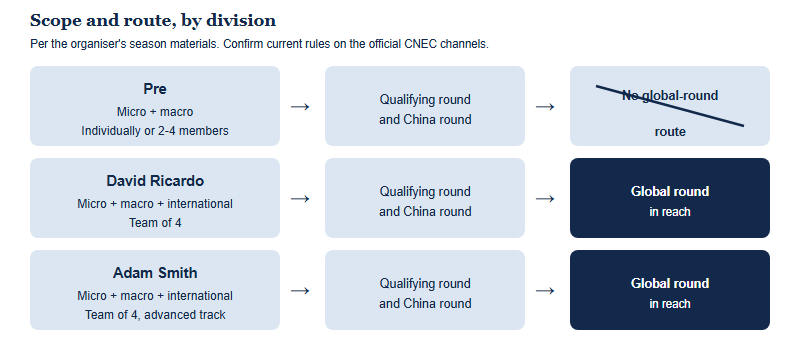
Read that ceiling correctly and it is useful rather than discouraging. It tells you that Pre is a learning tier, and that the right yardstick for a Grade 8 season is what the student can do at the end of it, not how far up a bracket they travelled.
Is a Grade 8 student actually ready? Three honest signals
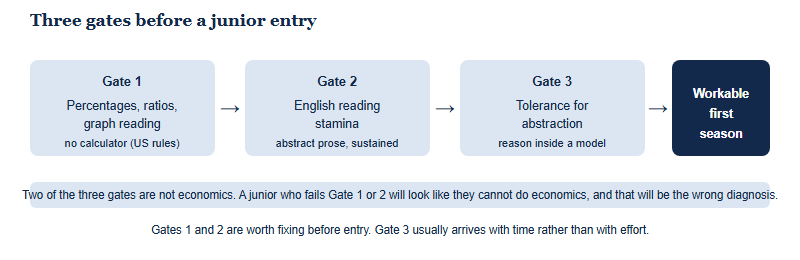
Age is a poor predictor here. The students who cope well at 13 and the students who struggle at 15 differ on three specific things, none of which is “how clever they are.”
| Readiness signal | What it actually requires | How to test it in an afternoon | If the answer is no |
|---|---|---|---|
| Percentage and ratio fluency | Confident percentage change, ratios, reading a simple graph — no calculus, and per the published US rules no calculators or personal devices during the exam | Ask them to work out a 4% rise on 250, then what fraction 30 is of 240, mentally, in under a minute | Wait a term. This is quick to fix and painful to compete without |
| English reading stamina | Reading dense abstract prose in English for sustained periods without translating sentence by sentence | Give them two pages of a principles-level economics chapter and ask for a spoken summary | Build the reading habit first; the economics will be much cheaper afterwards |
| Tolerance for abstraction | Accepting that a curve is a model, not a picture of reality, and reasoning inside assumptions | Explain “if price rises, quantity demanded falls, other things equal” and see whether they argue with the model or use it | Not a maturity failure — some students simply need another year. It arrives |
Notice what is absent from that list: prior economics knowledge. The entry divisions exist precisely because students arrive without it. Notice also that two of the three gates are not economics at all. That is the real reason some junior entries go badly — the student was defeated by reading load and mental arithmetic, and everyone concluded they “weren't ready for economics.”
Entering alone, or with a team
Per the organiser's materials, Pre can be entered individually or as a small group of two to four, while David Ricardo and Adam Smith require a team of four. Confirm current team rules on the official CNEC channels. That optionality is unusual and worth thinking about rather than defaulting.
Entering alone suits a Grade 7 or 8 student whose year group has no one else interested, and who would otherwise not compete at all. It removes the coordination overhead entirely — no scheduling, no free-rider problem, no negotiating who studies what — and for a first exposure that is a legitimate trade.
Entering with two or three friends suits almost everyone else, for a reason that has nothing to do with scoring: at 13 or 14, the thing that most often ends a preparation plan is simply losing interest in October. A small group is the cheapest available defence against that. Younger students also benefit disproportionately from having to explain concepts aloud, because explaining is where vague understanding gets exposed.
One caution: do not assemble a junior team by recruiting an older, more advanced student to “carry” it. Beyond the placement questions that raises — the published US rules move a whole team up if any member is enrolled in an advanced economics course, and CNEC placement rules should be confirmed with the organiser — it also defeats the point. A junior season is for building the student's own foundation.
What a good junior season actually looks like
Set the target at the right thing and a Grade 8 season is genuinely valuable. Set it at a medal and you have designed disappointment into the plan.
A good first junior season produces four outcomes: the student can explain the core micro diagrams unprompted; they can sit a timed multiple-choice paper in English without panicking; they know which of micro and macro they find harder; and they still want to do it again next year. That last one is not a soft outcome — it is the one that determines whether there is a second and third season, and multi-season students are the ones who eventually reach the harder divisions.
It is also worth understanding the shape of the competition they are entering, because the demands differ sharply by stage — the breakdown in the seven NEC rounds explained is the clearest starting point for a family new to the format. If the eventual ambition is the advanced track, the expectations there are set out in the Adam Smith division breakdown, and it is worth reading early simply to see what the destination requires.
For scale, and for calibration rather than encouragement: the 2026 global round's Asia site has now finished. Across one of our coaches’ teaching groups this season the de-identified tally was two team golds, one team silver and three team bronzes, plus a first place globally on the individual Quiz Bowl component in the Adam Smith division. That is our own count rather than a Council for Economic Education statistic, and individual results vary widely. The relevant point for a junior family is that, in our coaching experience, results at that stage tend to come from students several seasons in — which is exactly the argument for entering early with modest expectations rather than late with high ones.
Finally, if the student's real appetite is for extended argument rather than timed recall, it is worth checking the format fits before committing years to it. A timed multiple-choice team competition and a written economics prize reward genuinely different temperaments, and we compare them directly in NEC vs the economics essay competitions.
Q: Can a Grade 7 or 8 student enter NEC?
Per the organiser, CNEC's eligibility band spans grades 7 to 12 with an under-20 age limit. Confirm the current band and cut-off officially.
Q: Does the Pre division lead to the global round?
Per the organiser's materials, no — Pre does not route through to the global round. Confirm current advancement rules on the official channels.
Q: Can my child compete in Pre without a team?
Per the organiser, Pre may be entered individually or in a group of two to four. David Ricardo and Adam Smith require four. Confirm current team rules on the official CNEC channels.
Q: What should a junior fix before entering?
Percentage and ratio fluency without a calculator, and stamina for reading abstract English prose. Both matter more than prior economics.
Published by the NEC (CNEC) editorial desk, operated by Hanlin Education for China-based international-school students. Official rules are set by the competition and change yearly — confirm current details on councilforeconed.org and the official CNEC channels. Errors are corrected within 7 working days of notice.