
Somebody always leaves. A student transfers, falls ill, graduates early or takes a summer internship, and a team that spent months preparing suddenly has three people. Under the rules the Council for Economic Education (CEE) published for the 2025 National Economics Challenge, that is survivable — a team may reconstitute, but must retain at least two original members, and the replacement you choose can quietly change which division you are allowed to compete in.
The roster rules, as published
CEE's published 2025 rules and eligibility document set out team composition plainly. Teams had to be comprised of three or four members, and CEE encouraged competing with a full four. All members had to come from the same public school, private school, community organisation or club, or afterschool programme — which means students from different schools were eligible to sit on the same team provided they all belonged to one of those groups. Every team also had to have a coach who was an associate of that school, district, organisation or programme, and who was fit to accompany the students if the team advanced to the National Finals.
Those clauses are usually skimmed at registration and then forgotten. They become urgent the moment your roster changes — which, over a season that runs across a whole academic year, it very often does. Our round-by-round guide to the seven NEC events covers the competition structure itself; this piece is about keeping four eligible people attached to it from start to finish.
One scope note before the detail. Everything below is drawn from what CEE published for the 2025 United States route, with its two-division structure. The China national round administered through CNEC runs its own arrangement — four divisions for 2027, including an entry-level Pre tier and a new Herbert Simon AI division, and its own round line-up — and rules are reset each season. Use the reasoning here as a planning framework, and confirm your own season's roster and substitution provisions on councilforeconed.org and the official CNEC channels before you rely on any specific figure.
The two-original-members rule, and the tighter window later
The published rules drew a sharp distinction between two different moments in a season, and the distinction matters enormously for planning.
Before the National Semi-Finals, a team that had qualified could reconstitute its membership, subject to retaining at least two original members. Everyone on the rebuilt team still had to satisfy the team composition conditions, the general student eligibility conditions, and the eligibility conditions for the division in which the team qualified.
Between the National Semi-Finals and the National Finals, the door narrowed considerably. Reconstitution was permitted only in extraneous circumstances, with approval from CEE, and covered one to two members. The published examples of approved reasons were family emergency, illness, graduation and internship conflicts. The same two-original-members floor applied — and one additional condition appeared: any new member joining for the National Finals must also have competed in their state competition, at minimum in the first-round competition.
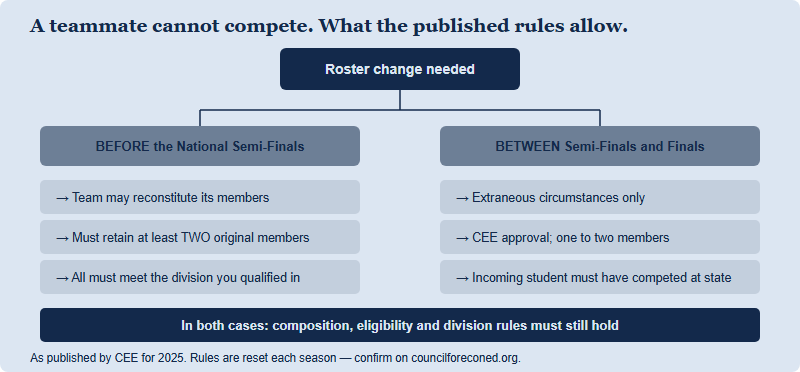
The planning consequence is straightforward and almost nobody acts on it: your realistic pool of replacements shrinks as the season progresses, and by the final stage it is limited to students who already competed earlier in the same season. If you want a genuine substitute available at the final stage, that person needs to have entered the competition earlier in the same season.
The substitution that changes your division
This is the trap that costs teams the most and is discussed the least. Under the published rules, division placement was not a preference — it was a consequence of who was on the roster.
The David Ricardo Division covered teams of students currently or previously enrolled in one general economics course or less, or in courses containing introductory economic concepts such as social studies, business or personal finance. The Adam Smith Division covered students enrolled in AP Microeconomics or AP Macroeconomics, International Baccalaureate economics including pre-IB, two economics courses, or any other advanced economics course. And then the decisive clause: any team consisting of one or more students enrolled in a course listed under the Adam Smith criteria had to compete in the Adam Smith Division.
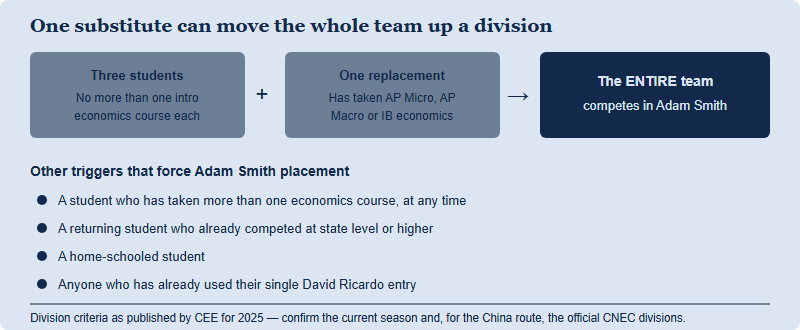
For students at Chinese international schools this is not a marginal risk — it is the default case. The most obvious person to call when a teammate drops out is the strongest economics student you know, and at an IB or AP school that student is almost by definition someone whose enrolment pushes the team into the advanced division. You solve a staffing problem and inherit a harder competition.
Two further published clauses tighten this. Students could participate in the David Ricardo Division only once, and any returning student who had already participated at state level or higher had to compete in Adam Smith in subsequent years regardless of coursework. So a second-year student is not an eligible David Ricardo substitute even if their coursework would otherwise allow it. If your team is heading for the advanced tier by accident or by choice, our guide to the Adam Smith division sets out what actually changes at that level.
| Situation | What the published rules allowed | What to do now |
|---|---|---|
| Member leaves before the semi-finals | Reconstitute, keeping at least two original members | Check the replacement's course history before confirming them |
| Member leaves after the semi-finals | Only in extraneous circumstances, with CEE approval, one to two members | Contact your coordinator immediately; do not assume a swap is automatic |
| Only three members available | Permitted, but a three-member team automatically forfeits the first tiebreaker | Safer than an ineligible fourth, but field a fourth if you can — verify eligibility before you confirm anyone |
| Replacement has taken AP or IB economics | The whole team must compete in Adam Smith | Decide consciously whether you accept the division change |
| Replacement competed last season | Returning competitors must enter Adam Smith | Not an eligible David Ricardo substitute |
| Replacement never competed this season | Finals substitutes had to have competed at state level | Register your reserve early enough that they qualify as a substitute |
| Teammate is from another school | Permitted if all belong to the same club, organisation or programme | Document the shared programme at registration, not later |
What counts as "the same school"
The composition clause is more generous than most students assume, and it is worth reading carefully rather than guessing. The published requirement was that all members come from the same public school, private school, community organisation or club, or afterschool programme — with the explicit note that students from different schools are eligible to be on the same team if they all belong to one of those groups.
For a student at a school with only two or three serious economics students, that clause is the difference between having a team and not having one. It also carries an administrative obligation: if your team is built through a club or programme rather than a single school, the shared affiliation is the thing that makes you eligible, so establish and record it at registration rather than trying to demonstrate it retrospectively when a question is asked.
Building a roster that survives a whole season
Roster attrition is predictable in aggregate even though it is unpredictable individually. A season spanning an academic year will collide with mock examinations, university application deadlines, summer programme commitments and, for Year 13 and Grade 12 students, graduation itself — which the published rules listed among the approved reasons for a late change.
- Register a fifth student early if your programme allows it. Because late substitutes had to have competed earlier in the season, a reserve who never entered is not a reserve at all. Check with your coordinator how a reserve should be registered on your route.
- Screen for eligibility, not just ability. Keep a simple record for every candidate: economics courses taken, whether they have competed before, and at what level. That list takes ten minutes to build and prevents the most expensive mistake in this article.
- Do not stack your roster by year group. A team of four Grade 12 students is a team that cannot return and is maximally exposed to graduation and application-season conflicts. Mixing year groups protects both this season and the next.
- Confirm the coach requirement early. The published rules required a coach who was an associate of the school or organisation and fit to accompany students to the National Finals. That is a travel and supervision commitment, not just a title on a form.
- Rehearse with three. If three-member competition is permitted on your route, run at least one full practice that way. Teams discover the reallocation problem far more cheaply in a practice room than on the day.
A first-party pattern on continuity
Drawn from the teaching record of one of our economics coaches and de-identified: across three seasons, that single coaching cohort advanced six of eight teams from the national round to the global round in 2026, four of eight in 2025, and seven of eleven in 2024. In the 2026 season, all twenty-six students in the cohort advanced from the regional round.
What is instructive here is the shape rather than the totals. Advancement is counted in teams, not in students — so a strong individual on a roster that falls apart contributes nothing to the column that matters, while an intact, moderately strong team keeps progressing. Roster continuity is not an administrative footnote sitting beside preparation; over a long season it behaves like a component of preparation. This is one coach's cohort record rather than a company-wide or official total, and results vary between students, teams and seasons.
A final word on where to verify. Team composition, division placement and substitution provisions are exactly the kind of rules that change between seasons, and they differ between the United States route and the China national round operated through CNEC. Before you finalise a roster, read the current year's rules document on councilforeconed.org and confirm the China-route specifics on the official CNEC channels. If you are still weighing whether a team competition is the right fit at all, our comparison of the test-and-team format against the essay prizes lays out what each format asks of you.
Can an NEC team compete with only three members?
CEE's published 2026 rules state teams must be comprised of three or four members, with four encouraged, and a three-member team forfeits the first tiebreaker.
Can you replace a teammate mid-season?
Yes, with limits. The published rules allowed reconstitution but required the team to retain at least two original members and to meet all division and eligibility conditions.
Does adding an AP or IB economics student change our division?
Under the published criteria, yes — a team with one or more students in an Adam Smith listed course had to compete in the Adam Smith Division.
Must all team members attend the same school?
Not necessarily. Members from different schools were eligible if they all belonged to the same club, community organisation or afterschool programme.
Published by the NEC (CNEC) editorial desk, operated by Hanlin Education for China-based international-school students. Official rules are set by the competition and change yearly — confirm current details on councilforeconed.org. Errors are corrected within 7 working days.