
CEE’s published rules for the National Economics Challenge state plainly that students who have never taken an economics course are eligible to compete in its David Ricardo Division. The China round sets its own division rules, so confirm your own placement on the official CNEC channels. Eligibility is usually the smaller obstacle — readiness is. This is the order to build in, and how to mark your own work.
The door is open — and what is actually behind it
Plenty of students at Chinese international schools sit in a science or maths track where economics simply is not offered until the diploma years, or is not offered at all. The natural assumption is that a national economics competition is closed to them. It is not.
CEE’s 2026 Rules and Eligibility document, published on councilforeconed.org, defines the David Ricardo Division as covering teams of students currently or previously enrolled in one general economics course or less — including courses that merely touch introductory economic concepts, such as social studies, business or personal finance — and states directly that students who have never taken an economics course are eligible to compete. The same document notes that a student may only compete in that division once.
Two important qualifications before you build a plan on that. First, those are CEE’s rules for its own competition structure. The China national round runs its own arrangements, including a third entry division alongside David Ricardo and Adam Smith, so confirm which division your situation places you in through the official CNEC channels rather than assuming the US definitions transfer unchanged. Second, CEE’s rules also state that a team containing even one student enrolled in an advanced economics course — AP Microeconomics, AP Macroeconomics, IB economics, or a second course — must compete in the higher division. In other words, division placement is a property of the whole team, not of you individually. If you are a complete beginner planning to team up with the school’s AP Economics star, understand what that does to your bracket before you commit, and check the current criteria officially.
So much for the door. Behind it, CEE states that content covers microeconomics, macroeconomics and international economics. That is a reassuringly small map. It is also, for a self-studier, a map with a strict recommended order — and getting the order wrong is the single most common reason beginners stall in week four.
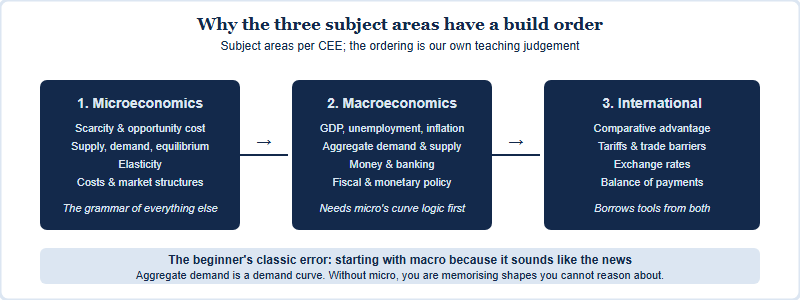
Self-taught students almost always want to begin with macroeconomics, because macro is what economics sounds like in the news: interest rates, inflation, growth. The trouble is that aggregate demand and aggregate supply are curves that shift for reasons, and if you have not internalised what a curve shifting means in a simple market, you end up memorising the picture without owning the mechanism. You will recognise the diagram and still get the question wrong, because the question asks what happens when only one thing changes.
A twelve-week build from zero
The plan below assumes six to eight focused hours a week and no teacher. It is deliberately output-driven: every block ends with something you produce, because production is the only reliable evidence that learning happened.
| Weeks | Focus | What you must be able to do by the end | Your output |
|---|---|---|---|
| 1–2 | Scarcity, opportunity cost, PPF, incentives | Explain a real trade-off in economic language without using the word “expensive” | One page: a decision at your school analysed as opportunity cost |
| 3–4 | Supply, demand, equilibrium, shifts vs movements | Predict price and quantity direction for any single shock, and say which curve moved and why | Twelve hand-drawn shock diagrams, no notes |
| 5 | Elasticity | Say who bears a tax and why, from relative elasticities alone | Written answer: why petrol taxes fall mostly on buyers |
| 6–7 | Costs, revenue, market structures | Distinguish four market structures by entry, number of firms and pricing power | A one-page comparison table built from memory |
| 8–9 | Macro measurement and AD/AS | Trace a shock from cause to output, price level and unemployment | Three worked chains: oil shock, tax cut, confidence collapse |
| 10 | Money, banking, monetary and fiscal policy | Explain what a central bank actually changes and how it transmits | Explain it aloud to a non-economist in three minutes |
| 11 | Trade, comparative advantage, tariffs | Show who gains and who loses from a tariff, and roughly why | One diagram plus a 200-word commentary |
| 12 | Exchange rates and the balance of payments | Predict currency direction from an interest-rate or trade change | Two worked examples using this month’s news |
Notice that international economics sits last and gets two weeks rather than four. That is not because it is unimportant — it is a named content area — but because almost everything in it is micro and macro tools pointed at two countries instead of one. Learn the tools first and the third area costs you a fortnight rather than a term.
How to mark your own work when nobody else can
This is the genuine disadvantage of self-study, and it is not the absence of a lecturer. It is the absence of anyone to tell you that your confident answer is wrong. Familiarity feels exactly like understanding from the inside, which is why so many self-taught students are shocked by their first real score.
The remedy is to stop asking yourself “do I know this?” and start asking “at which level do I know this?”
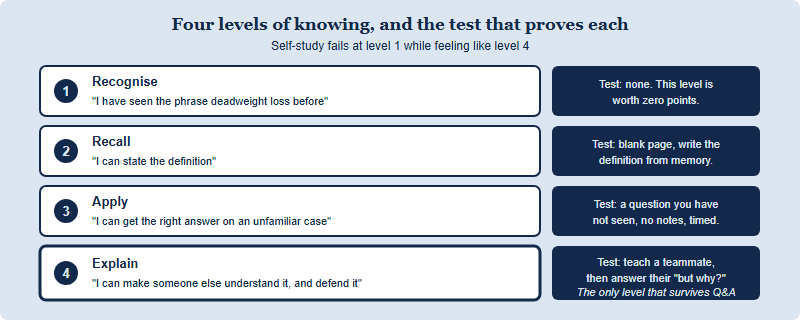
Three practical consequences follow. Close the book before you test yourself, or you are testing your reading speed. Time yourself from the beginning, because an answer you reach in six minutes is not the same asset as one you reach in sixty seconds. And find one person — a teammate, a friend, a patient parent — who will ask “but why?” once, because the second question is where self-study collapses.
Four traps — and the one thing you cannot self-teach
- Vocabulary without mechanism. You learn that a price ceiling causes shortages, but not why, so a question that changes the elasticity of supply defeats you. Fix: for every result you learn, write the causal chain in three steps before you write the conclusion.
- English as a hidden second subject. Economics has terms whose everyday meaning is misleading — investment, capital, demand, real. If English is your second language, you are learning two things at once and should treat the vocabulary as a study object rather than as friction.
- Diagram avoidance. It is quicker to read a paragraph than to redraw a graph, and quicker is why self-taught students end up unable to draw anything. Every model in this subject has a picture, and the picture is how you reason under time pressure.
- Studying alone all the way to the round. This is a team competition. Some rounds ask you to think aloud with other people, and thinking aloud is a separate skill from thinking. If you can only perform in silence, you have prepared for half the event — see our breakdown of the seven NEC rounds for how differently the stages ask you to work.
That last trap deserves expanding, because it is the one thing on this page you genuinely cannot solve alone. Written knowledge is self-teachable. Live performance is not. CEE’s rules for its National Finals describe a Critical Thinking Round in which teams get 25 minutes to prepare an analysis of a current economic problem, 12 minutes to present, and 8 minutes to answer judges’ questions, starting from a blank slide deck with no speaker notes. Whatever your national round’s format turns out to be — confirm it officially — no amount of solitary reading rehearses that.
The fix is cheap: from week six, once a fortnight, take a news story, give yourself 25 minutes, and present it for 12 minutes to whoever will sit still. Then have them ask you three hostile questions. That single habit is worth more than another textbook chapter.
Choosing a division when you have no grade to calibrate against
Students with a course have a school report to reason from. You do not, and the temptation is to over-correct in either direction — either assuming that no course means the entry track by default, or over-reaching to prove a point. Neither is a decision; both are guesses.
Do this instead. Complete weeks one to nine of the plan above, then sit a set of practice questions cold and timed. Your accuracy on unseen questions, not your coursework history, tells you where you actually stand. Then check that against the official division criteria for the round you are entering, because eligibility rules can place you somewhere your score alone would not — remember that under CEE’s rules a single teammate’s advanced coursework moves the whole team up. If you find yourself scoring well and wondering whether to aim higher, our guide to the Adam Smith division and who should attempt the advanced track covers the trade-off honestly.
One last piece of perspective. If what you actually enjoy is arguing a position at length in prose, a test-and-team competition may be the wrong home for your effort, and there is no shame in discovering that in September rather than March. We set out the difference in NEC versus the economics essay prizes. Starting from zero is a fine reason to be careful about what you commit a year to; it is not a reason to assume the door is shut.
Frequently asked questions
Can I really enter with no economics course at all?
CEE’s published rules state that students who have never taken an economics course are eligible for the David Ricardo Division. Confirm your own round’s division criteria officially.
How long does the build from zero realistically take?
Around twelve weeks at six to eight focused hours per week, if you work in the order micro, then macro, then international, and produce written output each block.
Does one teammate’s AP Economics course affect me?
Under CEE’s rules, a team containing any student in an advanced economics course must compete in the higher division. Team composition drives placement, so check before forming.
What is the single most common self-study mistake?
Starting with macroeconomics. Aggregate demand and supply are curves; without micro you memorise the picture and cannot reason when one variable changes.
Published by the NEC (CNEC) editorial desk, operated by Hanlin Education for China-based international-school students. Official rules are set by the competition and change yearly — confirm current details on councilforeconed.org and through the official CNEC channels. Errors are corrected within 7 working days.