
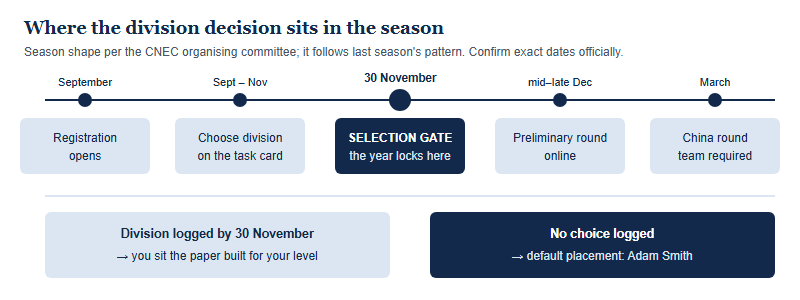
Registering does not place you in a division. You choose afterwards, on the task card — and per the CNEC organising committee, any registrant who has not chosen by 30 November is placed in Adam Smith, the division with no entry bar and the heaviest content load. A second step follows quickly: the preliminary round can be entered individually in the Pre division, but the China and global rounds require a team.
Registration is not placement
Most families treat the CNEC entry form as one decision. It is two, separated by weeks, and the second one is the one that shapes the year. The first is administrative: you register during the autumn window. The second is strategic: you select a division on the task card, and that selection determines which paper you sit, who you are compared against, and how much economics you need to have finished before December.
Per the CNEC organising committee’s briefing on the 2026–27 season — which follows last season’s pattern, with exact dates confirmed officially each year — registration runs from September to November, the preliminary round falls in mid-to-late December, the China round is in March, and the global sites sit in the US in May–June and in Asia and the UK in July–August. The 30 November selection gate therefore lands with roughly two to four weeks left before the preliminary. It is not a soft deadline that gets absorbed by a busy term. It is the last moment at which the year is still adjustable.
What the four divisions actually ask
CNEC runs three entry divisions where CEE’s own US competition runs two, and for 2027 it has added a fourth, Herbert Simon, which sits on top of those three rather than beside them. The third entry route — Pre — exists to give younger students a genuine entry point rather than a token one, and it is the only entry division with a different team rule. The table below is the organising committee’s own framing of who each division is for.
| Division | Who it is built for | Team size | Typical year group | The practical implication |
|---|---|---|---|---|
| Pre | Students who had not begun economics before the September gate, or who had only IGCSE-level introductory economics | Two to four | Mainly Years 7–9 | The division whose preliminary round can be entered individually — and the only one with a flexible team size |
| David Ricardo | Students who had studied one of IB, AP or AS micro or macro before the September gate | Four | Typically Years 9–11 | One completed course is your entry ticket, not a handicap; this is the division most first-timers with a school econ class belong in |
| Adam Smith | No entry bar at all; suits students who have finished both micro and macro | Four | Typically Years 10–12 | Because it has no entry bar it can absorb anyone — which is precisely why it is the default |
| Herbert Simon (AI) | New for 2027, and structurally different from the other three: it is an add-on that sits on top of a division you have already entered, not an entry route of its own | Two to four | Any, following your base division | You cannot default into it and you cannot enter it on its own — it requires an existing Pre, David Ricardo or Adam Smith registration |
Source: CNEC organising committee, 2026–27 season briefing. Division rules are set each season and change; confirm the current wording on the official CNEC channels before you commit a team.
Read the middle row twice. A large number of Chinese international-school students are in exactly that position — one AS or AP or IB economics course behind them, a full year of school ahead — and David Ricardo is built for them. It is not a consolation division. It is a division with a defined ceiling of assumed knowledge, which is the thing that makes a competition fair to enter.
The default is Adam Smith, and that is not neutral
Here is the mechanism in one sentence: because Adam Smith sets no entry bar, it is the one division a student can be placed into without anyone having checked their coursework first — so it is where the system puts you when you have not spoken.
That is administratively tidy and strategically expensive. Consider a Year 10 student who finished AS microeconomics last year, registered in early October, meant to discuss divisions with a teacher, and then had a fortnight of assessments. On 1 December she is an Adam Smith entrant. Nothing has gone wrong procedurally. But the division she will sit in December is pitched, per the organising committee, at students who have completed both micro and macro, and she has completed one. She will spend the preliminary round meeting material she has never been taught, in a division where her competitors are typically a year or two further into the syllabus.
The cost is not a bad score. The cost is a wasted season: she was a credible David Ricardo entrant and she will never find out. If you want the full picture of what the advanced track assumes before you decide whether to accept the default, our breakdown of the Adam Smith division sets out the content load in detail.
Three things follow from this that are worth saying plainly:
- The default is not a judgement. Nobody has assessed you as advanced. An unchosen field was filled by a rule.
- Adam Smith is a legitimate choice, deliberately made. Plenty of Year 10 and 11 students should be there. The problem is arriving there by silence rather than by decision.
- The reverse move is not automatic. Do not assume that a division assigned by default can be swapped in December because you have realised it was wrong. Whether and until when a change is possible is set by the organising committee — ask before the gate, not after it.
The step from an individual entry to a team
The second structural fact in the briefing is easy to read past. In the Pre division, the preliminary round can be entered by an individual student — but the China round and the global sites require a team. The gap between those two facts is roughly ten weeks, falling across a winter holiday and a new term.
So a Year 8 student can, quite reasonably, enter the December preliminary alone, do well, and discover in January that advancing means recruiting two or three teammates who did not sit the preliminary and may not be eligible in the same division. That is a solvable problem in October and a stressful one in February.
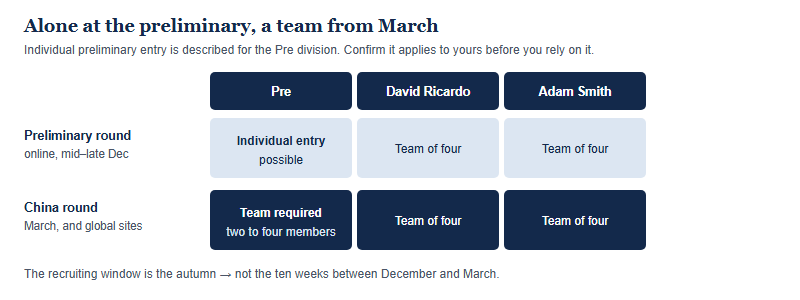
The practical instruction is short. Even if you intend to enter the preliminary alone, identify two to three plausible teammates before 30 November — same school or programme, same division eligibility, similar availability in March. You are not committing them to anything. You are making sure that a good December result does not die of logistics in January.
How the US rules route the same ambiguity
It is worth seeing that this is not a China-specific quirk. CEE’s published 2026 National Economics Challenge Rules and Eligibility govern a two-division US competition, and they solve the placement question with rules rather than a deadline — but they push in the same direction.
CEE’s document states that “any team consisting of one or more students enrolled in a course listed in A.1.c. must compete in the Adam Smith Division” — meaning a single AP or IB economics student pulls an entire team into the advanced division. It also states that “no student is permitted to compete in the David Ricardo Division more than once,” and that any returning student who has already competed at state level or higher “must compete in the Adam Smith Division in subsequent years, regardless of previous or current coursework.”
Both systems, in other words, resolve doubt upward. CEE does it through eligibility rules applied to your history; CNEC does it through a dated default applied to your silence. The design logic is the same: the division with no entry bar is the safe place to put an unresolved case.
One warning, because this is where people get things wrong. CEE’s rules describe the US competition. CNEC’s division definitions, its third Pre division, and its 30 November gate are set by the CNEC organising committee. Do not import a number or a threshold from one into the other — read each against its own published source, and where a season’s wording has not yet been released, treat it as unconfirmed. The round structure behind both is a useful orientation, but structure is not eligibility.
A September checklist, and what to do if you have already defaulted
Five actions, in order, all of which fit inside the registration window:
- Write down what you had finished before the September gate. Not what you are taking now — what was complete. That single sentence decides your division.
- Match it to the table above, then confirm the current season’s wording on the official CNEC channels rather than on last year’s article, including this one.
- Log the choice on the task card the same week you register. Treat 30 November as a fire alarm, not as your working deadline.
- Name two to three possible teammates, even for an individual Pre entry, and check they meet the same division’s conditions.
- Put the preliminary window and the March round in a shared calendar before December’s assessment schedule arrives and takes the space.
If you are reading this after a default has already happened, do not treat the season as lost. Ask the organising committee directly whether a change is still possible, and if it is not, plan for Adam Smith deliberately: narrow the content, accept that some questions are outside what you have been taught, and treat the December paper as a calibration exercise rather than a verdict.
For calibration rather than promise: our own de-identified tally from the 2026 Asia global site includes team golds, a team silver and team bronzes, plus a first place globally on an individual component. That is our own count, per Hanlin, not a CEE statistic, and results vary widely between cohorts and seasons. It shows that an ordinary school year can end at a global stop. It does not show that any particular division choice produces a result, and no competition result causes a university offer.
If the team requirement is genuinely the blocker — you are the only economics student in your year, and recruiting three more is not realistic — the honest answer may be a different format entirely. We compare the test-and-team shape of NEC with the individual, asynchronous shape of the economics essay prizes so you can pick the one your circumstances actually support.
Questions students ask about division selection
Does registering automatically put me in a division?
No. Registration and division selection are separate steps; the division is chosen afterwards on the task card.
What happens if I miss 30 November?
Per the CNEC organising committee, registrants who have not chosen by that date are placed in Adam Smith, the division with no entry bar.
Can I enter the preliminary round on my own?
Individual preliminary entry is described for the Pre division; the China round and global sites require a team. Confirm officially.
Is Adam Smith harder than David Ricardo?
It assumes more: it suits students who have completed both micro and macro, while David Ricardo assumes one prior course.
Published by the NEC (CNEC) editorial desk, operated by Hanlin Education for China-based international-school students. Official rules are set by the competition and change yearly — confirm current details on councilforeconed.org and through the official CNEC channels. Errors are corrected within 7 working days.