
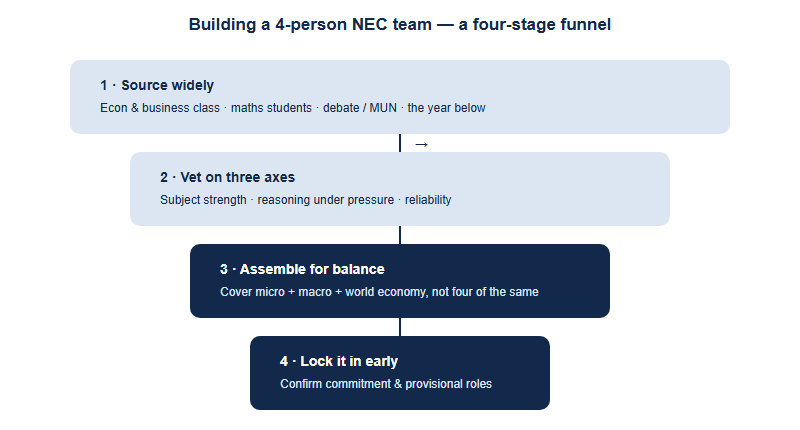
A strong National Economics Challenge (NEC) team is built, not gathered. Both the David Ricardo (intermediate) and Adam Smith (advanced) divisions require a team of four, so the people you recruit in the first few weeks largely decide your ceiling. The winning move is to recruit for balance across micro, macro and world economy, vet for both ability and reliability, then lock in commitment and provisional roles early — before the syllabus reading even begins.
Why team formation decides your season
The NEC, run by the Council for Economic Education (CEE, founded 1949), tests three bodies of knowledge — microeconomics, macroeconomics, and the world/international economy — across a sequence of rounds. No single Year 11 or 12 student arrives fluent in all three. That single fact is why a four-person team is the format: it lets a group cover more syllabus surface area than any individual could, and it rewards groups that deliberately spread their strengths rather than stacking four people who all love the same topic.
Teams that skip the formation step usually fail in one of two predictable ways. The first is level mismatch: a group bolts together one very strong economist and three near-beginners, so the strong member ends up carrying every round and burns out, while the others never get reps. The second is the reliability gap: a team picks the four highest test scores in the class without asking who will actually show up to weekly practice through a busy IB or A-Level term. A talented member who disappears in March is worth less than a solid member who turns up every week. Getting recruitment right is the cheapest, highest-leverage decision you will make all season — and unlike content, it cannot be fixed later.
A note on divisions before you recruit: the Pre division (entry level) can be entered as an individual or as a team of 2–4, whereas David Ricardo and Adam Smith both require a full team of four. If you are unsure which division fits your group's year and experience, confirm the current division rules on the official CNEC site before you finalise the roster — the CEE sets the academic standard and the CNEC desk runs the China round.
Where to recruit: casting a wide but targeted net
The best teammates are not always the most obvious ones. Limiting your search to friends or to the top of the economics class tends to produce a narrow, lopsided squad. Cast wider, then filter. Productive recruiting pools include:
- Your economics / business class. The natural first stop — but look past raw grades for students who argue well, ask sharp questions, or read the news for fun.
- Maths and further-maths students. NEC reasoning rewards comfort with graphs, ratios and simple modelling; a strong quantitative thinker can pick up content fast.
- Debate, MUN and current-affairs clubs. These students often own the world-economy material almost by default and can think on their feet in the live, buzzer-style rounds.
- Students a year below. Recruiting a capable younger member builds continuity, so the team does not collapse when seniors graduate.
Run a short, low-pressure interest meeting rather than quietly tapping four friends. A 30-minute session that explains the three subject areas, the divisions, and the weekly time commitment lets you see who is genuinely curious versus who is collecting an activity for a college application. The students who ask follow-up questions about macro policy or the global economy are usually the ones worth vetting properly.
Vetting: what to actually test for
Vetting is not an exam. You are trying to predict who will make the team stronger over a whole season, which means weighing three different things rather than one test score. We suggest scoring each candidate informally on the axes below — a candidate who is merely good on all three usually beats one who is brilliant on a single axis.
| Axis | What you are looking for | How to test it cheaply |
|---|---|---|
| Subject strength | A genuine grasp of at least one of micro, macro or world economy | A few past-style multiple-choice questions; ask them to explain a concept aloud |
| Reasoning under pressure | Quick, structured thinking — vital for live buzzer-style rounds | A timed rapid-fire question round; watch how they handle being wrong |
| Reliability | Will turn up to weekly practice and finish prep through a busy term | Their track record in other clubs; a frank conversation about their schedule |
| Coachability | Takes feedback well and works with others, not a lone wolf | Give a small piece of feedback in the trial and see how they respond |
Two warnings from the formation stage. First, beware the brilliant but unavailable candidate: a student who tops every diagnostic but already runs three other commitments is a reliability risk, and a team that depends on one person is fragile in the rounds that demand all four. Second, beware hidden level mismatch. It is fine, even healthy, to have a spread of ability — a mixed team where a stronger member mentors a developing one can be excellent. What hurts is an unacknowledged gap, where one member is so far ahead that practices stop being useful for everyone else. Be honest about the spread, then design around it: pair a developing member with a topic they can own and grow into, rather than leaving them to sink.
Assembling for balance, then locking it in early
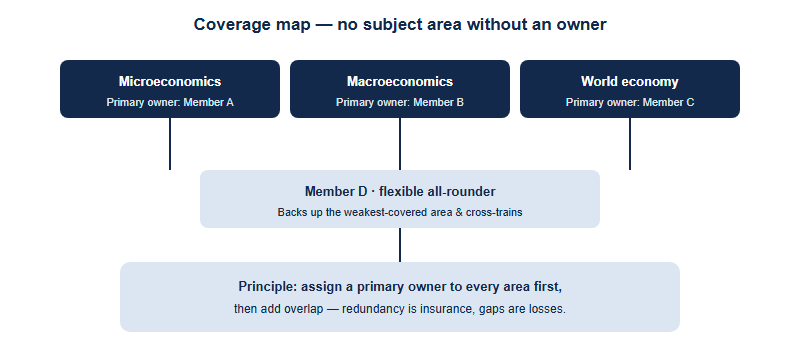
Once you have your shortlist, assemble for coverage. The single most common mistake is picking four strong micro students because micro is what everyone studies first — and then losing rounds on macro and world-economy questions nobody owned. Map your candidates against the three NEC subject areas and choose the combination that leaves no area uncovered. A useful rule of thumb: every one of micro, macro and the world economy should have at least one team member who is genuinely comfortable with it, with overlap as a bonus rather than the goal.
With a balanced four chosen, lock it in early — this is the step most teams rush. Locking in means three concrete things, all done before the heavy syllabus reading starts:
- Confirm commitment explicitly. Agree a realistic weekly practice rhythm and have everyone say yes to it out loud. A shared understanding now prevents the slow attrition that wrecks teams in the final weeks.
- Assign provisional roles. Give each member a subject area to own first, so reading is focused from day one rather than four people half-studying everything. These are starting points, not life sentences — let them evolve as strengths emerge.
- Set up a shared workspace and a captain. One shared folder, one practice calendar, and one person who keeps the group moving. Coordination, not raw talent, is what most teams actually lack.
Crucially, this article is about forming the squad — recruiting, vetting and locking commitment and starting roles. How those owners then divide work inside a live round (who buzzes, who anchors the written rounds, how you rotate) is a separate discipline covered elsewhere. Get the four right people committed first; the in-round choreography is far easier to build on a stable, well-matched roster.
A first-party note from the CNEC desk
As the officially authorized China test center for the NEC — the CNEC has run the China National Round since 2016, now reaching 20+ provinces and 300+ schools — the recurring pattern we see is that results track team construction at least as much as individual brilliance. The teams that travel furthest tend to have settled their roster and roles weeks before others have finished recruiting, which buys them more shared practice on the same syllabus the CEE defines.
The most common avoidable mistake is the all-star trap: assembling the four highest individual scorers without checking whether they cover all three subject areas or whether they will actually practise together. A deliberately balanced, reliable team of four usually out-performs a glittering but lopsided one. Form early, vet honestly, and treat commitment as seriously as content. For current division rules, team-size requirements and the China-round timeline, always confirm on the official CNEC channels, as the CEE sets the official academic standard.
Frequently asked questions
How many people are on an NEC team?
The David Ricardo and Adam Smith divisions require a team of four. The Pre division can be entered individually or as a team of 2–4 — confirm on the official CNEC site.
What should I vet teammates for?
Subject strength in micro, macro or world economy, fast reasoning under pressure, reliability across a full season, and coachability. A solid all-rounder beats a brilliant but absent member.
How do I avoid a mismatched team?
Map candidates against all three NEC subject areas so none is left uncovered, and be honest about any ability gap so you can pair developing members with a topic they can own.
When should roles be locked in?
Assign provisional subject-area owners and confirm the weekly commitment before serious syllabus reading begins; let roles evolve as strengths emerge through practice.
Published by the NEC / CNEC editorial desk, operated by Hanlin Education as the officially authorized China National Economics Challenge (CNEC) test center. The NEC is run by the Council for Economic Education, which sets the official rules — always confirm current dates, divisions, fees and awards on the official CNEC channels. Any errors will be corrected within 7 working days.